

Card Network Payment Authorization Process Flow Diagram




Try Before you Buy Download Free Sample Product
 Impress Your
Audience
 100%
Editable
 Save Hours
of Time


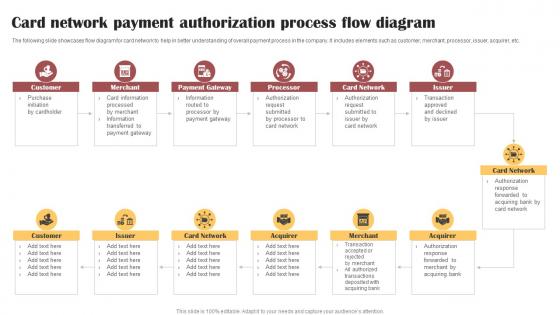
The following slide showcases flow diagram for card network to help in better understanding of overall payment process in the company. It includes elements such as customer, merchant, processor, issuer, acquirer, etc.
People who downloaded this PowerPoint presentation also viewed the following :
Card Network Payment Authorization Process Flow Diagram with all 6 slides:
Use our Card Network Payment Authorization Process Flow Diagram to effectively help you save your valuable time. They are readymade to fit into any presentation structure.






FAQs for Card Network Payment Authorization
Card network payment authorization involves merchant transaction initiation, payment processor routing, issuing bank verification, fraud screening, and authorization response delivery. These steps streamline payment processing by validating cardholder credentials, checking account balances, and assessing transaction risk, with financial institutions finding that automated authorization delivers faster checkout experiences, reduced fraud losses, and enhanced customer satisfaction across retail and e-commerce environments.
Major card networks handle authorization transactions through distinct protocols, risk assessment algorithms, and processing timeframes, though all follow similar multi-step verification processes. Visa emphasizes speed with real-time fraud scoring, MasterCard focuses on enhanced security protocols, while American Express maintains tighter control through direct issuing relationships, with financial institutions increasingly finding that network choice impacts transaction approval rates and customer experience quality.
Payment gateways serve as secure intermediaries that encrypt and transmit transaction data between merchants, card networks, and issuing banks during authorization processes. These platforms streamline payment processing by validating card details, routing authorization requests, and managing responses, while many e-commerce businesses and financial institutions find that modern gateways enhance security, reduce processing times, and ultimately deliver seamless customer experiences across multiple payment channels.
Real-time transaction processing dramatically accelerates payment authorization by eliminating batch delays, enabling instant verification of funds, and providing immediate merchant confirmation within seconds rather than minutes or hours. Through advanced processing infrastructure, banks and payment networks streamline authorization workflows, reduce transaction failures, and enhance customer experiences, with many retailers finding that faster approvals significantly increase completed sales and customer satisfaction.
Common payment authorization declines include insufficient funds, expired cards, incorrect payment details, suspected fraud detection, exceeding credit limits, and merchant account issues. These security measures protect both consumers and businesses by preventing unauthorized transactions, reducing chargebacks, and maintaining payment system integrity, with financial institutions increasingly using advanced algorithms to balance security with seamless customer experiences.
Security measures like tokenization and encryption significantly enhance authorization processes by replacing sensitive card data with secure tokens, encrypting transaction information during transmission, and creating multiple layers of fraud protection. These technologies streamline payment verification while minimizing data breach risks, with financial institutions and retailers finding that robust security protocols ultimately deliver faster transaction approvals and enhanced customer trust.
BIN (Bank Identification Number) serves as the critical first identifier in payment authorization, enabling merchants and processors to instantly determine the issuing bank, card type, geographic region, and applicable processing rules. This six-to-eight digit code streamlines transaction routing, fraud detection, and regulatory compliance, with financial institutions and retailers leveraging BIN data to enhance security protocols and optimize payment processing speeds across global networks.
Cross-border transactions significantly increase payment authorization complexity and processing times due to currency conversions, international banking networks, regulatory compliance checks, and fraud verification protocols. Financial institutions and payment processors navigate multiple jurisdictions, anti-money laundering requirements, and correspondent banking relationships, with many finding that advanced routing technologies and real-time monitoring systems help minimize delays while maintaining security standards.
PSD2 regulations require Strong Customer Authentication for most card transactions, mandating multi-factor verification that significantly impacts authorization flows, processing times, and user experiences. While this enhances security and reduces fraud substantially, financial institutions and merchants must balance compliance requirements with seamless customer journeys, ultimately delivering stronger consumer protection and competitive advantages for organizations that implement strategic authentication solutions effectively.
Merchants can optimize payment authorization rates by implementing advanced fraud detection systems, maintaining updated customer payment information, using machine learning algorithms for risk assessment, and establishing strong relationships with multiple payment processors. These strategies enhance transaction approval rates by reducing false declines, improving data accuracy, and ensuring redundancy, with many retailers finding that diversified payment routing and real-time data analytics significantly boost successful transactions while minimizing revenue loss.
Artificial intelligence, machine learning algorithms, blockchain technology, real-time fraud detection systems, and biometric authentication are revolutionizing payment authorization processes. These technologies streamline transaction verification by reducing processing times, enhancing security protocols, and minimizing false declines, with financial institutions and retail organizations finding that automated authorization delivers faster customer experiences and significantly lower operational costs.
Customer authentication serves as a critical security layer in card authorization through methods like PINs, signatures, CVV verification, biometrics, and two-factor authentication. These authentication protocols enable card networks and issuing banks to verify cardholder identity, reduce fraudulent transactions, and streamline legitimate purchases, with many financial institutions finding that enhanced authentication ultimately delivers faster approvals and improved customer trust.
Small businesses face challenges including high transaction fees, complex integration requirements, limited technical resources, regulatory compliance demands, and lengthy approval processes for merchant accounts. These obstacles can significantly impact cash flow and operational efficiency, with many small retailers finding that partnering with experienced payment processors and utilizing simplified integration tools helps streamline authorization systems while reducing costs and administrative burden.
Chargebacks significantly complicate payment authorization by requiring merchants to implement stronger verification processes, maintain detailed transaction records, and often increase authorization decline rates to minimize risk. While these protective measures can reduce fraudulent transactions and improve customer trust, they also present challenges through higher operational costs and potential lost sales, with many retail and e-commerce businesses finding that strategic chargeback management ultimately delivers better customer relationships and reduced financial exposure.
Mobile wallets are driving real-time authorization with biometric authentication, tokenization, and seamless integration across platforms, while cryptocurrencies introduce blockchain-based verification, decentralized processing, and smart contract automation. These technologies streamline transaction security, reduce processing times, and enhance customer experiences, with financial institutions and retailers increasingly finding that adaptive authorization systems deliver competitive advantage in digital commerce.
-
I am glad to have come across Slideteam. I was searching for some unique presentations and templates for my business. There are a lot of alternatives available here.
-
Perfect template with attractive color combination.