


Career aspiration timeline 2 powerpoint presentation examples




Try Before you Buy Download Free Sample Product
 Impress Your
 Audience
 100%
100% Editable
 Save Hours
 of Time


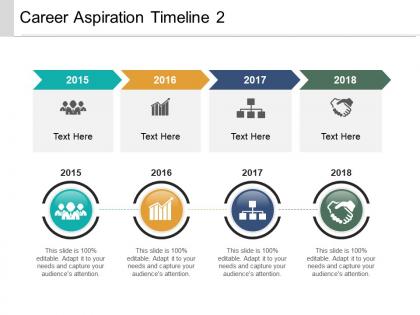
Present yourself in an innovative way using our career aspiration timeline 2 PowerPoint presentation examples. This presentation template helps you highlight the information about your career aspirations. The timeline shown in the slide 2015 to 2018 can be used to show the career development in the last four years, the challenges and achievements. The PPT diagram has been created wonderfully by a team of experienced and professional designers who understand the value of creating the design that assist individuals to accomplish their objectives. The PowerPoint layout can be downloaded with professionally designed icons that can communicate the message in an effective manner. The presentation graphic can be edited as per your business needs as it is easily editable. So, make this amazing design be part of your next career related presentation. To download it, just click the download button and save it in your system. Be an extraordinary achiever with our Career Aspiration Timeline 2 Powerpoint Presentation Examples. They have an extremely elevating effect.
People who downloaded this PowerPoint presentation also viewed the following :
Career aspiration timeline 2 powerpoint presentation examples with all 5 slides:
Ensure your ideas are included on the agenda with our Career Aspiration Timeline 2 Powerpoint Presentation Examples. It helps get it on the anvil.

FAQs for Career aspiration timeline 2
Key milestones in a career aspiration timeline include skill development phases, education or certification goals, performance achievements, leadership opportunities, and strategic role transitions. These milestones enable professionals to track progress systematically, with many organizations finding that structured career planning enhances employee retention, accelerates advancement, and ultimately delivers competitive advantage through strategic talent development.
Individuals can assess their current skills through self-evaluation frameworks, peer feedback, professional assessments, performance reviews, and competency mapping against industry standards. These approaches enable professionals to identify skill gaps, benchmark capabilities, and align aspirations with market demands, with many organizations finding that structured assessments streamline career planning and enhance strategic workforce development.
Networking accelerates career advancement by creating opportunities for mentorship, job referrals, industry insights, and professional visibility within your field. Through strategic relationship building, professionals gain access to hidden job markets, receive guidance from experienced leaders, and build reputation credibility, with many finding that sustained networking efforts ultimately deliver faster promotions and expanded career possibilities.
Industry trends significantly influence career aspiration timelines by accelerating skill requirements, creating new role categories, and shifting traditional advancement pathways through automation and digital transformation. In sectors like technology, healthcare, and finance, professionals increasingly find that emerging trends such as AI integration and remote work capabilities compress traditional 5-10 year career progressions, ultimately delivering faster specialization opportunities and competitive positioning.
Tools for creating effective career aspiration timelines include project management platforms like Trello or Asana, professional development apps, goal-tracking software, mentorship programs, and industry-specific assessment tools. These resources streamline career planning by enabling milestone tracking, skill gap analysis, and progress monitoring, with many professionals finding that combining digital tools with regular mentor consultations ultimately delivers clearer career direction and accelerated professional growth.
Short-term goals align with long-term career aspirations by serving as strategic stepping stones, building relevant skills, expanding professional networks, and creating measurable progress markers toward ultimate objectives. Through deliberate planning, professionals in fields like finance, healthcare, and technology find that quarterly achievements, targeted skill development, and strategic role transitions ultimately deliver accelerated career advancement and sustained competitive advantage.
Common obstacles include skill gaps, limited networking opportunities, economic downturns, organizational restructuring, and insufficient mentorship or guidance. These challenges can delay career progression by creating knowledge barriers, reducing job availability, and limiting professional development opportunities, though many professionals find that strategic upskilling, expanded networking, and adaptable goal-setting ultimately enable career resilience and competitive advantage.
Mentorship accelerates career aspiration journeys by providing strategic guidance, industry insights, networking opportunities, skill development feedback, and insider knowledge of advancement pathways. Through experienced mentors, professionals gain access to decision-makers, avoid common pitfalls, and receive personalized coaching, with many finding that mentor relationships ultimately deliver faster promotions and clearer career trajectory focus.
Career aspiration timelines should be revisited quarterly and comprehensively revised annually, with additional reviews triggered by major life changes, industry shifts, or goal achievements. This regular assessment enables professionals to adapt to evolving market conditions, emerging opportunities, and personal growth, while maintaining strategic alignment with long-term objectives, ultimately ensuring career trajectories remain relevant and achievable.
Continuing education significantly accelerates career advancement by expanding skill sets, increasing market value, and opening new professional pathways within evolving industries. Through updated certifications, advanced degrees, and specialized training, professionals enhance their competitive positioning, command higher salaries, and pivot into emerging fields, with many finding that strategic learning investments ultimately deliver faster promotions and expanded leadership opportunities.
Personal values significantly influence career aspiration timelines by determining priorities, acceptable trade-offs, and milestone definitions across professional development stages. Individuals prioritizing work-life balance may extend timelines for family considerations, while those valuing rapid advancement accelerate their progression, with many professionals finding that aligning career pacing with core values ultimately delivers greater satisfaction and sustainable success.
Motivation strategies include setting milestone celebrations, creating accountability partnerships, regularly reviewing progress against goals, maintaining flexibility for timeline adjustments, and connecting daily actions to long-term vision. These approaches work by providing consistent feedback loops, social support, and perspective maintenance, with many professionals finding that breaking ambitious timelines into quarterly wins and peer check-ins ultimately sustains momentum through inevitable challenges.
Tracking career aspiration progress involves setting specific milestones, conducting regular self-assessments, and maintaining detailed documentation of achievements, skills acquired, and feedback received. Through quarterly reviews and goal adjustments, professionals across industries like healthcare, finance, and technology can measure advancement, identify development gaps, and accelerate career trajectory, ultimately delivering enhanced performance and strategic positioning.
Career changes within your timeline require evaluating market demand, skill transferability, financial stability, and potential setbacks to your progression. While transitioning between industries or roles can extend your timeline, it also brings diverse experiences, expanded networks, and enhanced adaptability, with many professionals finding that strategic career pivots ultimately accelerate long-term growth and competitive advantage.
Work-life balance significantly influences career aspiration timelines by ensuring sustainable progression without burnout, allowing for strategic pacing of goals, and accommodating personal milestones alongside professional objectives. Many professionals find that integrating family considerations, health priorities, and personal interests into their career planning ultimately delivers greater job satisfaction, reduced turnover, and enhanced long-term performance across industries.
-
Designs have enough space to add content.
-
Excellent work done on template design and graphics.