

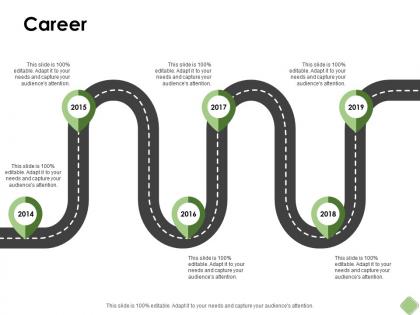
Career roadmap ppt powerpoint presentation pictures infographic template




Try Before you Buy Download Free Sample Product
 Impress Your
 Audience
 100%
100% Editable
 Save Hours
 of Time


Delve on examples of indomitable courage with our Career Roadmap Ppt Powerpoint Presentation Pictures Infographic Template. Breed a bunch of heroes.
People who downloaded this PowerPoint presentation also viewed the following :
Career roadmap ppt powerpoint presentation pictures infographic template with all 5 slides:
Be an inspiration for future heroes with our Career Roadmap Ppt Powerpoint Presentation Pictures Infographic Template. Ignite the desire to benefit humanity.



FAQs for Career roadmap ppt powerpoint presentation
Effective career roadmaps include clear goal-setting, skill gap analysis, timeline planning, milestone tracking, and regular review processes. These strategic components work together by aligning professional aspirations with actionable steps, identifying development opportunities, and enabling course corrections, with many professionals finding that structured roadmaps accelerate advancement and enhance career satisfaction.
Individuals can identify long-term career goals through self-assessment of skills, values, and interests, industry research, informational interviews, and analyzing growth trajectories within target sectors. By examining successful professionals in finance, healthcare, or technology, employees can map strategic pathways that align personal strengths with market opportunities, ultimately delivering clarity and competitive positioning.
Career roadmap tools include career assessment platforms, mentorship programs, professional development courses, industry networking events, and goal-tracking applications. These resources enhance career planning by identifying strengths, connecting professionals with guidance, and providing structured pathways, with many organizations finding that strategic combinations of digital tools and human expertise ultimately deliver clearer direction and accelerated professional growth.
Career roadmaps should be revised every 6-12 months, or whenever significant industry changes, skill developments, or personal priorities emerge. Regular revision ensures alignment with evolving market demands, technological advances, and emerging opportunities, while many professionals find that quarterly reviews enable proactive skill development, strategic pivoting, and sustained competitive advantage in increasingly dynamic career landscapes.
Mentorship and networking provide critical guidance, industry insights, opportunity access, skill development feedback, and strategic career advice that significantly influence career trajectory decisions. Through meaningful professional relationships, individuals gain exposure to hidden job markets, receive personalized development guidance, and build valuable connections across industries, ultimately accelerating career progression and opening doors to opportunities that might otherwise remain inaccessible.
Transferable skills can be strategically mapped across career transitions by identifying core competencies like communication, leadership, analytical thinking, and project management that apply universally across industries and roles. These skills serve as bridges between different career phases, enabling professionals to pivot into new sectors while demonstrating value, ultimately creating flexible pathways that enhance adaptability and competitive advantage in an increasingly dynamic job market.
Strategies include skill diversification, strategic networking, mentorship seeking, continuous learning, and adaptability cultivation. These approaches streamline career advancement by enhancing professional capabilities, expanding industry connections, and building resilience, with many professionals in sectors like technology, healthcare, and finance finding that proactive obstacle management ultimately delivers accelerated growth and competitive positioning in increasingly dynamic markets.
Aligning personal values with career goals involves identifying core principles, researching company cultures, and evaluating role compatibility through informational interviews and values assessments. This strategic approach enables professionals to pursue opportunities in organizations that match their ethics and priorities, ultimately delivering greater job satisfaction, enhanced performance, and long-term career sustainability.
Setting short-term goals provides immediate direction and measurable progress markers, while long-term goals establish strategic vision and ultimate career destination. This dual approach enables professionals to maintain momentum through quick wins, adapt to market changes, and stay aligned with broader aspirations, with many finding that quarterly milestones ultimately accelerate achievement of five to ten-year objectives.
A career roadmap helps navigate transitions by providing structured planning, identifying transferable skills, mapping required competencies, and establishing clear timelines for change. Through strategic goal-setting and milestone tracking, professionals can systematically bridge gaps between current roles and target positions, while maintaining momentum during uncertain periods, ultimately reducing transition anxiety and accelerating career pivot success.
Common mistakes include setting vague goals, ignoring skill gaps, lacking timeline flexibility, underestimating networking importance, and failing to research industry trends thoroughly. Many professionals find that overly rigid planning, neglecting mentorship opportunities, and focusing solely on promotions rather than skill development ultimately limit career advancement, while strategic roadmaps emphasizing adaptability and continuous learning deliver sustained professional growth.
Individuals can leverage their education and certifications by strategically aligning credentials with industry demands, pursuing continuous learning opportunities, and showcasing specialized skills to employers. These qualifications enhance career mobility by opening advancement pathways, increasing salary potential, and building professional credibility, with many professionals finding that targeted certifications accelerate progression within their chosen fields.
Career roadmap progress can be measured through skill acquisition rates, performance review scores, goal completion percentages, promotion timelines, and salary progression benchmarks. These metrics enable professionals to track their development systematically, with many organizations finding that employees using quantifiable career measurements achieve promotions 40% faster and demonstrate higher engagement levels, ultimately delivering enhanced performance and strategic career advancement.
Effectively communicating your career roadmap involves clearly articulating your short-term goals, long-term vision, and how the specific role aligns with your professional trajectory. Present your roadmap as a strategic progression that demonstrates ambition while showing genuine interest in contributing to the organization, with many candidates finding that connecting their career aspirations to the company's growth opportunities ultimately enhances their interview performance.
Continuous learning ensures career roadmaps remain relevant by identifying emerging skills, industry trends, technological advances, and evolving market demands. Through professional development courses, certifications, and industry networking, professionals adapt their career trajectories while staying competitive, with many finding that regular upskilling accelerates advancement opportunities and strategic positioning.
No Reviews