

Carpooling Service Pitch Deck Ppt Template





Try Before you Buy Download Free Sample Product
 Impress Your
Audience
 100%
Editable
 Save Hours
of Time


BlaBlaCar is a leading global platform that connects individuals with shared travel destinations to facilitate ride sharing. Access our expertly crafted Carpooling Service Pitch Deck PowerPoint presentation, a tool that empowers ride sharing enterprises to secure investor funding and expand their operational footprint. The pitch deck embarks on the challenges passengers face due to excessive travel costs. Additionally, the Investor Pitch Presentation delves into the organizations overview, mission, vision and array of products and services the company offers. It intricately outlines the companys Unique Selling Proposition USP, distinguishing it from other carpooling services. The presentation progresses with slides detailing funding history and allocation, showcasing prudent resource utilization. Lastly, the Capital Raise Pitch Deck encompasses sections on exit strategies, core teams, organizational structure and shareholding distribution. Get access to this 100percentage editable pitch deck now.
People who downloaded this PowerPoint presentation also viewed the following :
Content of this Powerpoint Presentation
Slide 1: This slide introduces Carpooling Service Pitch Deck. State your company name and begin.
Slide 2: This slide shows Table of Content for the presentation.
Slide 3: This slide continues showing Table of Content for the presentation.
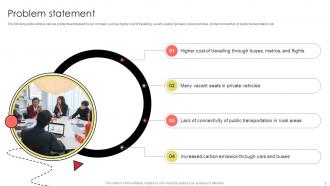
Slide 4: This slide outlines various problems addressed by our company such as higher cost of travelling, vacant seats in privately owned vehicles etc.
Slide 5: This slide presents brief introduction to company background. Information covered in this slide is related to company’s overview, mission and vision statement etc.
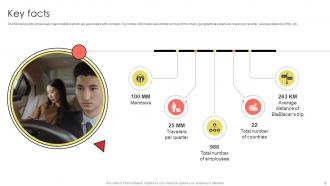
Slide 6: This slide showcases major statistics which are associated with company. It provides information about total number of members, geographical expansion etc.
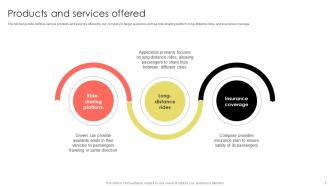
Slide 7: This slide outlines various products and services offered by our company to target audience such as ride-sharing platform, long-distance rides, and insurance coverage.
Slide 8: This slide highlights unique selling point (USP) of our company including information about cost-effective rides, easily accessible rides, sustainable transportation etc.
Slide 9: This slide showcases major milestones achieved by our company in field of ride-sharing industry.
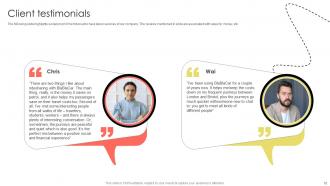
Slide 10: This slide presents social proof of members who have taken services of our company.
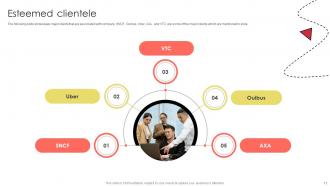
Slide 11: This slide showcases major clients that are associated with company. SNCF, Ouibus, Uber, AXA, and VTC are some of the major clients which are mentioned in slide.
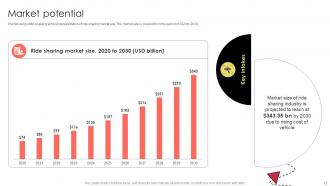
Slide 12: This slide display graphical representation of ride sharing market size. The market size is covered from the period of 2020 to 2030.
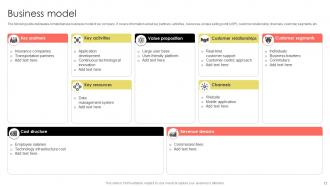
Slide 13: This slide presents a comprehensive business model of our company. It covers information about key partners, activities, resources, unique selling point (USP) etc.
Slide 14: This slide showcases sources of generating revenue for the company. Information covered in this slide is related to generating revenue through transaction fees.
Slide 15: This slide outlines comparative analysis of our company with other market leaders. The major competitors outlined in slide are Zipcar, Lyft, and Via.
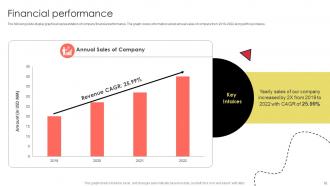
Slide 16: This slide display graphical representation of company financial performance.
Slide 17: This slide exhibits graphical representation of company financial projections.
Slide 18: This slide showcases major reasons for investing with our company such as higher demand for ride sharing industry, continuous investment in cutting edge technology, etc.
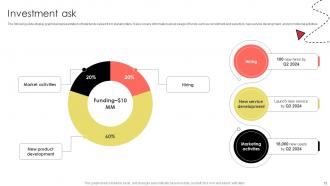
Slide 19: This slide display graphical representation of total funds raised from stakeholders.
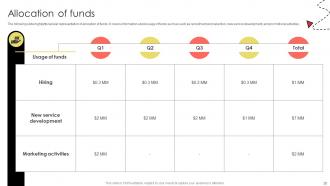
Slide 20: This slide highlights tabular representation of allocation of funds.
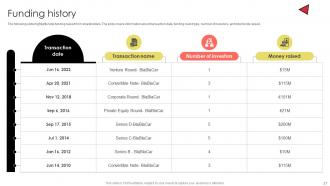
Slide 21: This slide displays total funding raised from shareholders. The slide covers information about transaction date, funding round type, number of investors etc.
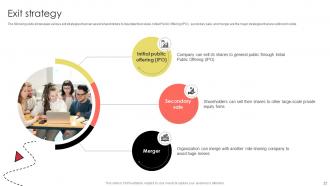
Slide 22: This slide showcases various exit strategies that can assist shareholders to liquidate their stake.
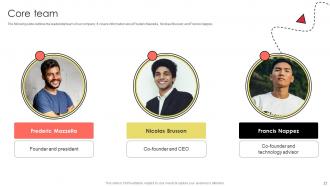
Slide 23: This slide outlines the leadership team of our company.
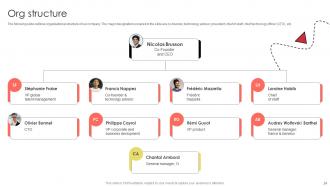
Slide 24: This slide presents organizational structure of our company. The major designations covered in the slide are co-founder, technology advisor, president etc.
Slide 25: This slide provides information about shareholding pattern. Information covered in this slide is related to equity split of shareholders before and after raising funds.
Slide 26: This slide shows all the icons included in the presentation.
Slide 27: This slide is titled as Additional Slides for moving forward.
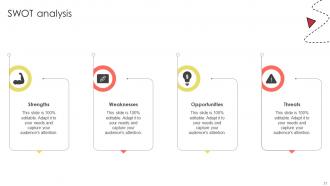
Slide 28: This slide shows SWOT analysis describing- Strength, Weakness, Opportunity, and Threat.
Slide 29: This slide contains Puzzle with related icons and text.
Slide 30: This is About Us slide to show company specifications etc.
Slide 31: This is a financial slide. Show your finance related stuff here.
Slide 32: This is Our Target slide. State your targets here.
Slide 33: This slide presents Roadmap with additional textboxes.
Carpooling Service Pitch Deck Ppt Template with all 40 slides:
Use our Carpooling Service Pitch Deck Ppt Template to effectively help you save your valuable time. They are readymade to fit into any presentation structure.






















FAQs for Carpooling Service Pitch
Key benefits of carpooling services for daily commuting include cost savings through shared fuel and parking expenses, reduced environmental impact, decreased traffic congestion, and enhanced social connectivity. These services streamline urban mobility by minimizing individual transportation costs, reducing carbon footprints, and optimizing road usage, with many commuters finding that carpooling delivers significant monthly savings while contributing to sustainable transportation solutions.
Carpooling services reduce urban traffic congestion by decreasing vehicle numbers through shared rides, optimizing route efficiency with smart algorithms, and encouraging modal shift from private car ownership. These platforms streamline transportation by consolidating multiple individual trips into single journeys, with cities like Seattle and Singapore finding that strategic carpooling initiatives deliver reduced peak-hour traffic and improved mobility.
Effective carpooling matching technologies include GPS tracking systems, machine learning algorithms, real-time traffic analysis, predictive routing software, and mobile app integration platforms. These solutions streamline rider-driver connections by analyzing location data, optimizing route efficiency, and predicting travel patterns, with many transportation companies finding that automated matching reduces wait times while enhancing user experience.
Carpooling platforms address safety concerns through driver background checks, vehicle inspections, real-time GPS tracking, in-app emergency features, and user rating systems. These comprehensive measures enable passengers and drivers to make informed decisions while providing 24/7 monitoring capabilities, with many transportation services finding that integrated safety protocols significantly enhance user confidence and platform adoption rates.
Incentives for carpooling services include cost savings through shared fuel expenses, priority parking spots, reduced tolls, flexible scheduling options, and loyalty reward programs. These strategic combinations enhance user adoption by minimizing transportation costs, streamlining urban mobility, and delivering environmental benefits, with many organizations finding that employee carpooling programs significantly reduce parking demands while improving workplace satisfaction.
Carpooling significantly reduces environmental impact by decreasing per-person carbon emissions, minimizing fuel consumption, and reducing traffic congestion through shared vehicle usage. With fewer cars on roads, this approach delivers lower air pollution, reduced greenhouse gas emissions, and decreased urban heat effects, while many transportation companies and corporate sustainability programs find that organized carpooling initiatives can cut commuter carbon footprints by 45-75% compared to solo driving.
Employers promote carpooling through transportation benefits, designated carpool parking spaces, ride-matching platforms, and flexible scheduling policies that accommodate shared commutes. These initiatives enhance employee satisfaction while reducing operational costs, with companies like Google and Microsoft finding that comprehensive carpooling programs decrease parking infrastructure needs, improve retention rates, and support sustainability goals.
Demographic factors influencing carpooling adoption include age, income levels, urban density, education, environmental consciousness, and technology comfort. Younger professionals in metropolitan areas, college students, and eco-minded individuals show higher usage rates, while families and suburban residents often prefer personal vehicle control, with many organizations finding that convenience and cost savings ultimately drive sustained participation across demographics.
Carpooling services benefit local businesses and communities by reducing transportation costs, decreasing parking demands, and increasing disposable income for local spending. These services enable businesses to attract talent from wider geographic areas, reduce employee transportation stress, and contribute to community sustainability goals, ultimately fostering economic growth through enhanced mobility and reduced infrastructure strain.
Carpooling services face challenges including driver-passenger matching inefficiencies, safety concerns, payment disputes, route optimization complexities, and maintaining consistent user engagement. These obstacles can be overcome through advanced AI matching algorithms, comprehensive background verification systems, and integrated payment platforms, with many transportation companies finding that real-time tracking, rating systems, and flexible scheduling ultimately deliver improved user trust and operational efficiency.
Carpooling service pricing operates through cost-sharing models including fare splitting among passengers, per-mile rates, subscription plans, and dynamic pricing based on demand and distance. Through digital platforms, riders share fuel, maintenance, and operational costs proportionally, while some services use fixed monthly fees or surge pricing during peak hours, ultimately delivering affordable transportation and reduced individual travel expenses.
Innovative carpooling app features include real-time route optimization, AI-powered passenger matching, integrated payment systems, carbon footprint tracking, and social verification profiles. These technologies enhance user experience by reducing wait times, ensuring compatible travel companions, and streamlining transactions, with many urban commuters finding that gamification elements and eco-impact dashboards ultimately deliver greater engagement and sustainable transportation choices.
Cultural attitudes towards carpooling vary significantly, with European countries like Germany and Netherlands embracing shared mobility for environmental reasons, while Americans often prefer individual car ownership for privacy and convenience. Asian markets, particularly in urban centers like Singapore and Seoul, increasingly adopt carpooling through mobile apps, with younger demographics driving adoption rates despite traditional preferences for personal transportation, ultimately creating diverse market opportunities for service providers.
Legal considerations for carpooling services include commercial driving licenses, insurance coverage, passenger liability, regulatory compliance, and tax obligations. These requirements vary significantly by jurisdiction, with many services finding that proper licensing, comprehensive insurance policies, and adherence to local transportation regulations ultimately deliver legal protection and operational legitimacy in an increasingly regulated mobility landscape.
Successful carpooling marketing strategies include targeted digital campaigns, community partnerships, workplace outreach programs, incentive-based promotions, and social proof testimonials. These approaches enhance awareness by leveraging local networks, emphasizing cost savings and environmental benefits, and showcasing real user experiences, with many transportation companies finding that community-focused messaging ultimately delivers higher adoption rates and sustainable user engagement.
-
The PPT layout is great and it has an effective design that helps in presenting corporate presentations. It's easy to edit and the stunning visuals make it an absolute steal!
-
The website is jam-packed with fantastic and creative templates for a variety of business concepts. They are easy to use and customize.