


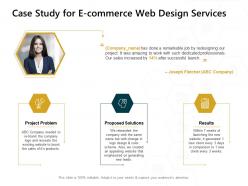
Case study for e commerce web design services problem ppt powerpoint presentation templates





Try Before you Buy Download Free Sample Product
 Impress Your
Audience
 100%
Editable
 Save Hours
of Time


Our Case Study For E Commerce Web Design Services Problem Ppt Powerpoint Presentation Templates are topically designed to provide an attractive backdrop to any subject. Use them to look like a presentation pro.
People who downloaded this PowerPoint presentation also viewed the following :
Case study for e commerce web design services problem ppt powerpoint presentation templates with all 2 slides:
Use our Case Study For E Commerce Web Design Services Problem Ppt Powerpoint Presentation Templates to effectively help you save your valuable time. They are readymade to fit into any presentation structure.

FAQs for Case study for e commerce web design services problem ppt
Key elements include clean navigation, high-quality product images, consistent branding, mobile responsiveness, and intuitive checkout processes. These design components enhance customer experience by reducing bounce rates, increasing conversion rates, and building trust, with many retail businesses finding that strategic visual hierarchy and streamlined user interfaces ultimately deliver higher sales and improved customer retention.
UX design significantly influences purchasing decisions by streamlining navigation, optimizing checkout processes, ensuring mobile responsiveness, and creating intuitive product discovery paths. Well-designed eCommerce platforms reduce cart abandonment rates, increase conversion rates, and build customer trust through seamless interactions, with many retail businesses finding that strategic UX improvements deliver higher sales and enhanced customer loyalty.
Mobile responsiveness ensures eCommerce websites function seamlessly across all devices, delivering consistent user experiences, faster loading times, and intuitive navigation that drives conversions. With mobile commerce accounting for over half of online sales, responsive design enables retailers to capture broader audiences, reduce bounce rates, and ultimately enhance customer satisfaction while maintaining competitive advantage in an increasingly mobile-first marketplace.
Color psychology enhances eCommerce conversion rates by strategically using hues to influence purchasing decisions, build trust, and guide user behavior throughout the shopping journey. Red creates urgency for sales, blue establishes credibility for payment areas, and green encourages "add to cart" actions, with many online retailers finding that strategic color choices increase conversions by 10-15%.
SEO optimization for product pages includes strategic keyword placement in titles and descriptions, high-quality images with descriptive alt text, user-generated reviews, fast loading speeds, and mobile responsiveness. These practices enhance search visibility by improving user experience, increasing dwell time, and building content authority, with many eCommerce retailers finding that optimized pages deliver significantly higher organic traffic and conversion rates.
Secure payment gateway integration is absolutely critical in eCommerce web design, serving as the foundation for customer trust, transaction security, and regulatory compliance. This integration enables businesses to process payments safely, reduce cart abandonment rates, and meet PCI DSS standards, with many retailers finding that robust payment security directly correlates with increased conversion rates and customer loyalty.
eCommerce navigation should include intuitive product categories, prominent search functionality, account access, shopping cart visibility, and clear checkout pathways. These features streamline customer journeys by reducing search time, minimizing cart abandonment, and enhancing product discovery, with many online retailers finding that strategic navigation design ultimately delivers higher conversion rates and improved customer satisfaction.
eCommerce websites leverage A/B testing by systematically comparing different design elements, layouts, product page configurations, checkout processes, and call-to-action placements to identify what drives higher conversions. Through controlled testing of homepage designs, navigation structures, and payment flows, retailers can optimize user experiences, reduce cart abandonment rates, and increase sales, with many finding that data-driven design decisions deliver significantly better ROI than intuition-based approaches.
Common eCommerce website design mistakes include poor navigation structure, lack of mobile optimization, complicated checkout processes, insufficient product information, and weak search functionality. These design flaws significantly impact user experience and conversion rates, with many online retailers finding that streamlined navigation, responsive design, and simplified purchasing workflows ultimately deliver higher customer satisfaction and increased sales performance.
Typography significantly affects eCommerce readability through font size, spacing, contrast, and hierarchy, directly impacting user engagement, conversion rates, and brand perception. Strategic typography choices enhance product discovery, streamline checkout processes, and build customer trust, with many online retailers finding that optimized font selections reduce bounce rates while increasing time spent browsing and ultimately driving higher sales conversions.
High-quality images and videos in eCommerce design enhance customer trust, reduce return rates, increase conversion rates, and improve search engine rankings through better engagement metrics. These visual elements enable customers to make confident purchasing decisions by providing detailed product views, demonstrations, and lifestyle contexts, with many retailers finding that professional visuals significantly boost sales and customer satisfaction.
Personalized design elements improve customer retention by creating tailored shopping experiences through customized product recommendations, dynamic content based on browsing history, and individualized user interfaces. These strategic approaches enhance customer engagement, streamline purchasing decisions, and build emotional connections with brands, with many eCommerce retailers finding that personalized experiences increase repeat purchases and long-term loyalty significantly.
Loading speed significantly impacts eCommerce success by affecting user experience, conversion rates, search engine rankings, and customer retention. Fast-loading sites reduce bounce rates, increase sales conversions, and improve SEO visibility, with many online retailers finding that even one-second delays can decrease conversions by up to 7%, ultimately delivering competitive advantage in increasingly crowded digital marketplaces.
eCommerce websites can effectively integrate customer reviews through prominent homepage testimonials, product-specific review sections, star ratings in search results, video testimonials, and social proof widgets. These design elements enhance credibility by showcasing authentic experiences, streamline purchase decisions through peer validation, and ultimately increase conversion rates, with many online retailers finding that strategically placed reviews boost customer confidence and sales.
Emerging eCommerce web design trends include AI-powered personalization, voice commerce integration, augmented reality product visualization, progressive web applications, and sustainable design practices. These innovations enhance customer experiences by delivering faster load times, immersive shopping interactions, and personalized recommendations, with retailers like fashion and electronics companies finding significant improvements in conversion rates and customer engagement.
-
Visually stunning presentation, love the content.
-
Informative design.
-
Colors used are bright and distinctive.