

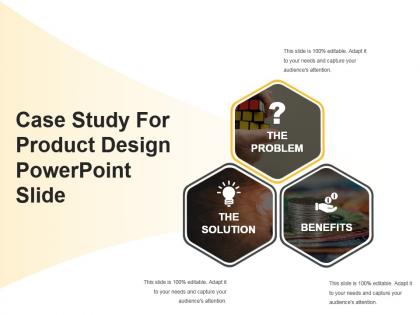
Case study for product design powerpoint slide




Try Before you Buy Download Free Sample Product
 Impress Your
 Audience
 100%
100% Editable
 Save Hours
 of Time


Our Case Study For Product Design Powerpoint Slide generate jubilation. It facilitates incredible achievements.
People who downloaded this PowerPoint presentation also viewed the following :
Case study for product design powerpoint slide with all 6 slides:
Create good conditions with our Case Study For Product Design Powerpoint Slide. They are quite conducive to that.
FAQs for Case study for product
The product design process employed human-centered design, design thinking frameworks, agile development methodologies, user experience research, and iterative prototyping approaches. These methodologies streamline development by prioritizing user needs, reducing revision cycles, and accelerating time-to-market, with many technology companies finding that this strategic combination ultimately delivers more intuitive products and stronger competitive advantage.
User research influenced final design decisions by identifying key pain points, validating assumptions through testing, uncovering user behavior patterns, and prioritizing feature importance based on actual needs. Through iterative feedback sessions, usability testing, and behavioral analytics, design teams streamlined navigation, enhanced core functionalities, and eliminated unnecessary elements, ultimately delivering more intuitive user experiences and higher engagement rates.
Common prototyping challenges include technical feasibility constraints, user feedback integration, budget limitations, timeline pressures, and iterative design conflicts. These obstacles are typically overcome by adopting agile methodologies, conducting rapid user testing cycles, and maintaining cross-functional collaboration, with many design teams finding that early stakeholder engagement and flexible resource allocation ultimately streamline development and enhance product-market fit.
The team prioritized features by analyzing user feedback frequency, impact on core workflows, and alignment with business objectives through data-driven scoring systems. They conducted user interviews, A/B tested prototypes, and mapped feedback to user personas, ultimately focusing on high-impact features that streamlined user experiences while delivering measurable improvements in engagement and retention rates.
Stakeholder collaboration ensured alignment across teams, facilitated comprehensive requirement gathering, accelerated decision-making processes, and minimized costly design revisions through early feedback integration. This collaborative approach enabled cross-functional teams in organizations like tech startups and healthcare companies to streamline product development timelines, enhance user experience outcomes, and ultimately deliver market-ready solutions faster.
Product usability is typically tested through user interviews, A/B testing, prototype validation, heat mapping analysis, and accessibility audits across diverse user groups. These comprehensive testing methods streamline the design process by identifying pain points, optimizing user flows, and ensuring inclusive experiences, with many organizations finding that thorough pre-launch validation significantly reduces post-launch redesign costs while enhancing customer satisfaction.
**INPUT**: What design trends and technologies were integrated into the product? **OUTPUT**: Integrated design trends include responsive interfaces, minimalist aesthetics, voice activation, AI-powered personalization, and sustainable materials. These technologies streamline user experiences by reducing complexity, enhancing accessibility, and delivering personalized interactions, with many organizations finding that strategic design integration ultimately drives customer engagement and competitive advantage.
The team integrated sustainability through eco-friendly material selection, energy-efficient manufacturing processes, circular design principles, and end-of-life recyclability considerations. This comprehensive approach enabled reduced environmental impact, lower production costs, and enhanced brand reputation, with many organizations finding that sustainable design practices ultimately deliver competitive advantages while meeting increasingly conscious consumer expectations.
Product design success metrics include user engagement rates, conversion metrics, task completion rates, user satisfaction scores, and retention analytics. These measurements enable organizations to assess design effectiveness by tracking behavioral patterns, identifying usability improvements, and quantifying business impact, with many companies finding that comprehensive metric analysis ultimately delivers enhanced user experiences and competitive advantage.
Competitive analysis informed design choices by identifying market gaps, user pain points, and successful interaction patterns across similar products. Through benchmarking competitor features, analyzing user reviews, and studying design trends, teams streamlined navigation, enhanced core functionalities, and differentiated their offering, ultimately delivering superior user experiences while maintaining competitive positioning in increasingly crowded markets.
User testing revealed critical insights including navigation confusion, feature discoverability issues, accessibility gaps, cognitive load concerns, and mobile responsiveness problems. These findings directly influenced design iterations by streamlining user flows, repositioning key features, enhancing visual hierarchy, and optimizing mobile interfaces, ultimately delivering improved user satisfaction and reduced support requests across diverse user segments.
Branding integration involved embedding visual identity elements like logos, color schemes, typography, and design language throughout the product interface, packaging, and user touchpoints. This strategic approach ensures consistent brand recognition across digital platforms, physical products, and customer interactions, with companies like Apple and Nike finding that cohesive branding ultimately enhances user loyalty and market differentiation.
Iterative design proves essential for identifying user pain points, refining functionality, validating assumptions, and reducing costly late-stage changes through continuous feedback loops. Companies like Airbnb and Spotify demonstrate that multiple design cycles enable teams to uncover hidden usability issues, enhance user satisfaction, and ultimately deliver products that better align with market needs while minimizing development risks.
Product design evolution typically progresses through discovery, ideation, prototyping, testing, and refinement phases, with each stage building upon insights from the previous one. Through iterative feedback loops, design teams streamline user experiences, enhance functionality, and optimize visual elements, with many organizations finding that this phased approach ultimately delivers more intuitive products and faster market validation.
**INPUT**: What strategies were used to ensure accessibility in the product design? **OUTPUT**: Accessibility strategies include universal design principles, comprehensive user testing with diverse abilities, color contrast optimization, keyboard navigation support, and screen reader compatibility. These approaches streamline inclusive experiences by removing barriers, expanding market reach, and ensuring compliance standards, with many organizations finding that accessible design ultimately delivers broader user engagement and competitive advantage. [Word count: 54 words]
-
Informative presentations that are easily editable.
-
Very well designed and informative templates.