


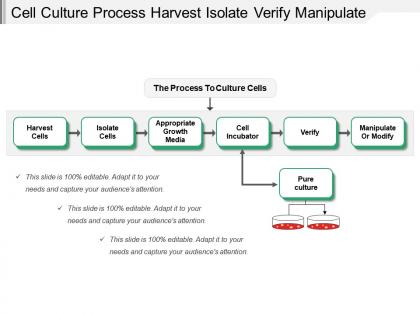
Cell culture process harvest isolate verify manipulate




Try Before you Buy Download Free Sample Product
 Impress Your
 Audience
 100%
100% Editable
 Save Hours
 of Time


Experience infinite confidence with our Cell Culture Process Harvest Isolate Verify Manipulate. Feel assured of beating back any challenge.
People who downloaded this PowerPoint presentation also viewed the following :
Cell culture process harvest isolate verify manipulate with all 5 slides:
Bring an end to divisive influences with our Cell Culture Process Harvest Isolate Verify Manipulate. Increase efforts at integration.



FAQs for Cell culture process harvest
Cell culture techniques are based on creating sterile environments, providing appropriate nutrients, maintaining optimal temperature and pH conditions, ensuring proper gas exchange, and controlling osmotic pressure. These principles enable researchers in pharmaceutical development, regenerative medicine, and biotechnology to cultivate healthy cell populations for drug testing, tissue engineering, and therapeutic applications, ultimately delivering faster research outcomes and more reliable experimental results.
Different culture media significantly impact cell growth and differentiation by providing varying nutrient compositions, growth factors, and pH conditions that either promote proliferation or guide cells toward specific lineages. Serum-rich media typically enhances rapid growth in research laboratories, while defined media with specific supplements drives targeted differentiation in biotechnology companies and pharmaceutical manufacturers, ultimately enabling controlled outcomes for drug development and tissue engineering applications.
Sterile techniques are critical in cell culture as they prevent bacterial, fungal, and viral contamination that can compromise experimental results, destroy valuable cell lines, and invalidate research data. Contamination can be minimized through proper aseptic handling procedures, regular sterilization of equipment and work surfaces, use of laminar flow hoods, and implementing strict protocols for media preparation, with many research laboratories finding that consistent sterile practices ultimately deliver reliable experimental outcomes and protect costly cell culture investments.
Primary cell cultures are directly isolated from tissues and maintain original characteristics but have limited lifespan, while established cell lines are immortalized cells that can divide indefinitely with consistent properties. Primary cultures offer greater biological relevance for research applications like drug testing and disease modeling, whereas cell lines provide reproducibility and scalability, with many pharmaceutical companies finding that combining both approaches enhances research outcomes and accelerates therapeutic development.
Researchers select cell lines by evaluating experimental objectives, tissue origin relevance, genetic characteristics, growth requirements, and contamination history. Through careful assessment of factors like doubling time, morphology, and specific biomarkers, laboratories can match cellular models to research goals, ultimately ensuring reproducible results and meaningful data for pharmaceutical development, toxicology studies, and disease research applications.
Substrates and coatings provide essential surface modifications that enhance cell adhesion, proliferation, and differentiation by mimicking natural extracellular matrix conditions. These materials, including collagen, fibronectin, laminin, and synthetic polymers, enable researchers to optimize cell behavior for specific applications, with pharmaceutical companies and tissue engineering labs finding that strategic substrate selection significantly improves experimental reproducibility and therapeutic outcomes.
Researchers ensure cell culture reproducibility by maintaining consistent environmental conditions, standardizing protocols, using authenticated cell lines, implementing rigorous contamination controls, and documenting all procedural variations. These systematic approaches streamline experimental workflows by minimizing variables, enhancing data quality, and enabling reliable cross-laboratory validation, with many research institutions finding that standardized practices ultimately deliver faster discovery timelines and more robust scientific outcomes.
**2D cell culture advantages** include cost-effectiveness, simplicity, standardized protocols, and high reproducibility, while **3D systems** offer enhanced physiological relevance, better cell-cell interactions, and improved drug response predictions. While 2D cultures streamline routine screening and basic research with faster results, 3D systems present both challenges in standardization and opportunities for more accurate disease modeling, with many pharmaceutical companies finding that strategic combination of both approaches ultimately delivers comprehensive insights and accelerated drug development timelines.
Environmental factors like pH and temperature significantly impact cell culture success by influencing cellular metabolism, protein function, and growth rates, with optimal conditions typically requiring pH 7.2-7.4 and 37°C for mammalian cells. These parameters affect enzyme activity, nutrient uptake, and waste removal, with pharmaceutical companies and research institutions finding that precise environmental control enhances reproducibility, accelerates drug development timelines, and ultimately delivers more reliable experimental outcomes.
Stem cell culture techniques include specialized media formulations, feeder cell systems, matrix-based substrates, growth factor supplementation, and controlled environmental conditions to maintain pluripotency. These approaches differ from traditional methods by requiring more complex protocols, sterile handling procedures, and continuous monitoring, with research institutions and biotechnology companies finding that successful stem cell cultivation ultimately delivers enhanced therapeutic potential and regenerative medicine applications.
Bioreactors enhance large-scale cell culture production by providing precise environmental control, automated monitoring systems, optimized nutrient delivery, and consistent mixing capabilities. These systems streamline operations by maintaining optimal pH, temperature, and oxygen levels throughout cultivation, enabling pharmaceutical and biotechnology companies to achieve higher cell densities, reduced contamination risks, and improved product yields.
Researchers must consider animal welfare implications, source transparency, and alternative availability when using animal-derived components like fetal bovine serum in culture media. While these components remain essential for many applications, institutions increasingly adopt policies requiring ethical sourcing verification, exploring synthetic alternatives, and implementing the 3Rs principles (replacement, reduction, refinement), ultimately balancing research integrity with responsible practices.
Cell culture techniques accelerate drug development by enabling researchers to test compound efficacy, assess toxicity levels, and study cellular responses in controlled laboratory environments before costly animal trials. These methods streamline pharmaceutical research by reducing development timelines, minimizing regulatory risks, and enhancing safety profiles, with biotechnology companies finding that cellular models deliver faster screening processes and more predictable clinical outcomes.
Recent innovations in cell culture technology include 3D organoid systems, microfluidic organ-on-chip platforms, automated bioreactors, perfusion-based culture systems, and advanced biomaterial scaffolds. These technologies enhance research capabilities by providing more physiologically relevant models, improving reproducibility, and enabling high-throughput screening, with pharmaceutical companies and research institutions finding that organoid systems significantly accelerate drug discovery timelines while reducing development costs.
Digital tools and automation enhance cell culture workflows by streamlining monitoring, reducing contamination risks, and standardizing protocols across laboratories. Automated incubators, real-time imaging systems, and digital tracking platforms enable researchers to maintain consistent environmental conditions, accelerate data collection, and minimize manual errors, ultimately delivering faster experimental results and improved reproducibility for biotechnology and pharmaceutical organizations.
-
Awesome use of colors and designs in product templates.
-
Commendable slides with attractive designs. Extremely pleased with the fact that they are easy to modify. Great work!