

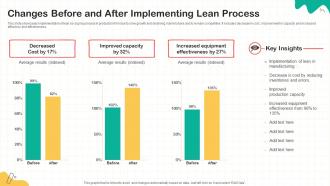
Changes Before And After Implementing Lean Process





Try Before you Buy Download Free Sample Product
 Impress Your
Audience
 100%
Editable
 Save Hours
of Time


This slide showcases implementation of lean six sigma process in production firm due to slow growth and declining market share and to remain competitive. It includes decrease in cost , improvement in capacity and increased efficiency and effectiveness.
People who downloaded this PowerPoint presentation also viewed the following :
Changes Before And After Implementing Lean Process with all 7 slides:
Use our Changes Before And After Implementing Lean Process to effectively help you save your valuable time. They are readymade to fit into any presentation structure.






FAQs for Changes Before And After
So Lean has five main things: figure out what customers actually value, map your whole process, make everything flow smoothly, set up pull systems, and keep improving forever. The big difference? Most traditional methods just automate whatever mess you already have - which is kinda pointless if you think about it. Lean actually cuts out the waste first. Traditional stuff is usually top-down and project-heavy. But Lean lets your frontline people spot problems and fix them every day. My advice? Walk through one process and ask yourself which steps truly help the customer.
Honestly, just walk around and watch how work actually happens - you'll be amazed at the stuff you miss from your desk. Map out each step and time things, even roughly. The bottlenecks become super obvious once you're paying attention. Your frontline folks are goldmines for this stuff since they deal with the BS daily. They'll tell you exactly where things get stuck or take forever. Focus on the worst time-wasters first rather than trying to fix everything at once. Value stream mapping sounds fancy but it's basically just drawing out your process flow. Quick wins keep people motivated.
Dude, leadership makes or breaks this stuff. I've watched so many transformations crash because executives just vanish after the kickoff meeting. Your leaders can't just delegate and ghost - they need to actually show up, model the behaviors, and clear roadblocks when teams get stuck. The communication part is huge too. People need to understand why you're doing this, not just what you're doing. Oh, and patience is key since results don't happen overnight. Honestly? Don't even bother starting unless leadership is genuinely all-in. Half-hearted support will torpedo everything.
Honestly, start with the basics - cycle time, defect rates, and how much you're actually getting done. Those show results fast. Customer satisfaction and employee engagement matter too because grumpy employees will tank any improvement effort, trust me. Financial stuff like cost per unit and inventory turns are what the bosses care about. Oh, and get your baseline numbers first or you'll have nothing to compare against later. Don't go crazy measuring everything though - pick maybe 4-5 key things max. You'll just drown in spreadsheets otherwise and nobody wants that headache.
Honestly, you've gotta loop people in from day one or they'll just dig their heels in. Explain why you're doing this whole thing - nobody likes being kept in the dark. Let them actually own pieces of it, like finding waste in their own areas. Way better than just telling everyone what to do from your office. Training is huge too, otherwise people feel lost. Oh and celebrate the small stuff together! Be real about what's working and what isn't. Those feedback sessions where you actually listen? Game changer. People can tell when you're just going through the motions.
Honestly, getting people on board is gonna be your biggest headache. Everyone gets set in their ways, you know? Even when current processes suck, change feels threatening. Your team might think you're basically saying they've been doing everything wrong this whole time. Leadership can be just as stubborn if they don't see immediate ROI. Oh, and don't get me started on how easy it is to slip back into old habits when deadlines hit. Resource-wise, you're looking at serious upfront costs for training. My advice? Pick one small area first. Get some quick wins under your belt, then people will actually listen when you want to expand it company-wide.
Honestly, tech can be a game changer for lean stuff if you do it right. Start with automating the boring manual work that's eating up time. Real-time dashboards show you where things are getting stuck - way better than guessing. IoT sensors track how smooth everything's flowing, and AI can spot problems before they blow up (still blows my mind how well that works). Your team can report issues instantly with mobile apps instead of waiting around. Don't get sucked into shiny object syndrome though. Pick tech that actually fixes your waste issues, not just because it looks cool. Test one process first, prove it works, then expand from there.
Start with value stream mapping - it'll show you where the real problems are hiding. For organizing your workspace, 5S is solid. Kaizen events work great for getting everyone involved in improvements. I'm a big fan of gemba walks too, honestly they catch stuff you'd never notice from your desk. Root cause analysis like the 5 Whys keeps you from just treating symptoms. Kanban boards help with workflow, and PDCA cycles give you structure. Oh, and document your standard work processes - otherwise people just drift back to old habits. The value stream map should be your starting point though.
Honestly, culture can totally make or break your Lean thing. If your workplace is all about pointing fingers when stuff goes wrong, you're screwed before you start. Leadership has to actually practice what they preach - not just talk about improvement while shutting down ideas. People need to feel safe bringing up problems without getting thrown under the bus. Oh, and if departments barely talk to each other normally? Good luck with value stream mapping - that'll be a mess. I'd say figure out where your culture actually stands first, then worry about the fancy tools later.
So Toyota basically invented modern Lean manufacturing - they're the gold standard. Boeing cut their 737 production from 22 days down to 11, which is wild for something that complex. Virginia Mason Medical Center applied it to healthcare and slashed patient wait times by 85%. Amazon does it too in their warehouses for picking routes and stuff. Honestly, if you're just getting started, check out Toyota's "5S" method first. It's pretty straightforward and works across different industries. Good place to dive in without getting overwhelmed.
Oh yeah, Lean totally works outside manufacturing! Healthcare cuts patient wait times with it. Banks use it for faster loan approvals. Software teams even apply it to ditch pointless meetings - honestly, that one's my favorite because who hasn't sat through meetings that could've been emails? The basic idea is pretty straightforward: figure out what customers actually value, map your current process, then hunt down all the waste. Pick some annoying process at work and walk through it step-by-step. You'll be shocked how much time gets burned on stuff that doesn't matter.
Start with the basics - value stream mapping, 5S, kaizen fundamentals. ASQ has decent online courses but honestly? Skip the theory-heavy stuff. Hands-on workshops where your team works with actual processes are gold. Get a couple people Green Belt certified to lead the charge. Oh, and definitely budget for change management training because people will push back hard. I learned that one the hard way! Two-day workshop for everyone first, then customize training by role. Don't try to boil the ocean right away.
Look, you can't just do this as a one-off thing and call it done. Build it right into how everyone works every day. Weekly team check-ins are honestly your best bet - that's where people actually dig into what's working and what sucks. And here's the thing about leadership... if they disappear after the kickoff meeting, you're screwed. Everyone will just go back to the old way. Train new hires on Lean stuff from their first week. When someone spots a problem or has a bright idea? Make noise about it. The companies that nail this long-term don't make it feel like extra homework - it just becomes part of the job.
You've gotta build improvement right into your daily routine. Get leadership doing regular gemba walks - actually watching processes and chatting with frontline people. Most companies totally blow this part once the initial hype dies down, honestly. Create those Plan-Do-Check-Act cycles and cross-functional teams. Here's the thing though - people need actual time and permission to suggest changes, not just lip service about it. Keep tracking your key metrics and celebrate the small wins too. I'd start with one improvement cycle monthly. Better to stay consistent than get all crazy ambitious and burn out.
So Lean and sustainability work really well together since they're both about cutting waste. You streamline processes and automatically use fewer resources - less inventory sitting around, shorter transport routes, that kind of thing. The continuous improvement stuff helps you spot environmental opportunities too. We had one team map their workflow and realized they could ditch 60% of their paperwork just by questioning each step. Honestly, it's pretty satisfying when your cost cuts also help the planet. Try walking through your workspace looking for both types of waste at once - you'll be surprised what jumps out.
-
Satisfied with the way SlideTeam resolved my query regarding the right business PPTs that I was having difficulty finding. I found the perfect match with their assistance.
-
The templates are handy and I can personalize them as per my needs. Glad to be your subscriber!