

Channel Partner Market Scan And Broadlist Development Partner Central




Try Before you Buy Download Free Sample Product
 Impress Your
 Audience
 100%
100% Editable
 Save Hours
 of Time


Our Channel Partner Market Scan And Broadlist Development Partner Central are topically designed to provide an attractive backdrop to any subject. Use them to look like a presentation pro.
People who downloaded this PowerPoint presentation also viewed the following :
Content of this Powerpoint Presentation
Slide 1: This slide introduces Channel Partner. State Your Company Name and begin.
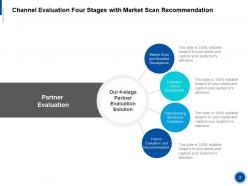
Slide 2: This slide shows Channel Evaluation Four Stages with Market Scan Recommendation.
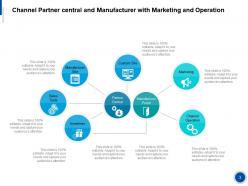
Slide 3: This slide presents Channel Partner central and Manufacturer with Marketing and Operation.
Slide 4: This slide displays Channel Partner Evaluation From with One to Five Scale.
Slide 5: This slide represents Channel Partner with Handshaking Info Graphics.
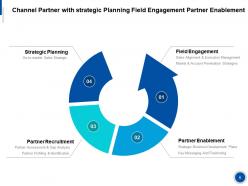
Slide 6: This slide showcases Channel Partner with strategic Planning Field Engagement Partner Enablement.
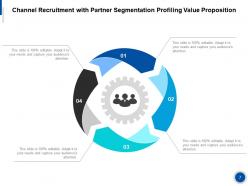
Slide 7: This slide shows Channel Recruitment with Partner Segmentation Profiling Value Proposition.
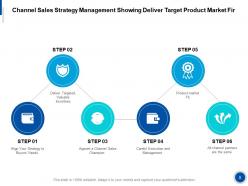
Slide 8: This slide presents Channel Sales Strategy Management describing- Deliver Targeted, Valuable Incentives, Product-market Fit, Align Your Strategy to Buyers’ Needs, Appoint a Channel Sales Champion, Careful Execution and Management, All channel partners are the same.
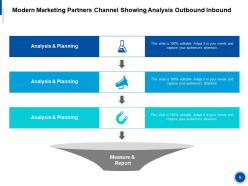
Slide 9: This slide displays Modern Marketing Partners Channel Showing Analysis Outbound Inbound.
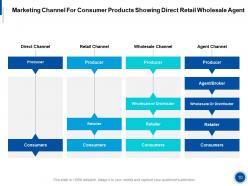
Slide 10: This slide represents Marketing Channel For Consumer Products Showing- Direct, Retail, Wholesale and Agent channels.
Slide 11: This is a THANK YOU slide with address, contact number and email address.
Channel Partner Market Scan And Broadlist Development Partner Central with all 11 slides:
Use our Channel Partner Market Scan And Broadlist Development Partner Central to effectively help you save your valuable time. They are readymade to fit into any presentation structure.



FAQs for Channel Partner Market Scan And Broadlist
Businesses should track partner revenue potential, market reach, customer base alignment, sales capabilities, and technical expertise when evaluating potential channel partners. These metrics enable organizations to assess strategic fit, scalability, and growth opportunities, with many companies finding that partners with complementary strengths and proven track records deliver accelerated market penetration and enhanced competitive advantage.
Companies can effectively assess partner alignment through comprehensive due diligence processes, including cultural assessments, strategic goal reviews, operational audits, and shared vision workshops. These evaluation methods streamline partner selection by examining business philosophies, market approaches, and long-term objectives, with many organizations finding that structured alignment assessments significantly reduce partnership conflicts and enhance collaborative success.
Market segmentation enables businesses to identify channel partners by analyzing customer demographics, geographic reach, industry expertise, buying behaviors, and technical capabilities. Through strategic segmentation, organizations can match partners with specific market niches, ensuring aligned strengths and complementary resources, while ultimately delivering targeted customer experiences and enhanced market penetration across diverse sectors.
Emerging trends include digital transformation acceleration, ecosystem-based partnerships, data-driven partner enablement, sustainability-focused collaborations, and AI-powered channel management platforms. These developments streamline partner onboarding, enhance performance analytics, and enable more strategic resource allocation, with many organizations finding that integrated digital ecosystems deliver faster market penetration and improved competitive positioning.
Businesses can leverage technology to enhance channel partner communication through cloud-based portals, real-time messaging platforms, collaborative project management tools, automated reporting systems, and integrated CRM solutions. These technologies streamline information sharing, enable instant updates on inventory and pricing, and facilitate joint planning sessions, ultimately delivering improved transparency, faster response times, and stronger strategic alignment across partner networks.
**INPUT**: What strategies can be implemented to nurture and maintain strong relationships with existing channel partners? **OUTPUT**: Effective partner relationship strategies include regular communication cadences, joint business planning, co-marketing initiatives, dedicated support resources, and performance-based incentive programs. These approaches streamline collaboration by aligning goals, enhancing market visibility, and providing mutual value creation, with many organizations finding that consistent engagement and shared success metrics ultimately deliver increased revenue growth and sustainable competitive advantage. **Word count: 58 words**
Cultural differences significantly impact channel partnerships through varying communication styles, business practices, relationship-building approaches, and decision-making processes across global markets. While these differences present challenges, they also create opportunities for deeper market penetration, with many multinational companies finding that culturally-adapted partnership strategies ultimately deliver stronger local market presence and enhanced customer trust.
Common onboarding pitfalls include inadequate training programs, unclear communication channels, insufficient sales enablement resources, misaligned expectations, and lack of ongoing support structures. These challenges can be avoided by implementing comprehensive partner education systems, establishing regular communication protocols, and providing dedicated partner success teams, with many organizations finding that structured onboarding processes ultimately deliver faster time-to-market and stronger partner relationships.
Market potential, competitive landscape, regulatory requirements, cultural considerations, and local business practices should guide geographical scope decisions for channel partnerships. Companies must evaluate infrastructure capabilities, partner availability, and market entry costs across regions, with many organizations finding that phased expansion approaches enable better resource allocation and risk management while delivering sustainable growth.
Businesses can measure channel partner performance through revenue metrics, lead conversion rates, market penetration analysis, partner engagement scores, and customer satisfaction indicators. These measurements enable organizations to optimize partner relationships, identify top-performing channels, and calculate ROI by comparing program costs against generated revenue, ultimately delivering strategic insights for enhanced partnership strategies.
Companies can support channel partners through comprehensive training programs, marketing co-investment, lead sharing systems, dedicated partner portals, and performance incentives that align mutual objectives. These strategic approaches enhance partner capabilities while streamlining collaboration, with many organizations finding that robust partner enablement, combined with regular communication and shared technology platforms, ultimately delivers accelerated market penetration and sustainable revenue growth.
Best practices for conducting competitive analysis in the channel partner landscape include mapping partner ecosystems, evaluating recruitment strategies, analyzing support programs, assessing technology integrations, and monitoring performance metrics. These approaches enable organizations to identify partnership gaps, benchmark compensation structures, and evaluate market positioning, with many companies finding that comprehensive partner landscape analysis ultimately delivers enhanced recruitment strategies and competitive advantage in channel development.
Marketing collateral can be adapted for channel partners through customizable templates, partner-specific branding guidelines, localized messaging frameworks, tiered content libraries, and co-branded material options. These strategic approaches enable partners to maintain brand consistency while addressing their unique market segments, with many organizations finding that personalized collateral increases partner engagement and ultimately delivers higher conversion rates across diverse channel networks.
Businesses must consider contract terms, intellectual property protection, data privacy regulations, antitrust laws, and industry-specific compliance requirements when establishing channel partnerships. These legal frameworks ensure proper liability allocation, regulatory adherence, and risk mitigation, with many organizations finding that comprehensive partnership agreements ultimately deliver operational clarity, reduced legal exposure, and stronger competitive positioning in regulated markets.
Changes in consumer behavior significantly influence channel partnerships by driving demand for omnichannel experiences, faster delivery expectations, and personalized service touchpoints. These evolving preferences compel partners to realign their strategies, invest in digital integration capabilities, and develop more agile response mechanisms, with many retail and technology organizations finding that successful partnerships now require real-time data sharing and collaborative customer journey optimization to maintain competitive advantage.
-
Excellent design and quick turnaround.