

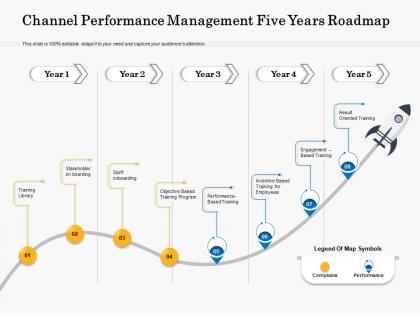
Channel performance management five years roadmap




Try Before you Buy Download Free Sample Product
 Impress Your
Audience
 100%
Editable
 Save Hours
of Time


Visualize your work plan and communicate your ideas impactfully with our pre designed Channel Performance Management Five Years Roadmap. Showcase the detailed overview of the project, the key deliverables, and the milestones to be achieved with the help of our fully customizable PowerPoint layout. You can easily emphasize on the project goals and discuss all the activities involved in an easy to comprehend manner by utilizing our professionally designed PPT theme. This roadmap PowerPoint layout is a perfect strategic planning tool that can help in keeping the project on track. With our attractive PowerPoint theme, you can articulate the workflow, track the work progress, and have a clear vision of the goal to be achieved. Download this versatile Channel Performance Management Five Years Roadmap and save your hours of work.
People who downloaded this PowerPoint presentation also viewed the following :
Channel performance management five years roadmap with all 2 slides:
Use our Channel Performance Management Five Years Roadmap to effectively help you save your valuable time. They are readymade to fit into any presentation structure.


FAQs for Channel performance management
Key metrics include channel revenue, partner profitability, market penetration rates, lead conversion ratios, and time-to-market acceleration across different territories. These performance indicators streamline partner evaluation by tracking sales velocity, customer acquisition costs, and territorial coverage effectiveness, with many organizations finding that comprehensive metric frameworks ultimately deliver improved channel accountability and strategic resource allocation for competitive advantage.
Businesses align channel performance goals with corporate strategy by establishing cascading objectives, implementing shared KPIs across channels, and creating integrated performance dashboards that track both individual channel metrics and overall business outcomes. Through regular cross-functional planning sessions, companies ensure channel investments support broader strategic initiatives like market expansion or customer experience enhancement, ultimately delivering coordinated growth and competitive advantage.
Data analytics enhances channel performance by identifying trends, measuring partner effectiveness, tracking customer behavior, and optimizing resource allocation across distribution networks. Through predictive modeling and real-time dashboards, organizations streamline partner onboarding, improve inventory management, and accelerate sales cycles, with many retailers finding that data-driven insights ultimately deliver higher conversion rates and competitive advantage.
Identifying underperforming channels requires analyzing key metrics including sales volume, revenue growth, market penetration rates, customer acquisition costs, and conversion ratios across your distribution network. These analytics enable organizations to benchmark channel performance against targets and peer channels, with many companies finding that combining quantitative data with qualitative feedback ultimately delivers actionable insights for strategic optimization.
Best practices for setting KPIs in channel performance management include aligning metrics with business objectives, establishing both leading and lagging indicators, ensuring measurable and time-bound targets, incorporating partner feedback, and balancing quantitative metrics with qualitative assessments. These practices enable organizations to track revenue growth, partner satisfaction, and market penetration effectively, while many companies find that regularly reviewing and adjusting KPIs based on channel evolution ultimately delivers stronger partnerships and competitive advantage.
Feedback from channel partners can be integrated through regular surveys, quarterly business reviews, joint performance scorecards, digital feedback platforms, and collaborative goal-setting sessions. These mechanisms enable organizations to capture partner insights on market conditions, competitive challenges, and resource needs, while incorporating their perspectives into mutual performance metrics, ultimately strengthening relationships and improving strategic alignment across the distribution network.
**INPUT**: What technologies are most effective in supporting channel performance management? **OUTPUT**: Effective channel performance management technologies include CRM systems, partner portals, analytics platforms, automation tools, and integrated dashboard solutions. These technologies streamline partner onboarding, real-time performance tracking, and data-driven decision making, with many organizations finding that strategic combinations ultimately deliver enhanced partner relationships, improved sales visibility, and measurable competitive advantage across their channel networks. [Word count: 57 words]
Companies should review channel performance strategies quarterly for comprehensive assessments, with monthly monitoring of key metrics and weekly tracking during peak periods or major campaigns. This tiered approach enables organizations to respond quickly to market changes, seasonal fluctuations, and emerging opportunities, while ensuring strategic alignment with business objectives and maintaining competitive advantage in dynamic marketplace conditions.
Common pitfalls include inadequate partner communication, unclear performance metrics, lack of regular feedback cycles, insufficient training resources, and misaligned incentive structures. These challenges often stem from treating channel management as transactional rather than strategic, with many organizations finding that proactive relationship building, transparent goal-setting, and consistent support ultimately deliver stronger partner engagement and sustained revenue growth.
Organizations ensure consistent communication with channel partners about performance metrics through regular review meetings, automated reporting dashboards, and standardized performance scorecards that provide real-time visibility into sales data, market penetration, and revenue targets. Through digital partner portals and quarterly business reviews, companies streamline feedback loops, enhance transparency in goal-setting, and ultimately strengthen collaborative relationships, with many finding that structured communication schedules deliver improved partner engagement and accelerated revenue growth.
Channel performance directly influences customer satisfaction through faster response times, consistent service quality, seamless omnichannel experiences, and efficient issue resolution. When channels operate effectively, customers receive reliable support across touchpoints, with many retail and financial services organizations finding that optimized channel performance increases customer retention rates while reducing service costs, ultimately delivering competitive advantage in an increasingly experience-driven marketplace.
Market changes and trends significantly influence channel performance metrics by shifting customer expectations, altering competitive landscapes, and introducing new technologies that require updated measurement frameworks. Organizations must adapt their metrics to reflect emerging behaviors like digital-first purchasing, omnichannel preferences, and real-time service demands, with many companies finding that traditional metrics become obsolete without continuous recalibration to market realities.
Channel partners should receive comprehensive training covering product knowledge, sales techniques, marketing best practices, technical implementation, and customer service excellence. This strategic combination enables partners to effectively represent your brand, accelerate deal closure, and deliver superior customer experiences, with many organizations finding that ongoing certification programs and dedicated support resources ultimately drive higher revenue growth and stronger partnership loyalty.
Businesses can balance channel investments by allocating 70-80% of resources to proven high-performing channels while dedicating 20-30% to experimental new opportunities, using data-driven performance metrics to guide decisions. This strategic approach enables organizations to maintain steady revenue streams from established channels like direct sales or key partnerships, while simultaneously testing emerging digital platforms, ultimately delivering sustainable growth and competitive diversification.
Channel performance directly impacts supply chain efficiency, cost management, inventory optimization, demand forecasting accuracy, and overall operational resilience. Poor channel performance creates bottlenecks, excess inventory, and reduced customer satisfaction, while optimized channels enable streamlined logistics, better resource allocation, and enhanced visibility across the entire supply network, ultimately delivering competitive advantage and improved profitability.
No Reviews