

Key Components Of Chatgpt Openai Model Ppt Slides Model




Try Before you Buy Download Free Sample Product
 Impress Your
Audience
 100%
Editable
 Save Hours
of Time


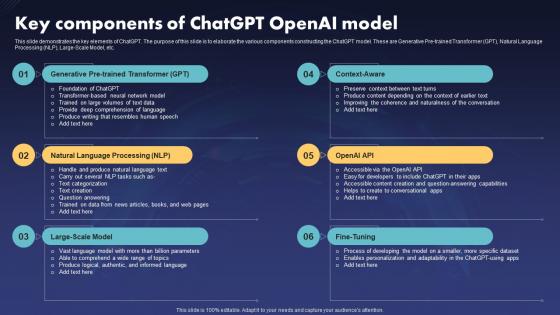
This slide demonstrates the key elements of ChatGPT. The purpose of this slide is to elaborate the various components constructing the ChatGPT model. These are Generative Pre trained Transformer GPT, Natural Language Processing NLP, Large Scale Model, etc.
People who downloaded this PowerPoint presentation also viewed the following :
Key Components Of Chatgpt Openai Model Ppt Slides Model with all 6 slides:
Use our Key Components Of Chatgpt Openai Model Ppt Slides Model to effectively help you save your valuable time. They are readymade to fit into any presentation structure.






FAQs for Key Components Of Chatgpt Openai Model
ChatGPT's foundational architectures include transformer neural networks, attention mechanisms, multi-layer perceptrons, positional encoding systems, and autoregressive language modeling frameworks. These technologies work together by processing sequential data efficiently, maintaining contextual understanding across conversations, and generating coherent responses, with many organizations finding that this architecture enables scalable AI applications across customer service, content creation, and automated communication systems.
ChatGPT's training differs from traditional machine learning through unsupervised pre-training on vast text datasets, followed by supervised fine-tuning and reinforcement learning from human feedback. While traditional models rely on labeled datasets for specific tasks, ChatGPT leverages transformer architecture to understand context and generate human-like responses, with many organizations finding that this approach delivers more versatile, conversational AI capabilities for customer service and content creation.
Reinforcement learning enhances ChatGPT's responses by training the model to align with human preferences through reward-based feedback, optimizing conversational quality, and reducing harmful or inappropriate outputs. This approach enables ChatGPT to deliver more helpful, accurate, and contextually relevant responses across customer service, content creation, and educational applications, ultimately improving user satisfaction and business outcomes.
Tokenization significantly influences ChatGPT's language understanding by determining how text is segmented into processable units, affecting vocabulary recognition, context interpretation, and cross-language capabilities. This process enables the model to handle diverse linguistic patterns, manage out-of-vocabulary words through subword tokenization, and maintain semantic relationships across different languages, ultimately delivering more accurate responses and enhanced multilingual communication experiences for organizations operating in increasingly global markets.
ChatGPT manages context retention through attention mechanisms, token-based memory systems, and sliding window approaches that maintain conversational coherence across extended interactions. While the model processes conversations sequentially and references previous exchanges to maintain relevance, it faces limitations with very long conversations, with many organizations finding that structuring dialogues and periodic context summarization enhances performance for customer service applications.
Fine-tuning ChatGPT employs supervised fine-tuning, reinforcement learning from human feedback (RLHF), domain-specific dataset training, prompt engineering, and parameter-efficient methods like LoRA. These techniques enable organizations to customize responses for specific sectors like healthcare, finance, or customer service, while maintaining conversational quality, ultimately delivering more accurate, contextually relevant interactions that enhance user experiences and operational efficiency.
ChatGPT ensures coherence and relevance through advanced attention mechanisms, contextual understanding algorithms, extensive pre-training on diverse datasets, and fine-tuning processes that optimize response quality. These technologies work by maintaining conversation context, identifying key information patterns, and generating responses that align with user intent, with many organizations finding that this delivers more accurate customer interactions, streamlined communication processes, and ultimately enhanced user experiences across various business applications.
OpenAI implements several bias mitigation measures including diverse training data curation, reinforcement learning from human feedback, content filtering systems, and ongoing model refinements. These approaches work by incorporating multiple perspectives during training, using human reviewers to identify problematic outputs, and continuously updating guidelines, with many organizations finding that combining these technical safeguards with user awareness ultimately delivers more balanced AI interactions.
ChatGPT handles ambiguous queries by asking clarifying questions, making reasonable assumptions based on context, and providing multiple interpretations when uncertainty exists. Through advanced natural language processing, it analyzes conversational patterns, identifies potential meanings, and guides users toward more specific requests, ultimately delivering more accurate responses while maintaining helpful dialogue flow.
Dataset diversity enables ChatGPT to understand varied contexts, languages, writing styles, cultural perspectives, and specialized domains across numerous industries and applications. This comprehensive training foundation allows the model to generate contextually appropriate responses for different sectors like healthcare, finance, education, and technology, while minimizing biases and enhancing reliability for diverse business communications and customer interactions.
ChatGPT model versions demonstrate progressive improvements, with GPT-4 delivering enhanced reasoning capabilities, better contextual understanding, reduced hallucinations, and improved safety measures compared to GPT-3.5. These advancements enable organizations across finance, healthcare, and customer service to streamline operations with more accurate responses, ultimately delivering enhanced user experiences and competitive advantage.
Scaling ChatGPT for wider applications presents both computational complexity and resource allocation challenges, including increased infrastructure demands, latency management, data privacy concerns, and maintaining response quality across diverse use cases. While organizations in healthcare, financial services, and customer support increasingly adopt these solutions, they find that strategic implementation with proper resource planning, security protocols, and performance optimization ultimately delivers enhanced operational efficiency and competitive advantage.
User feedback drives ChatGPT's iterative improvement through reinforcement learning from human feedback (RLHF), supervised fine-tuning on conversation data, and continuous model retraining cycles. OpenAI analyzes user interactions, safety reports, and performance metrics to identify improvement areas, ultimately enhancing response accuracy, reducing harmful outputs, and delivering more contextually appropriate conversations across diverse applications.
Ethical considerations include bias mitigation, privacy protection, transparency requirements, accountability frameworks, and content safety measures. These challenges present opportunities for organizations to develop responsible AI governance, with sectors like healthcare, finance, and education finding that proactive ethical frameworks ultimately deliver enhanced user trust, regulatory compliance, and sustainable competitive advantage.
Developers can customize ChatGPT through fine-tuning on domain-specific datasets, prompt engineering, API parameter adjustments, and integration with specialized knowledge bases or tools. These approaches enable organizations to tailor responses for specific industries like healthcare, finance, or legal services, ultimately delivering more accurate, contextually relevant interactions while maintaining compliance with sector-specific requirements and enhancing operational efficiency.
-
I have been using SlideTeam for the past six months. Very happy and satisfied!
-
Really like the color and design of the presentation.