

Checklist For Service Delivery Model Implementation




Try Before you Buy Download Free Sample Product
 Impress Your
 Audience
 100%
100% Editable
 Save Hours
 of Time


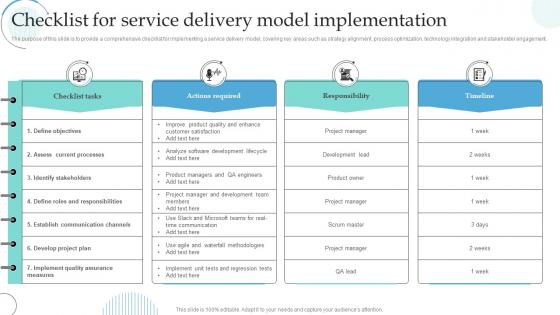
The purpose of this slide is to provide a comprehensive checklist for implementing a service delivery model, covering key areas such as strategy alignment, process optimization, technology integration and stakeholder engagement.
People who downloaded this PowerPoint presentation also viewed the following :
Checklist For Service Delivery Model Implementation with all 9 slides:
Use our Checklist For Service Delivery Model Implementation to effectively help you save your valuable time. They are readymade to fit into any presentation structure.








FAQs for Checklist For Service
**INPUT**: What are the key components of an effective service delivery model? **OUTPUT**: Effective service delivery models include clear service definitions, standardized processes, defined roles and responsibilities, performance metrics, and continuous improvement mechanisms. These components work together by streamlining operations, enhancing customer experiences, and ensuring consistent quality, with many organizations finding that strategic integration of these elements delivers competitive advantage and operational efficiency. **Word count: 52 words**
The choice of service delivery model significantly impacts customer satisfaction by determining response times, service quality, and accessibility across different touchpoints. Strategic models like omnichannel support, self-service portals, and hybrid approaches enhance customer experiences through faster resolution, personalized interactions, and 24/7 availability, with many organizations finding that integrated delivery models ultimately drive higher satisfaction scores and customer retention.
Technology serves as the backbone of modern service delivery models, enabling automation, real-time analytics, cloud integration, AI-powered personalization, and seamless omnichannel experiences. Through these digital capabilities, organizations streamline operations, reduce costs, and deliver faster, more responsive services, with many companies finding that strategic technology adoption ultimately creates significant competitive advantages in increasingly demanding markets.
Organizations can assess their service delivery model effectiveness through performance metrics analysis, customer satisfaction surveys, cost-per-service calculations, response time measurements, and quality assurance evaluations. These assessment methods enable businesses to identify operational bottlenecks, resource allocation inefficiencies, and customer experience gaps, ultimately delivering enhanced service quality and competitive advantage in increasingly demanding markets.
Common challenges include resistance to change, inadequate staff training, technology integration issues, budget constraints, and misaligned stakeholder expectations. Organizations often find that these obstacles can be overcome through phased implementation, comprehensive change management strategies, and clear communication protocols, ultimately delivering improved operational efficiency and enhanced customer experiences across service touchpoints.
Service delivery models vary significantly across industries based on customer expectations, regulatory requirements, and operational complexity. Healthcare emphasizes patient safety and compliance through standardized protocols, while technology companies prioritize agility and rapid deployment, and financial services focus on security and regulatory adherence, with many organizations finding that industry-specific customization ultimately delivers better customer experiences and competitive advantage.
Key metrics include customer satisfaction scores, service level agreement compliance, first-call resolution rates, mean time to resolution, and cost per transaction. These performance indicators enable organizations to track operational efficiency, customer experience quality, and resource utilization across different service channels, with many companies finding that balanced scorecards combining financial and operational metrics ultimately deliver comprehensive insights for continuous improvement and competitive advantage.
Companies ensure flexibility in their service delivery model through modular architecture, cross-trained teams, agile methodologies, scalable technology platforms, and continuous feedback loops. These approaches enable organizations to pivot quickly during market shifts, customize offerings for different client segments, and maintain operational efficiency, with many businesses finding that flexible models ultimately deliver competitive advantage and enhanced customer satisfaction.
Training staff on new service delivery processes involves comprehensive onboarding programs, hands-on simulations, mentorship pairing, regular feedback sessions, and technology-enabled learning platforms. These strategies enhance adoption by providing practical experience, continuous support, and measurable skill development, with many organizations finding that blended learning approaches ultimately deliver faster implementation and improved customer service quality.
Cultural differences significantly influence service delivery models through varying communication styles, customer expectations, regulatory requirements, and business practices across global markets. Organizations adapt by localizing customer interactions, adjusting service channels, and modifying operational processes, with many multinational companies finding that culturally-sensitive approaches enhance customer satisfaction and competitive positioning.
Decentralized service delivery models offer greater local responsiveness, faster decision-making, reduced bottlenecks, and customized solutions for specific markets, while centralized models provide standardized processes, cost efficiency, resource optimization, and consistent quality control. Organizations increasingly find that hybrid approaches deliver the best outcomes, with many financial services and healthcare institutions combining centralized oversight with localized execution to enhance customer experiences while maintaining operational efficiency.
Stakeholder engagement is crucial for service delivery model success, ensuring alignment with user needs, operational capabilities, and strategic objectives while identifying potential challenges early. Organizations that actively involve customers, employees, and partners during design phases typically achieve higher adoption rates, reduced implementation risks, and enhanced service quality, ultimately delivering more effective solutions and stronger competitive advantage.
Feedback loops can be integrated through automated customer surveys, real-time performance monitoring, regular stakeholder reviews, and data analytics platforms that track service metrics continuously. These mechanisms enable organizations to identify bottlenecks, optimize resource allocation, and enhance service quality systematically, with many companies finding that structured feedback integration delivers faster response times and improved customer satisfaction.
Artificial intelligence, automation technologies, cloud-based platforms, IoT integration, and predictive analytics are revolutionizing service delivery models across industries. These innovations streamline operations by enabling real-time monitoring, personalized customer experiences, and proactive issue resolution, with many organizations finding that strategic combinations ultimately deliver faster response times, reduced operational costs, and significant competitive advantages.
The service delivery model aligns with business strategy by ensuring operational processes support strategic objectives, customer value propositions, and competitive positioning. Organizations streamline resource allocation, enhance customer experiences, and optimize service quality through strategic alignment, with many companies finding that integrated delivery models significantly improve market responsiveness and operational efficiency.
-
Thrilled to see several customizable templates catering various verticals and industries.
-
A library of engaging, customizable and content-ready templates.