

Checklist To Determine Chatbot Deployment Readiness AI Chatbot For Different Industries AI SS





Try Before you Buy Download Free Sample Product
 Impress Your
Audience
 100%
Editable
 Save Hours
of Time


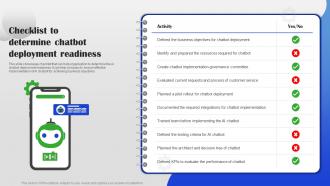
This slide showcases checklist that can help organization to determine the AI chatbot deployment readiness. It can help company to ensure effective implementation of AI chatbot for achieving business objectives.
People who downloaded this PowerPoint presentation also viewed the following :
Checklist To Determine Chatbot Deployment Readiness AI Chatbot For Different Industries AI SS with all 6 slides:
Use our Checklist To Determine Chatbot Deployment Readiness AI Chatbot For Different Industries AI SS to effectively help you save your valuable time. They are readymade to fit into any presentation structure.





FAQs for Checklist To Determine Chatbot Deployment Readiness AI Chatbot For Different
Key objectives for deploying chatbots include enhancing customer service efficiency, reducing operational costs, providing 24/7 support availability, streamlining routine inquiries, and improving response consistency across all interactions. These technologies enable organizations to automate repetitive tasks, scale customer support capabilities, and free human agents for complex issues, with many businesses finding that strategic chatbot deployment ultimately delivers faster resolution times and significantly improved customer satisfaction while reducing overall service costs.
The target audience for chatbots typically includes customers seeking instant support, employees needing internal assistance, and prospects requiring product information or service guidance. Understanding specific needs involves analyzing user pain points, preferred communication channels, common query types, and desired response times, with many organizations finding that personalized interactions, 24/7 availability, and seamless escalation paths ultimately enhance customer satisfaction and operational efficiency.
Chatbots need to support natural language processing, multi-channel integration, conversation flow management, user authentication, and seamless handoff to human agents. These functionalities enable organizations to automate customer inquiries, process transactions, and provide 24/7 support across websites, mobile apps, and social platforms, ultimately delivering faster response times and enhanced customer experiences.
Chatbots are typically deployed across multiple platforms including company websites, mobile applications, social media channels like Facebook Messenger and WhatsApp, customer service portals, and messaging platforms. This multi-platform approach enables businesses to meet customers where they are, streamlining support across touchpoints while delivering consistent experiences, with many organizations finding that strategic deployment across channels significantly enhances customer engagement and operational efficiency.
Ensuring seamless cross-device chatbot experiences requires responsive design optimization, consistent user interface elements, thorough testing across multiple platforms and screen sizes, and adaptive conversation flows. Organizations achieve this through progressive web app frameworks, device-specific performance tuning, and unified backend systems, with many retail and financial services companies finding that consistent omnichannel experiences significantly enhance customer satisfaction and engagement rates.
Effective chatbot models require diverse training data including conversational datasets, domain-specific FAQs, customer service transcripts, intent examples, and entity recognition samples. Through comprehensive datasets covering various user interactions, businesses streamline customer experiences, reduce response times, and enhance service accuracy, with many organizations finding that well-trained models significantly improve operational efficiency.
**INPUT**: How will the chatbot handle user queries that fall outside its trained scope? **OUTPUT**: Chatbots handle out-of-scope queries through fallback protocols, escalation to human agents, transparent communication about limitations, and continuous learning mechanisms that capture unrecognized patterns. These systems enhance customer experiences by seamlessly transferring complex cases to live support, maintaining service quality, and ultimately delivering both automated efficiency and human expertise when needed.
**INPUT**: What metrics will we use to measure the success and performance of the chatbot? **OUTPUT**: Chatbot performance metrics include response accuracy rates, conversation completion rates, user satisfaction scores, resolution times, and cost per interaction. These measurements enable organizations to optimize customer experiences, reduce operational costs, and enhance service delivery, with many financial services and retail companies finding that comprehensive analytics drive continuous improvement and competitive advantage.
Ensuring chatbot compliance requires implementing end-to-end encryption, regular security audits, data minimization protocols, user consent mechanisms, and robust access controls throughout the system. These measures streamline regulatory adherence by protecting sensitive information, maintaining audit trails, and enabling transparent data handling, with many organizations finding that proactive compliance frameworks ultimately deliver enhanced customer trust and competitive advantage.
Post-deployment support typically includes 24/7 monitoring, regular updates, performance optimization, user training, and technical troubleshooting services. These maintenance frameworks ensure chatbots continue delivering seamless customer interactions, with many organizations finding that proactive support reduces downtime by 60% while enhancing user satisfaction and operational efficiency.
Gathering user feedback involves implementing multiple collection channels, including in-chat satisfaction surveys, conversation analytics, user behavior tracking, and direct feedback forms integrated throughout the customer journey. Organizations typically establish systematic review cycles where customer service teams, developers, and business stakeholders analyze conversation logs, identify common pain points, and prioritize improvements, with many companies finding that regular feedback implementation significantly enhances customer satisfaction and reduces support costs.
Chatbots need integration capabilities with CRM systems, helpdesk platforms, payment gateways, inventory management systems, and knowledge bases to function effectively within existing business ecosystems. These integrations streamline customer interactions by enabling seamless data flow, automated ticket creation, and real-time information access, ultimately delivering faster service resolution and enhanced customer experiences.
Managing handover between chatbots and human agents requires seamless integration protocols, clear escalation triggers, context preservation systems, and real-time queue management. Through intelligent routing algorithms, organizations streamline customer experiences by maintaining conversation history, prioritizing urgent cases, and ensuring agents receive complete interaction summaries, ultimately delivering faster resolution times and enhanced customer satisfaction across service channels.
Chatbot deployment typically spans 4-8 weeks, encompassing initial testing phases, user acceptance testing, pilot rollouts, and iterative feedback incorporation. This timeline includes pre-deployment testing, gradual user group expansion, performance monitoring, and continuous refinement loops, with many organizations finding that phased approaches enable smoother transitions and higher adoption rates.
Promote your chatbot through multi-channel marketing including email campaigns, website banners, social media announcements, and in-app notifications that highlight specific benefits and capabilities. Strategic promotion across customer touchpoints, combined with staff training and gradual feature rollouts, ensures higher adoption rates and sustained engagement, with many organizations finding that targeted messaging about time-saving benefits drives initial user interaction.
-
I was never satisfied with my own presentation design but SlideTeam has solved that problem for me. Thank you SlideTeam!
-
SlideTeam makes creating presentations easy. Unlimited products, premium quality designs and affordable.