

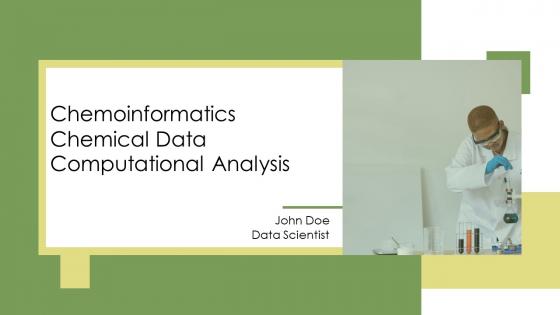
Chemoinformatics Chemical Data Computational Analysis PPT Presentation ST AI




Try Before you Buy Download Free Sample Product
 Impress Your
Audience
 100%
Editable
 Save Hours
of Time


This professional PowerPoint presentation deck provides a comprehensive overview of Chemoinformatics Chemical Data Computational Analysis. It expertly illustrates the integration of chemical data with computational techniques, enhancing understanding of chemical structures and reactions. Ideal for researchers, students, and professionals in the field of chemistry and bioinformatics.
People who downloaded this PowerPoint presentation also viewed the following :
Chemoinformatics Chemical Data Computational Analysis PPT Presentation ST AI with all 39 slides:
Use our Chemoinformatics Chemical Data Computational Analysis PPT Presentation ST AI to effectively help you save your valuable time. They are readymade to fit into any presentation structure.










FAQs for Chemoinformatics Chemical Data Computational Analysis PPT
Cheminformatics integrates computational methods, molecular databases, statistical modeling, machine learning algorithms, and chemical structure representation systems to analyze molecular data at scale. These digital approaches enable pharmaceutical companies, research institutions, and biotechnology firms to accelerate drug discovery, predict molecular properties, and optimize chemical reactions through automated analysis, ultimately delivering faster research timelines and enhanced therapeutic development compared to traditional laboratory-only methods.
Cheminformatics tools accelerate drug discovery by automating molecular analysis, predicting compound properties, optimizing lead structures, and identifying potential drug targets through computational modeling. These platforms streamline research workflows by reducing laboratory testing time, minimizing experimental costs, and enhancing compound screening efficiency, with pharmaceutical companies finding significantly faster development cycles and improved success rates in bringing therapeutic candidates to market.
Cheminformatics enhances molecular understanding through computational modeling, structure-activity relationship analysis, property prediction algorithms, molecular visualization tools, and database mining techniques. These technologies streamline drug discovery by enabling researchers to predict toxicity, optimize compound libraries, and identify promising candidates faster, with pharmaceutical companies finding that automated molecular analysis significantly reduces development costs and accelerates therapeutic breakthroughs.
Machine learning revolutionizes cheminformatics by automating molecular property prediction, drug discovery processes, and chemical reaction optimization through pattern recognition in vast chemical datasets. These algorithms enable pharmaceutical companies and research institutions to accelerate lead compound identification, predict toxicity profiles, and optimize synthesis pathways, ultimately delivering faster drug development timelines and reduced research costs.
Cheminformatics enables virtual screening by computationally filtering large chemical databases using molecular descriptors, pharmacophore modeling, and structure-activity relationships to identify promising drug candidates. These approaches streamline early-stage drug discovery by predicting binding affinities, toxicity profiles, and ADMET properties, with pharmaceutical companies finding that virtual screening significantly reduces experimental costs while accelerating lead compound identification.
Data integration challenges in cheminformatics include inconsistent data formats, varying chemical nomenclature systems, database compatibility issues, quality control across sources, and standardization of molecular representations. These complexities require sophisticated mapping algorithms, unified data schemas, and robust validation protocols, with many pharmaceutical and research organizations finding that strategic integration ultimately delivers enhanced drug discovery capabilities and accelerated research timelines.
Molecular descriptors function as numerical representations of chemical structures, encoding properties like molecular weight, surface area, lipophilicity, and electronic characteristics into quantifiable data points. These descriptors enable computational algorithms to identify structure-activity relationships, predict drug toxicity, and optimize lead compounds, with pharmaceutical companies increasingly leveraging these analyses to accelerate drug discovery timelines and reduce development costs.
Ethical considerations in cheminformatics include data privacy protection, intellectual property rights, algorithmic bias prevention, environmental impact assessment, and equitable access to research benefits. These considerations become increasingly complex when pharmaceutical companies and research institutions leverage computational models for drug discovery, with many organizations finding that transparent methodologies and responsible data sharing ultimately enhance both scientific credibility and public trust.
Cheminformatics contributes to personalized medicine by analyzing molecular structures, predicting drug-target interactions, and identifying patient-specific therapeutic pathways through computational modeling and data mining. Through advanced algorithms, healthcare institutions can optimize treatment selection, minimize adverse reactions, and accelerate precision drug discovery, with many pharmaceutical companies finding that personalized approaches significantly enhance patient outcomes while reducing development costs.
Current trends in cheminformatics software development include cloud-based platforms, AI-integrated molecular modeling, open-source collaborative tools, automated workflow systems, and real-time data visualization capabilities. These technologies streamline drug discovery by accelerating compound analysis, enhancing predictive modeling, and enabling seamless collaboration across research teams, with pharmaceutical companies and academic institutions finding that integrated platforms significantly reduce development timelines while improving research outcomes.
Cheminformatics supports environmental chemistry through molecular modeling for green synthesis, predictive toxicity screening, and biodegradability assessment tools that minimize harmful chemical development. These computational approaches enable pharmaceutical and manufacturing companies to design safer alternatives, optimize resource usage, and accelerate regulatory compliance processes, ultimately delivering reduced environmental impact while maintaining innovation efficiency.
Cheminformatics significantly reduces drug formulation costs by streamlining compound screening, optimizing molecular design, and predicting drug properties before expensive laboratory testing. Through computational modeling and database analysis, pharmaceutical companies minimize failed experiments, accelerate lead compound identification, and reduce development timelines, with many organizations finding that early-stage virtual screening delivers substantial cost savings and competitive advantage.
Cheminformatics improves reaction predictability by leveraging machine learning algorithms, reaction databases, quantum chemical calculations, and molecular descriptors to analyze reaction patterns and outcomes. Through predictive modeling and computational chemistry tools, researchers can forecast reaction yields, selectivity, and feasibility more accurately, while identifying optimal conditions and potential side reactions, ultimately accelerating drug discovery and chemical synthesis processes.
Current cheminformatics methodologies face limitations including data quality inconsistencies, computational scalability challenges, limited predictive accuracy for novel compounds, inadequate integration across diverse databases, and difficulty handling complex molecular interactions. While pharmaceutical companies and research institutions increasingly address these through advanced machine learning and cloud computing, many organizations find that combining multiple approaches with rigorous data validation delivers more reliable drug discovery outcomes.
Cheminformatics interfaces with genomics and proteomics through integrated data analysis platforms, molecular modeling systems, and drug-target interaction databases that combine chemical structures with biological sequence data. These interdisciplinary approaches enable pharmaceutical companies and research institutions to accelerate drug discovery, predict protein-drug interactions, and identify therapeutic targets more efficiently, ultimately delivering faster development timelines and more targeted treatments.
-
You know what? I'm so glad I opted for this PPT design. It has been a total game-changer for me and my presentations. Thank you!
-
One word for SlideTeam–Versatile!