


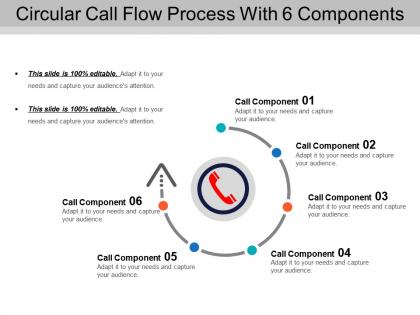
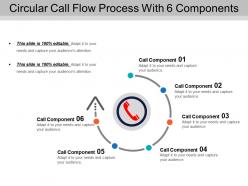
Circular call flow process with 6 components




Try Before you Buy Download Free Sample Product
 Impress Your
 Audience
 100%
100% Editable
 Save Hours
 of Time


Counsel adroitly with our Circular Call Flow Process With 6 Components. They will find your concern endearing.
People who downloaded this PowerPoint presentation also viewed the following :
Circular call flow process with 6 components with all 5 slides:
Get to establish an ideal balance with our Circular Call Flow Process With 6 Components. Intelligently assess all the alternatives.



FAQs for Circular call flow process
Key components include intelligent call routing, real-time queue management, automated callback systems, comprehensive analytics tracking, and seamless agent handoff protocols. These technologies enhance customer experiences by reducing wait times, minimizing call abandonment, and optimizing resource allocation, with many call centers finding that circular flows deliver improved operational efficiency and higher customer satisfaction rates.
Businesses integrate customer feedback into circular call flows through post-call surveys, real-time sentiment analysis, and automated feedback collection at key interaction points. This creates continuous improvement loops where insights drive routing optimization, agent training updates, and service enhancements, with many organizations finding that feedback-driven adjustments reduce call volumes while significantly improving customer satisfaction and operational efficiency.
Technologies best suited for circular call flow include Automatic Call Distributors (ACD), Interactive Voice Response (IVR) systems, Computer Telephony Integration (CTI), workforce management software, and cloud-based contact center platforms. These technologies streamline call routing, minimize wait times, and optimize agent allocation, with many organizations finding that strategic integration delivers enhanced customer experiences and operational efficiency.
Circular call flow enhances customer experience by eliminating dead ends, providing continuous routing options, and reducing call abandonment rates compared to linear models that often trap callers. Through intelligent looping mechanisms, customers receive alternative solutions, escalation pathways, and callback options, with many contact centers finding that circular flows deliver faster resolution times and significantly higher satisfaction scores.
Organizations measure circular call flow effectiveness through key performance indicators including first-call resolution rates, average handling times, customer satisfaction scores, queue abandonment rates, and agent productivity metrics. These measurements enable streamlined operations by identifying bottlenecks, optimizing resource allocation, and enhancing customer experiences, with many contact centers finding that regular analysis ultimately delivers improved service quality and operational efficiency.
Data analytics optimizes circular call flow by identifying bottlenecks, predicting call volumes, analyzing agent performance metrics, and tracking customer satisfaction patterns. Through predictive modeling and real-time dashboards, call centers streamline resource allocation, reduce wait times, and enhance service quality, with many organizations finding that data-driven insights ultimately deliver improved operational efficiency and competitive advantage.
Businesses can troubleshoot circular call flow issues by monitoring call routing patterns, analyzing queue bottlenecks, reviewing agent availability metrics, and implementing real-time dashboard tracking. Through systematic diagnostics and performance analytics, organizations streamline customer service operations, reduce wait times, and enhance caller experiences, with many contact centers finding that proactive monitoring ultimately delivers improved efficiency and customer satisfaction.
Best practices for training staff on circular call flow systems include comprehensive system orientation, role-specific workflow training, hands-on simulation exercises, escalation procedure protocols, and ongoing performance monitoring. Through interactive workshops and real-time practice scenarios, organizations streamline agent onboarding, enhance customer service consistency, and reduce call resolution times, with many call centers finding that structured training programs ultimately deliver improved operational efficiency and better customer experiences.
A circular call flow process supports multi-channel communication by creating seamless handoffs between phone, email, chat, and social media touchpoints, ensuring consistent customer experiences across all platforms. This integrated approach enables organizations to maintain conversation continuity, reduce response times, and provide unified customer data access, with many retail and financial services companies finding that circular flows ultimately deliver higher satisfaction rates and operational efficiency.
**INPUT**: What are the potential challenges of implementing a circular call flow process in a large organization? **OUTPUT**: Implementing circular call flow in large organizations presents challenges including system integration complexities, staff training requirements, customer adaptation periods, and initial setup costs. While these hurdles require careful planning, many enterprises find that strategic implementation across departments like customer service and technical support ultimately delivers improved efficiency and enhanced caller experiences, providing significant competitive advantage. **Word count: 54 words**
Circular call flow processes adapt to different industries by incorporating sector-specific protocols, compliance requirements, and specialized routing logic. Healthcare implementations prioritize patient privacy through HIPAA-compliant pathways and emergency escalation procedures, while financial services emphasize fraud detection, secure authentication, and regulatory compliance checkpoints, ultimately delivering enhanced customer experiences and operational efficiency across diverse business environments.
Circular call flow significantly enhances team collaboration by ensuring equitable workload distribution, reducing bottlenecks, and maintaining consistent service quality across all team members. This systematic approach streamlines communication workflows, minimizes idle time, and enables faster response rates, with many customer service organizations and sales teams finding that it ultimately delivers improved productivity and stronger collaborative dynamics.
CRM systems integrate into circular call flows by automatically populating customer data, tracking interaction history, and enabling personalized routing based on previous touchpoints and preferences. Through API connections and real-time data synchronization, call centers can deliver seamless handoffs between agents, maintain conversation continuity, and provide contextual customer insights, ultimately enhancing service quality while reducing resolution times.
Successful circular call flow implementations include Amazon's customer service routing, Chase Bank's loan inquiry systems, Zappos' support escalation processes, and Microsoft's technical support channels. These systems enhance customer satisfaction by eliminating dropped calls, reducing wait times, and ensuring comprehensive issue resolution, with many organizations reporting 40-60% improvements in first-call resolution rates.
Circular call flow aligns with continuous improvement by creating feedback loops that enable constant monitoring, analysis, and refinement of communication processes. Through iterative cycles, organizations streamline customer interactions, reduce response times, and enhance service quality, with many call centers finding that this approach delivers improved operational efficiency, better customer satisfaction, and sustained competitive advantage.
-
Great product with effective design. Helped a lot in our corporate presentations. Easy to edit and stunning visuals.
-
Excellent work done on template design and graphics.