

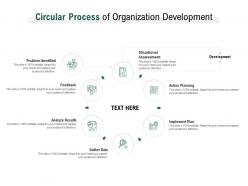
Circular process of organization development





Try Before you Buy Download Free Sample Product
 Impress Your
Audience
 100%
Editable
 Save Hours
of Time


Bite the bullet with our Circular Process Of Organization Development. They make difficult decisions easier to accept.
People who downloaded this PowerPoint presentation also viewed the following :
Circular process of organization development with all 5 slides:
Create a collaborative culture with our Circular Process Of Organization Development. They generate a conducive climate.


FAQs for Circular process
The key stages include diagnosis and assessment, planning and design, implementation and intervention, evaluation and feedback, and continuous adjustment. These stages work cyclically, with organizations like healthcare systems and manufacturing companies finding that each phase informs the next, enabling continuous improvement, enhanced operational efficiency, and sustained competitive advantage in an increasingly dynamic business environment.
The circular process emphasizes continuous feedback loops, iterative improvements, and ongoing adaptation, while linear models follow sequential, one-directional phases from assessment to implementation. This cyclical approach enables organizations to respond dynamically to changing market conditions, incorporate real-time stakeholder feedback, and refine strategies continuously, ultimately delivering greater agility and sustainable transformation compared to traditional step-by-step methodologies.
Feedback serves as the critical link between each phase of organization development, enabling continuous assessment, course correction, and iterative improvement throughout the circular process. It facilitates data-driven decision making, stakeholder alignment, and real-time adjustments, with many organizations finding that systematic feedback loops ultimately enhance intervention effectiveness and sustainable organizational transformation.
Leadership influences circular process effectiveness by establishing clear vision and goals, fostering open communication channels, allocating necessary resources, and modeling commitment to continuous improvement throughout all organizational levels. Through strategic decision-making and employee engagement initiatives, leaders create psychological safety for feedback, streamline implementation of changes, and ensure sustainable transformation, with many organizations finding that executive sponsorship ultimately determines long-term success.
Organizations measure circular process success through key performance indicators like employee engagement scores, productivity metrics, customer satisfaction ratings, and operational efficiency improvements. These measurements enable continuous feedback loops across development cycles, with many companies finding that regular assessment at each process stage delivers enhanced strategic alignment, faster adaptation to market changes, and sustained competitive advantage.
Organizations may face resistance to change from employees, inadequate resource allocation, lack of leadership commitment, poor communication across departments, and difficulty measuring progress effectively. While these challenges can initially slow implementation, many companies in manufacturing, healthcare, and financial services find that addressing cultural barriers early, establishing clear feedback mechanisms, and maintaining consistent stakeholder engagement ultimately delivers improved organizational agility and competitive advantage.
Yes, the circular process integrates seamlessly with agile methodologies through shared principles of iterative feedback, continuous improvement, and adaptive planning cycles. Many organizations find that combining these approaches enhances operational efficiency by enabling faster pivots, streamlined change management, and more responsive organizational structures, ultimately delivering greater competitive advantage in increasingly dynamic business environments.
The circular process facilitates continuous learning by creating feedback loops that capture insights from each implementation phase, enabling organizations to refine strategies, adapt methodologies, and build institutional knowledge systematically. Through regular assessment cycles, companies like Toyota and GE continuously optimize operations, enhance employee capabilities, and strengthen organizational resilience, ultimately delivering sustained competitive advantage and improved performance outcomes.
Techniques include cross-functional workshops, collaborative planning sessions, rotating team leadership, joint problem-solving forums, and shared accountability frameworks. These approaches enhance communication by breaking down silos, encouraging diverse perspectives, and creating shared ownership of outcomes, with many organizations finding that structured collaboration accelerates change implementation while building stronger internal partnerships.
The circular process addresses employee engagement by incorporating continuous feedback loops, collaborative planning sessions, participatory decision-making, and iterative improvement cycles throughout organizational development initiatives. This approach enables employees in manufacturing, healthcare, and financial services to actively contribute insights, shape strategic directions, and witness direct implementation of their recommendations, ultimately delivering higher ownership levels, improved job satisfaction, and enhanced organizational commitment across all development phases.
Companies like Microsoft, Toyota, and General Electric exemplify successful circular organization development through continuous assessment, strategic planning, implementation, and feedback integration. Microsoft's cultural transformation under Satya Nadella demonstrates iterative leadership development and employee engagement cycles, while Toyota's kaizen philosophy and GE's WorkOut sessions showcase ongoing operational improvements, ultimately delivering enhanced performance, innovation capabilities, and sustained competitive advantage across diverse market conditions.
Technology supports the circular process of organization development through data analytics platforms, collaboration tools, performance management systems, feedback applications, and automation software. These technologies streamline assessment phases, enhance communication during implementation, and provide real-time monitoring of organizational changes, with many companies finding that integrated digital platforms accelerate development cycles while delivering measurable improvements in efficiency and employee engagement.
Sustainability strategies include continuous stakeholder engagement, regular feedback integration, adaptive resource allocation, systematic performance monitoring, and embedding change management principles throughout each cycle. Organizations in healthcare, manufacturing, and financial services find that combining data-driven assessment tools with flexible implementation frameworks ensures long-term viability, while building organizational resilience and maintaining competitive advantage in increasingly dynamic business environments.
The circular process aligns with change management principles by emphasizing continuous assessment, iterative implementation, and ongoing feedback loops throughout organizational transformation. This cyclical approach mirrors established change frameworks like Kotter's model, enabling organizations to adapt strategies based on real-time results, address resistance proactively, and sustain improvements, ultimately delivering more effective and lasting organizational change.
Organizational culture serves as the foundation for circular process effectiveness, influencing employee engagement, change acceptance, feedback openness, and continuous improvement mindsets throughout each development cycle. Companies with collaborative cultures, such as those in tech and healthcare sectors, find that cultural alignment accelerates implementation timelines and enhances sustainable transformation outcomes.
No Reviews