

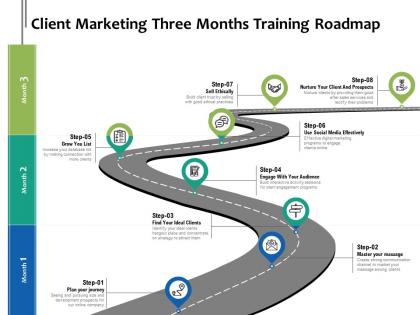
Client marketing three months training roadmap




Try Before you Buy Download Free Sample Product
 Impress Your
 Audience
 100%
100% Editable
 Save Hours
 of Time


The success rate of business plans is hugely dependent on the plan of action, and this editable Client Marketing Three Months Training Roadmap rightly serves the purpose. Encapsulate all the information related to the project in a well structured manner to obtain maximum efficiency by incorporating our stunning PowerPoint theme. State the critical deliverable, steps involved, time frame, workforce allocation, and lots more in an easy to understand manner by utilizing this pre designed roadmap PowerPoint layout. You can also prioritize your tasks and discuss the problem areas with your colleagues by incorporating this tailor made PPT layout. Empower your work plan by employing this professionally designed PPT theme. Entrepreneurs can download Client Marketing Three Months Training Roadmap as a beneficial communication tool that facilitates in collaborating with different tasks and achieve targets.
People who downloaded this PowerPoint presentation also viewed the following :
Client marketing three months training roadmap with all 2 slides:
Use our Client Marketing Three Months Training Roadmap to effectively help you save your valuable time. They are readymade to fit into any presentation structure.

FAQs for Client marketing three
Key components of a successful client marketing strategy include audience segmentation, personalized messaging, multi-channel engagement, performance analytics, and retention-focused campaigns. These elements work together by targeting specific client needs, delivering relevant content across touchpoints, and measuring results, with many organizations finding that this strategic combination ultimately enhances customer lifetime value and drives sustainable growth.
Effective target audience identification involves analyzing existing client data, conducting market research surveys, creating detailed buyer personas, segmenting by demographics and behavior patterns, and leveraging social media analytics. Through these strategic methods, businesses can pinpoint ideal prospects across industries like financial services, healthcare, and retail, ultimately delivering more personalized campaigns, higher conversion rates, and improved marketing ROI while reducing acquisition costs.
Data analytics drives client marketing strategy by identifying customer behavior patterns, measuring campaign effectiveness, predicting future trends, and optimizing resource allocation across channels. Through advanced analytics platforms, organizations can segment audiences more precisely, personalize messaging strategies, and track ROI in real-time, with many companies finding that data-driven approaches deliver significantly higher conversion rates and customer lifetime value.
Social media platforms enhance client engagement through targeted content strategies, real-time customer interactions, personalized messaging campaigns, community building initiatives, and data-driven audience insights. These digital channels streamline marketing efforts by increasing brand visibility, fostering direct client relationships, and enabling cost-effective promotional activities, with many businesses finding that strategic social media integration ultimately delivers improved customer retention and measurable competitive advantage.
Personalization techniques include dynamic content insertion, behavioral segmentation, predictive analytics, AI-driven recommendations, and multichannel journey mapping. These approaches enhance engagement by delivering targeted messaging, customized product suggestions, and timely communications based on client preferences, with many organizations finding that personalized campaigns increase conversion rates and customer loyalty significantly.
Success measurement includes tracking conversion rates, client engagement metrics, retention statistics, revenue attribution, and campaign ROI through analytics platforms. These metrics enable organizations to optimize strategies by identifying high-performing channels, adjusting messaging effectiveness, and reallocating resources strategically, with many businesses finding that comprehensive measurement ultimately delivers improved client acquisition costs and enhanced marketing accountability.
Common mistakes include failing to segment audiences properly, neglecting personalized messaging, inconsistent brand communication, insufficient data analytics utilization, and poor follow-up processes. These pitfalls can be avoided by implementing comprehensive customer segmentation strategies, developing targeted content frameworks, and establishing systematic tracking protocols, with many organizations finding that strategic training programs and cross-departmental collaboration ultimately deliver improved customer engagement and higher conversion rates.
Your team can stay updated through industry publications, marketing conferences, webinars, professional certifications, and networking with peers in similar sectors. Regular participation in these activities enables continuous learning while building strategic connections, with many organizations finding that dedicated learning schedules and cross-functional knowledge sharing ultimately enhance client engagement strategies and competitive positioning.
Segmentation enables personalized marketing by dividing clients into distinct groups based on demographics, behavior, purchase history, and engagement patterns, ultimately delivering more relevant experiences and higher conversion rates. Through data analytics and CRM systems, organizations can implement targeted campaigns, customized messaging, and tailored service offerings, with many financial services and retail companies finding that strategic segmentation increases customer lifetime value significantly.
Incorporating client feedback into marketing strategy involves systematic collection through surveys, interviews, focus groups, and social media monitoring, then analyzing patterns to identify opportunities and pain points. Financial services firms and retail companies increasingly use this approach to refine messaging, adjust targeting, and develop products that resonate, ultimately delivering more personalized campaigns and stronger customer relationships.
Marketing automation tools include CRM platforms, email marketing software, social media schedulers, lead scoring systems, and analytics dashboards. These technologies streamline client outreach by personalizing communications, tracking engagement patterns, and nurturing prospects through automated workflows, with many organizations finding that strategic automation delivers faster response times, improved conversion rates, and enhanced client experiences while reducing manual effort.
Storytelling enhances client marketing messages by creating emotional connections, simplifying complex concepts, and making content more memorable and relatable. Through narrative structures, businesses can transform product features into compelling customer journeys, with many financial services and healthcare organizations finding that story-driven campaigns significantly increase engagement rates and conversion outcomes.
Ethical client marketing considerations include transparent data usage, honest messaging, respect for customer privacy, consent-based communications, and avoiding manipulative tactics. These principles enhance brand trust and long-term relationships by ensuring authentic engagement, protecting customer information, and delivering genuine value, with many organizations finding that ethical approaches ultimately drive stronger customer loyalty and sustainable business growth.
Effective team training involves establishing continuous learning frameworks, implementing hands-on scenario planning, conducting regular industry trend workshops, and creating cross-functional collaboration sessions. Through structured upskilling programs, teams can master emerging digital channels, data analytics tools, and evolving customer engagement strategies, while maintaining agility in campaign execution, ultimately delivering enhanced client results and competitive advantage.
Best practices for collaborating with clients during marketing include establishing clear communication protocols, setting defined project milestones, maintaining regular feedback loops, creating shared documentation systems, and implementing transparent reporting structures. These collaborative approaches streamline campaign development by aligning expectations, accelerating decision-making, and ensuring strategic consistency, with many agencies finding that structured client partnerships ultimately deliver stronger campaign performance and enhanced long-term relationships.
No Reviews