

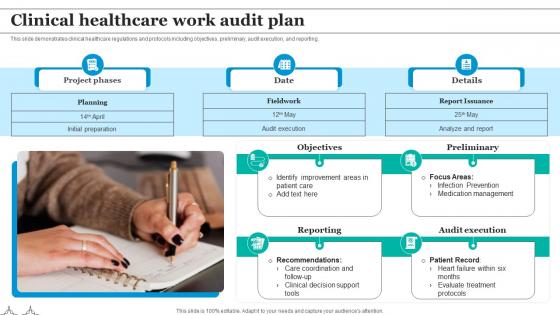
Clinical Healthcare Work Audit Plan




Try Before you Buy Download Free Sample Product
 Impress Your
Audience
 100%
Editable
 Save Hours
of Time


This slide demonstrates clinical healthcare regulations and protocols including objectives, preliminary, audit execution, and reporting.
People who downloaded this PowerPoint presentation also viewed the following :
Clinical Healthcare Work Audit Plan with all 9 slides:
Use our Clinical Healthcare Work Audit Plan to effectively help you save your valuable time. They are readymade to fit into any presentation structure.








FAQs for Clinical Healthcare
Start by nailing down what you're actually trying to find - your audit objectives. Then dive into the medical records, billing stuff, and compliance procedures. Documentation is huge since you need solid evidence for anything you uncover. Here's the thing though - definitely talk to the staff because they'll tell you things the paperwork won't. Sample your data properly and follow those audit trails all the way through. Oh, and make yourself a checklist beforehand so you don't accidentally skip something important. Trust me, it's way easier than trying to remember everything on the fly.
Honestly, don't wait until audit season to get your stuff together - stay on top of it year-round. We got burned by a surprise visit last year because our documentation was a mess. Train your staff on HIPAA, Medicare rules, and whatever state regs apply to you. Internal audits are your friend - they help catch problems before auditors do. Having someone dedicated to compliance makes a huge difference, trust me. Document everything (I know, it's annoying but necessary). The key is treating this as ongoing work, not something you can cram for like a college exam.
Honestly, data analytics is a game changer for audit accuracy. You can spot weird patterns and anomalies that would take forever to find manually - stuff like duplicate payments or sketchy billing codes. The predictive models get pretty smart at flagging high-risk areas first, so you're not just randomly sampling claims anymore. Real-time dashboards show you compliance trends across departments, which helps you deploy your team where they'll actually make a difference. Machine learning does get weirdly good at this once it has enough data to work with. I'd start by figuring out your biggest headaches and see what data you've already got lying around.
Quarterly is usually a good starting point, but honestly it depends on your setup. High-risk stuff like billing or patient safety? I'd do those monthly - I've seen too many places get screwed by waiting too long. Compliance problems spiral quick in healthcare. Lower-risk processes can probably wait six months between audits. Check what your accreditation folks require first though, since they'll have their own timeline demands. Map out your critical processes and hit those more often. You can always dial back the frequency later if things look solid.
Poor documentation will absolutely kill you - I learned that the hard way. Scope creep is the other big one, so pin down exactly what you're auditing before you start. Otherwise it just keeps growing and growing. Make sure your data sources are actually current too, don't just assume those records are good. HIPAA stuff will bite you if you miss requirements there. Communication though? That's honestly the worst pitfall. Staff gets confused, stakeholders feel left out, then everything falls apart. Oh and definitely make a checklist upfront with clear timelines. Sounds obvious but you'd be surprised how many people skip that step.
Start with training your team on documentation - where stuff is, what records matter. Do a practice run first! I can't tell you how many places I've seen completely fall apart because nobody knew what they were doing when the real auditors showed up. Hit your weak spots hard - billing and patient privacy are usually the biggest headaches. Make checklists for each department so they're not scrambling around. Pick a few people who can actually talk to the auditors without freaking out. Give everyone at least 2-3 weeks to prep, maybe more if your records are a mess.
Honestly, you want to focus on three main types: revenue cycle, compliance, and CDI audits. Start with revenue cycle - that's where you'll actually see money come back pretty fast from catching billing mistakes and missed opportunities. Compliance audits are boring but they'll save your butt with HIPAA and Medicare stuff. CDI reviews make sure your documentation matches what you're actually doing and billing for. I mean, if I had to pick just one? Definitely go revenue cycle first. We did one last year and found like $50K in missed charges within the first month. The ROI is usually pretty solid on those.
So basically, it comes down to who's doing the watching. Government audits hit public hospitals hard - they're all about federal compliance and making sure taxpayer dollars aren't disappearing into thin air. Private places? They deal more with insurance companies and accreditation folks checking profitability stuff. Public audits are honestly a paperwork nightmare - like, mountains of documentation. Private ones have more wiggle room. But yeah, both still care about patient safety and whether your books add up. Oh, and figure out your specific regulations first - that's gonna shape everything else you do.
Ok so there's basically three areas you'll want to hit: clinical outcomes, process stuff, and safety metrics. Clinical outcomes are the big picture things - mortality rates, readmissions, infections. Did people actually get better? Process measures check if your team followed protocols right, like med timing and documentation (super boring but necessary). Safety metrics track falls, adverse events, near misses - all that fun stuff. Pick maybe 3-5 key metrics that actually connect to your quality goals instead of going crazy trying to measure everything. Trust me, you'll drown in data otherwise. What department are you auditing again? That'll help narrow down which specific metrics make the most sense.
Honestly, tech is a game-changer for healthcare audits. Automated data extraction pulls info straight from your EHR systems - no more manually digging through endless records (which is soul-crushing anyway). AI flags weird patterns and compliance issues instantly. Real-time dashboards let your whole team see what's happening from wherever they're working. You're looking at cutting review time by 60-70% easy. The trick is figuring out what's eating up most of your time right now, then finding software that tackles those specific headaches first. Trust me, once you automate the tedious stuff, audits become way less painful.
So there's a bunch of ways to track this stuff. Readmission rates and mortality are the big ones obviously. Infection rates, length of stay - all that clinical data matters. Patient satisfaction scores are actually really telling too, like way more than people think. Pain levels, whether they're hitting treatment goals on time, how well they're sticking to protocols. Oh and functional improvement - that's huge. Honestly though, don't try to track everything at once or you'll go crazy. Pick maybe 3-5 metrics that actually matter for your specific patients and just focus on those consistently. Recovery data will show you if your interventions are working.
Obviously patient confidentiality is huge here - stick to HIPAA rules and don't peek at stuff outside your audit scope. I know it's tempting when all that data's sitting right there, but resist! Check if you've got any conflicts of interest too, like auditing your own work or a close colleague's. That never ends well. Get proper authorization first and document everything you're doing to stay ethical. Try not to stress out the staff while you're poking around - they're probably already nervous about being audited. Keep your findings objective even if you find something sketchy.
Honestly, you've got to match your style to who you're talking to. Executives just want the big picture stuff - how much will this cost us? Department heads need the nitty-gritty for their teams. Visual dashboards are your best friend here because let's be real, nobody's reading a 20-page audit report. Always start with your worst findings first, then give them actual steps they can take. I'd set up check-ins later to see if they're actually doing anything about it. The trick is framing problems as "here's how we fix this" instead of just dumping bad news on them.
Honestly, you'll get way better results if you loop in people from different departments. Finance people notice weird billing stuff that doctors miss. IT spots system problems that nobody else sees. Each group has their own perspective, which is actually super valuable. Don't wait until the end to include them either - that's when you get pushback and people acting all defensive about your findings. I learned this the hard way on a project last year. Get representatives from every affected department involved right from the planning stage. Makes everything smoother.
So basically you're creating this real-time feedback loop that catches problems before they blow up. Instead of waiting for those annual reviews (which honestly, who has time for that?), you're monitoring stuff weekly. Pick maybe two metrics to start - could be medication errors, patient satisfaction, whatever's bugging you most. The trick is actually doing something with the data instead of letting it pile up in someone's email. You'll start seeing patterns pretty quickly. It's kind of like giving your own operations a constant checkup, which is weird but makes sense. Bottom line: spot issues early, fix them fast, and your patient care gets way better.
-
Eye-catching PPT designs, outstanding team, and best customer service. I’m a super satisfied customer here!
-
Keep doing the good work guys. Surpass the needs and expectations always!!