

Cloud CDN Powerpoint Presentation Slides





Try Before you Buy Download Free Sample Product
 Impress Your
Audience
 100%
Editable
 Save Hours
of Time


A vast, dispersed network of computers connected to the Internet and spread across numerous data centers is known as a content distribution network CDN. Grab our professionally curated Cloud CDN template. It is a valuable resource for learning about Content Delivery Networks, their advantages, and how to use them to solve practical business issues like latency. Our Content Distribution Network deck discusses the necessity, benefits, and significance of content delivery to the company and market share of CDN. Additionally, it describes how the architecture, Cloud CDN, and CDN edge server function. Our Delivery Network PPT also illustrates CDN characteristics, the problems it solves, and the value of CDN suppliers to the industry. Further, it offers a checklist for implementing CDN in a business, a timeline, and a roadmap for tracking the deployment process. Lastly, our Cloud CDN module includes a 30-day, 60-day, and 90-day plan to implement CDN in business and a dashboard to track the effectiveness and effects of the CDN deployment within the company. Get instant access right away.
People who downloaded this PowerPoint presentation also viewed the following :
Content of this Powerpoint Presentation
Slide 1: This slide introduces Cloud CDN. Commence by stating Your Company Name.
Slide 2: This slide depicts the Agenda of the presentation.
Slide 3: This slide incorporates the Table of contents.
Slide 4: This is yet another slide continuing the Table of contents.
Slide 5: This slide highlights the Title for the Topics to be covered further.
Slide 6: This slide depicts the high latency faced by the company on its server.
Slide 7: This slide describes the reputational damage faced by the company because of high load times and poor server experience.
Slide 8: This slide includes the Heading for the Contents to be discussed next.
Slide 9: This slide represents the need for CDN in business.
Slide 10: This slide describes the importance of a content delivery network(CDN).
Slide 12: This slide demonstrates the global market share of CDN (content delivery network) market from the year 2016 to 2023.
Slide 13: This slide continues the global market share of CDN in the year 2020 and forecasts growth of the upcoming year 2027 in various sectors.
Slide 14: This slide indicates the Title for the Ideas to be covered further.
Slide 15: This slide describes the performance as a pillar of CDN design.
Slide 16: This slide explains scalability as a pillar of the content delivery network.
Slide 17: This slide displays the reliability as a pillar of CDN design.
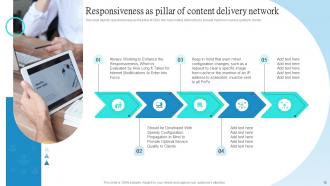
Slide 18: This slide shows Responsiveness as pillar of content delivery network.
Slide 19: This slide contains the Heading for the Ideas to be discussed further.
Slide 20: This slide explains the features of content delivery networks.
Slide 21: This slide mentions the Title for the Contents to be covered in the following template.
Slide 22: This slide explains the content delivery network architecture.
Slide 23: This slide demonstrates the working of content delivery network.
Slide 24: Thsi slide inidcates the Heading for the Topics to be discussed in the upcoming template.
Slide 25: This slide describes the scattered as a content delivery network topology.
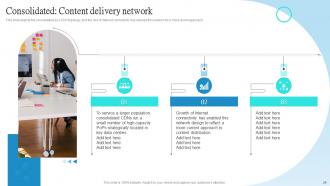
Slide 26: This slide depicts the consolidated as a CDN topology.
Slide 27: This slide includes the Title for the Topics to be covered in the next template.
Slide 28: This slide describes the CDN-supported cloud computing.
Slide 29: This slide demonstrates the response flow of cloud CDN in which origin servers must pass through an HTTP(s) load balancer.
Slide 30: This slide exhibits the Heading for the Contents to be discussed further.
Slide 31: This slide depicts the push zone as a content delivery network in which materials are uploaded to different servers.
Slide 32: This slide represents the pull zone as a type of content delivery network.
Slide 33: This slide highlights the Title for the Ideas to be covered in the forth-coming template.
Slide 34: This slide demonstrates introduction to CDN edge server.
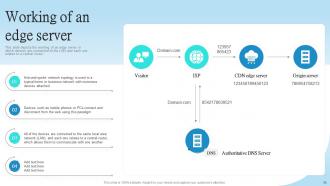
Slide 35: This slide displays the working of an edge server in which devices are connected to the LAN and each one relates to a central router.
Slide 36: This slide incorporates the Heading for the Ideas to be discussed in the following template.
Slide 37: This slide represents introduction to CDN caching.
Slide 38: This slide depicts types of CDN caching.
Slide 39: This slide includes the Title for the Contents to be covered further.
Slide 40: This slide depicts the attributes of a great CDN provider.
Slide 41: This slide shows how CDN providers help the business by reducing the server load and increasing the speed of analytics.
Slide 42: This slide represents the key CDN metrics to watch while looking for a CDN provider.
Slide 43: This slide portrays the top CDN cloud service providers.
Slide 44: This slide exhibits the Heading for the Topics to be discussed further.
Slide 45: This slide explains latency and how does CDN handles website times by reducing the distance between users and website resources.
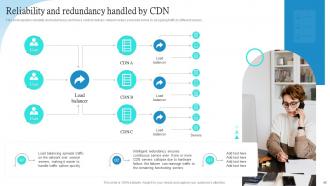
Slide 46: This slide presents reliability and redundancy and how a content delivery network keeps a website online.
Slide 47: This slide demonstrates how CDN protects data by issuing TLS/SSL certificates, blocking Bots and crawlers, and defending against DDoS assaults.
Slide 48: This slide reveals the Title for the Topics to be covered in the upcoming template.
Slide 49: This slide depicts the checklist for CDN implementation in the business.
Slide 50: This slide describes the implementation of a content delivery network in business.
Slide 51: This slide showcases the CDN training for employees in the company.
Slide 52: This slide demonstrates the company's budget for content delivery network implementation.
Slide 53: This slide includes the Heading for the Contents to be discussed in the following template.
Slide 54: This slide explains the increased performance post CDN implementation in the company.
Slide 55: This slide displays the graph about how bandwidth costs are reduced by 99% after the implementation of the content delivery network.
Slide 56: This slide explains reduced bandwidth costs post CDN implementation by paying only for the services that are utilized and are required.
Slide 57: This slide includes the Title for the Ideas to be covered next.
Slide 58: This slide depicts the 30-60-90 days plan for implementation of CDN.
Slide 59: This slide shows the Heading for the Ideas to be discussed further.
Slide 60: This slide represents the roadmap for the implementation of CDN in the company.
Slide 61: This slide elucidates the Title for the Components to be covered next.
Slide 62: This slide depicts the dashboard for content delivery network.
Slide 63: This slide shows a comparative dashboard for before and after CDN implementation.
Slide 64: This is the Icons slide containing all the Icons used in the plan.
Slide 65: This slide is used for revealing some Additional information.
Slide 66: This slide includes the Heading for the Topics to be discussed further.
Slide 67: This slide describes a content delivery network that states a geographically dispersed network of servers and data centers.
Slide 68: This slide displays the Title for the Topics to be covered in the forth-coming template.
Slide 69: This slide demonstrates the use cases of content delivery networks like CDN for online shopping, academic learning, and corporate sites.
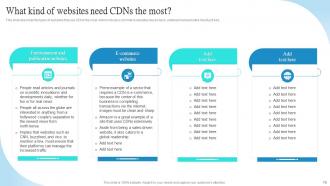
Slide 70: This slide describes the types of websites that use CDNs the most.
Slide 71: This slide presents the company's mission, vision, and goal.
Slide 72: This is the About us slide. State your company-related information here.
Slide 73: This slide presents the Location of the organization across the globe.
Slide 74: This slide elucidates the firm's Timeline.
Slide 75: This is the Magnifying glass for minute details.
Slide 76: This slide contains the Post it notes for reminders and deadlines.
Slide 77: This is the Puzzle slide with related iamgery.
Slide 78: This slide presents the company Roadmap.
Slide 79: This slide showcases the SWOT analysis.
Slide 80: This is the Idea generation slide for encouraging innovative ideas.
Slide 81: This is the Thank You slide for acknowledgement.
Cloud CDN Powerpoint Presentation Slides with all 86 slides:
Use our Cloud CDN Powerpoint Presentation Slides to effectively help you save your valuable time. They are readymade to fit into any presentation structure.


























FAQs for Cloud CDN
Cloud CDN benefits include faster content delivery, reduced server load, improved user experience, enhanced scalability, and global reach capabilities. These technologies streamline performance by caching content closer to users, minimizing latency, and ensuring reliable access, with many e-commerce and media organizations finding that CDNs ultimately deliver competitive advantage through faster load times.
A Cloud CDN improves website performance by caching content across geographically distributed servers, reducing latency, minimizing bandwidth usage, and accelerating data delivery to users worldwide. Through strategic edge server placement, businesses enhance user experiences with faster load times, reduced server strain, and improved scalability, while delivering significantly better performance for global audiences across industries.
Traditional CDNs rely on fixed physical infrastructure and manual scaling, while Cloud CDNs leverage elastic cloud resources, automated scaling, and integrated cloud services like storage and analytics. Cloud CDNs deliver enhanced flexibility, cost efficiency, and seamless integration with existing cloud architectures, enabling businesses to dynamically adjust capacity based on demand while reducing infrastructure overhead and operational complexity.
Cloud CDNs handle dynamic content through edge computing capabilities, real-time data processing, intelligent caching algorithms, and API acceleration techniques. These technologies streamline delivery by reducing server response times, optimizing database queries, and leveraging smart routing protocols, with many e-commerce platforms and financial services finding that dynamic content acceleration significantly enhances user experiences while maintaining data freshness.
Caching serves as the core mechanism of Cloud CDN functionality, storing frequently requested content like images, videos, CSS files, and JavaScript at strategically distributed edge servers worldwide. This approach dramatically reduces latency, minimizes bandwidth consumption, and decreases server load, with many e-commerce platforms and media companies finding that effective caching strategies ultimately deliver faster page loads and enhanced user experiences globally.
Cloud CDNs enhance security through DDoS protection, SSL/TLS encryption, Web Application Firewalls, bot mitigation, and geographic access controls. These distributed networks shield origin servers by filtering malicious traffic, encrypting data transmission, and blocking attacks at edge locations, with many e-commerce and banking platforms finding significantly reduced security incidents and faster threat response times.
Cloud CDN integration presents both immediate costs and long-term savings, with expenses including monthly usage fees, bandwidth charges, and potential setup costs, while delivering significant reductions in infrastructure expenses, server loads, and operational overhead. Many organizations find that improved site performance, reduced bounce rates, and enhanced user experiences ultimately generate revenue increases that far exceed CDN investment costs.
Cloud CDNs support scalability during traffic spikes by automatically distributing content across multiple edge servers, dynamically allocating bandwidth, and caching frequently requested data closer to users. This distributed architecture enables organizations to handle sudden surges seamlessly, with many e-commerce and media companies finding that CDNs reduce server load by up to 80%, ultimately delivering consistent performance and enhanced user experiences.
Static content like images, videos, CSS files, JavaScript libraries, and downloadable documents are best suited for Cloud CDN delivery. These content types benefit significantly from edge caching and global distribution, with media companies, e-commerce platforms, and software providers finding that CDNs dramatically reduce load times, minimize bandwidth costs, and enhance user experiences across diverse geographical locations.
Geographic distribution and latency directly impact CDN performance by determining how quickly content reaches users, with servers closer to end-users delivering significantly faster load times and reduced data transfer delays. Strategic global placement enables CDNs to minimize latency across regions, enhance user experiences through faster page loads, and deliver competitive advantages for businesses serving international audiences, ultimately improving customer satisfaction and retention rates.
Organizations should monitor latency reduction, cache hit ratios, bandwidth savings, origin server load reduction, and global response times to evaluate Cloud CDN effectiveness. These metrics enable businesses to assess user experience improvements, cost optimization, and infrastructure performance across different regions, with many enterprises finding that comprehensive monitoring ultimately delivers faster content delivery, reduced operational costs, and enhanced customer satisfaction in increasingly competitive digital markets.
Cloud CDN facilitates mobile content delivery by optimizing bandwidth usage, compressing images and files, and automatically adapting content formats for different mobile devices and screen sizes. Through strategically distributed edge servers, mobile users experience faster loading times, reduced data consumption, and seamless streaming experiences, while businesses deliver consistent performance across varying network conditions, ultimately enhancing customer satisfaction and engagement.
Yes, Cloud CDNs seamlessly integrate with various cloud services including storage solutions, computing platforms, analytics tools, load balancers, and security services through APIs and native connectors. This strategic combination enables organizations to streamline content delivery workflows, automate scaling processes, and enhance performance monitoring, with many enterprises finding that integrated CDN ecosystems deliver significantly improved operational efficiency and faster deployment cycles.
Common challenges when implementing Cloud CDN solutions include cache configuration complexity, origin server integration issues, SSL certificate management, geographic coverage gaps, and cost optimization difficulties. While these present initial hurdles, many organizations find that strategic planning and phased deployment ultimately streamline content delivery, reduce bandwidth costs, and enhance user experiences across global markets.
Cloud CDN significantly enhances SEO performance by reducing page load times, improving site speed scores, and delivering content from geographically optimized servers closer to users. These performance improvements directly boost search engine rankings, especially for mobile searches, while reducing bounce rates and increasing user engagement metrics that search algorithms prioritize for better visibility.
-
SlideTeam is the best in the business. Their templates are engaging and customizable. You can rely on them.
-
“The presentation template I got from you was a very useful one.My presentation went very well and the comments were positive.Thank you for the support. Kudos to the team!”