


Cloud Complexity Challenges And Solution Powerpoint Presentation Slides




Try Before you Buy Download Free Sample Product
 Impress Your
 Audience
 100%
100% Editable
 Save Hours
 of Time


This complete PowerPoint presentation provides strategies for the organizations to manage multi cloud complexity and successfully manage functions, automation, security, and regulations to take advantage of the multi cloud environment flexibility. Check out our professionally designed Cloud Complexity Challenges and Solution template. The main aim of this module is to implement different strategies and solutions to remove complexity from the multi-cloud environment. It covers a brief introduction to IT and the problems faced by the company due to complex multi cloud services, such as no decision making power regarding its services, the large amount spent on cloud services, etc. It also covers the solutions for visibility management in multi cloud, such as detailed response time analytics, identification of worst-performing apps, and many more. This presentation also includes a training schedule for IT professionals and a Cloud Management Platform that helps manage, optimize and govern the cloud with Data Protection Multi Cloud Data Encryption. It also covers the cost management dashboard interface along with the Removing Complexity and Cloud Performance Tracking Dashboard. Build a powerful template like this for yourself and book a free demo with our research team now.
People who downloaded this PowerPoint presentation also viewed the following :
Content of this Powerpoint Presentation
Slide 1: This slide introduces Cloud Complexity Challenges and Solution. State your company name and begin.
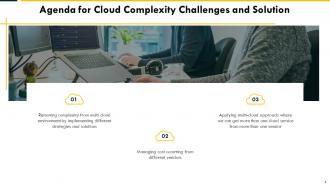
Slide 2: This slide states Agenda of the presentation.
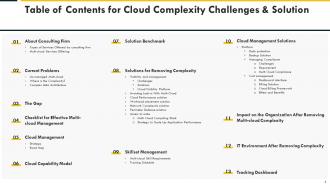
Slide 3: This slide presents Table of Content for the presentation.
Slide 4: This slide highlights title for topics that are to be covered next in the template.
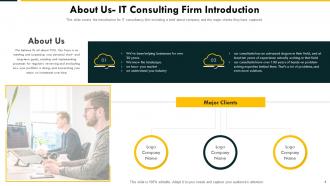
Slide 5: This slide displays the introduction for IT consultancy firm including a brief about company.
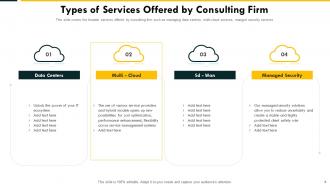
Slide 6: This slide represents Types of Services Offered by Consulting Firm.
Slide 7: This slide covers the services offered by the consulting firm for multi cloud solutions.
Slide 8: This slide highlights title for topics that are to be covered next in the template.
Slide 9: This slide showcases Problems Faced by Company due to Un-Managed Multi-Cloud.
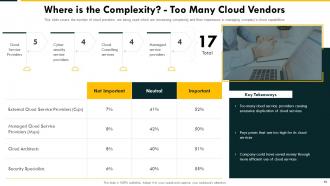
Slide 10: This slide shows increasing complexity and its importance in managing company’s cloud capabilities.
Slide 11: This slide presents current complex multi-cloud architecture with all their inherent complexity.
Slide 12: This slide highlights title for topics that are to be covered next in the template.
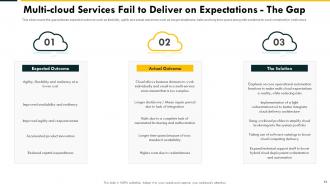
Slide 13: This slide covers the gap between expected outcome such as flexibility, agility and actual outcomes.
Slide 14: This slide displays Checklist for Effective Multi-Cloud Automation and Management.
Slide 15: This slide highlights title for topics that are to be covered next in the template.
Slide 16: This slide covers the strategies for cloud management such as cloud environment audits, cloud strategy, etc.
Slide 17: This slide represents roadmap for cloud management strategy implementation.
Slide 18: This slide highlights title for topics that are to be covered next in the template.
Slide 19: This slide showcases Cloud Capability Model for Strategy, Architecture and Governance.
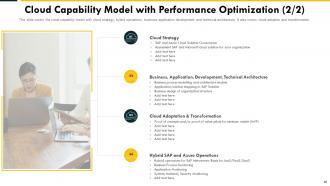
Slide 20: This slide presents Cloud Capability Model with Performance Optimization.
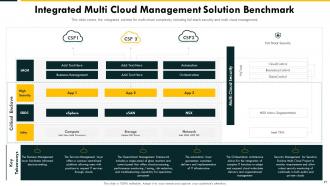
Slide 21: This slide displays Integrated Multi Cloud Management Solution Benchmark.
Slide 22: This slide highlights title for topics that are to be covered next in the template.
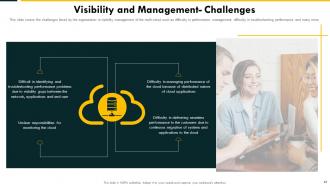
Slide 23: This slide represents challenges faced by the organization in visibility management of the multi-cloud.
Slide 24: This slide showcases solutions for visibility management in multi-cloud.
Slide 25: This slide covers the multi-cloud visibility platform infrastructure including on-premise data centers, cloud web servers and cloud platforms.
Slide 26: This slide highlights title for topics that are to be covered next in the template.
Slide 27: This slide shows Strategies to Avoid Lock-in with Multi-Cloud.
Slide 28: This slide presents performance challenges in multi-cloud architecture and solutions to overcome the challenges.
Slide 29: This slide displays Model for Workload Placement for On and Off Premises.
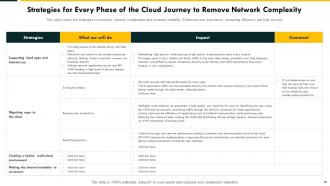
Slide 30: This slide represents strategies to overcome network complexities and increase reliability.
Slide 31: This slide covers Network that Prevent Cyber Attacks with a Software Defined Perimeter .
Slide 32: This slide highlights title for topics that are to be covered next in the template.
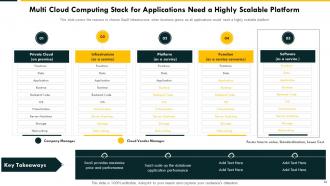
Slide 33: This slide shows reasons to choose SaaS infrastructure when business grows.
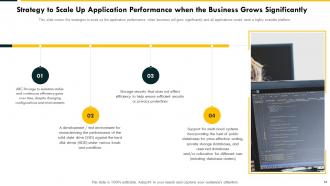
Slide 34: This slide presents Strategy to Scale Up Application Performance when the Business Grows Significantly.
Slide 35: This slide highlights title for topics that are to be covered next in the template.
Slide 36: This slide displays several roles found within multi-cloud teams.
Slide 37: This slide represents training schedule for IT professionals or staff to manage the multi-cloud environment.
Slide 38: This slide highlights title for topics that are to be covered next in the template.
Slide 39: This slide showcases Optimize and Govern the Cloud with Multi-Cloud Management Platform.
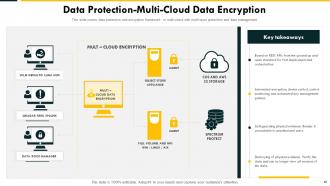
Slide 40: This slide covers data protection and encryption framework in multi-cloud.
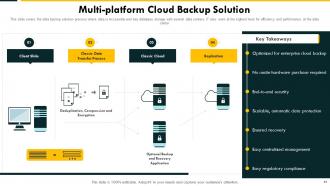
Slide 41: This slide shows the data backup solution process where data is Accessible.
Slide 42: This slide highlights title for topics that are to be covered next in the template.
Slide 43: This slide presents Challenges Faced by the Firm while Managing Policies in Multi Cloud Environment.
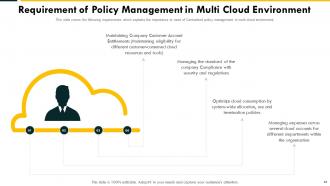
Slide 44: This slide displays Requirement of Policy Management in Multi Cloud Environment.
Slide 45: This slide represents Managing Compliance in Multi Cloud Environment.
Slide 46: This slide highlights title for topics that are to be covered next in the template.
Slide 47: This slide showcases Cost Management Dashboard in Cloud Management Platform.
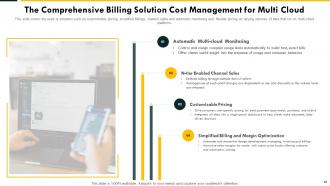
Slide 48: This slide covers the need or solutions such as customizable pricing, simplified billings, channel sales, etc.
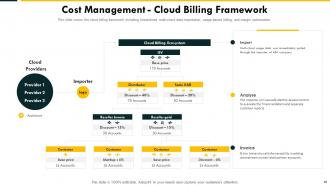
Slide 49: This slide shows the cloud billing framework including streamlined multi-cloud data importation.
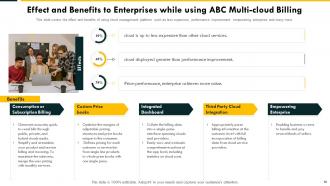
Slide 50: This slide presents Effect and Benefits to Enterprises while using ABC Multi-Cloud Billing.
Slide 51: This slide highlights title for topics that are to be covered next in the template.
Slide 52: This slide displays Impact on the Organization after Removing Multi-Cloud Complexity.
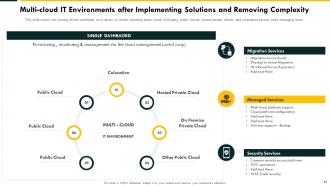
Slide 53: This slide represents the running all the workloads on a variety of clouds.
Slide 54: This slide showcases the Key performance indicators for tracking performance of the cloud.
Slide 55: This slide is titled as Additional Slides for moving forward.
Slide 56: This is Our Team slide with names and designation.
Slide 57: This is Our Mission slide with related imagery and text.
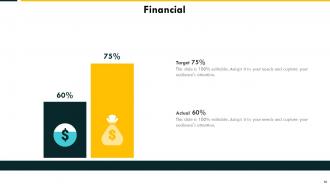
Slide 58: This is a Financial slide. Show your finance related stuff here.
Slide 59: This slide shows Post It Notes. Post your important notes here.
Slide 60: This is Our Target slide. State your targets here.
Slide 61: This slide shows Silhouettes with additional textboxes.
Slide 62: This slide contains Puzzle with related icons and text.
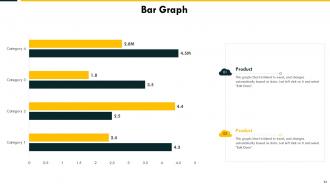
Slide 63: This slide presents Bar chart with two products comparison.
Slide 64: This is a Timeline slide. Show data related to time intervals here.
Slide 65: This is a Thank You slide with address, contact numbers and email address.
Cloud Complexity Challenges And Solution Powerpoint Presentation Slides with all 70 slides:
Use our Cloud Complexity Challenges And Solution Powerpoint Presentation Slides to effectively help you save your valuable time. They are readymade to fit into any presentation structure.
































FAQs for Cloud Complexity Challenges And Solution
Primary factors contributing to cloud complexity include multi-cloud environments, legacy system integration, data governance across platforms, security compliance requirements, and resource optimization challenges. These interconnected elements create operational overhead by requiring specialized expertise, increasing management costs, and complicating workflow automation, with many enterprises finding that strategic cloud architecture planning and centralized management tools ultimately streamline operations while delivering improved scalability.
Multi-cloud adoption intensifies complexity by creating fragmented architectures across different platforms, each with unique APIs, security protocols, and management interfaces. This strategic approach, while offering enhanced resilience and vendor flexibility, requires organizations to navigate disparate systems simultaneously, ultimately demanding sophisticated integration strategies and specialized expertise to maintain operational efficiency.
Cloud governance establishes frameworks for security policies, resource management, cost control, compliance standards, and access controls across multi-cloud environments. Through automated policy enforcement and centralized oversight, organizations streamline operations, reduce security risks, and optimize resource allocation, with many enterprises finding that robust governance ultimately delivers operational efficiency and regulatory compliance in increasingly complex cloud landscapes.
Organizations can effectively monitor cloud costs through automated cost management tools, real-time usage tracking, resource tagging, budget alerts, and regular cost audits. These approaches streamline financial oversight by providing granular visibility into spending patterns, identifying unused resources, and enabling proactive optimization, with many enterprises finding that strategic cost governance ultimately delivers 20-30% savings while maintaining operational efficiency.
Cloud architecture simplification requires implementing Infrastructure as Code, adopting microservices patterns, standardizing deployment processes, establishing clear governance frameworks, and leveraging automation tools. These practices streamline operations by reducing manual configurations, improving scalability, and enhancing system reliability, with many organizations finding that strategic standardization ultimately delivers faster deployment cycles and significantly lower operational overhead.
Network complexities significantly impact cloud application performance through latency issues, bandwidth limitations, routing inefficiencies, and connectivity disruptions between distributed components. These challenges can result in slower response times, degraded user experiences, and reduced operational efficiency, with many organizations finding that strategic network optimization and monitoring tools ultimately enhance application reliability and deliver competitive advantage.
Strategies include implementing zero-trust architecture, automated security monitoring, multi-layered encryption, identity and access management, and comprehensive compliance frameworks. These approaches streamline protection by centralizing visibility, automating threat detection, and standardizing security protocols across complex environments, with many organizations finding that integrated security platforms ultimately deliver reduced vulnerabilities and enhanced operational confidence.
Compliance requirements add complexity to cloud management by mandating stringent data governance, audit trails, and regulatory reporting across multiple jurisdictions and frameworks. Organizations must navigate GDPR, HIPAA, SOX, and industry-specific regulations while ensuring continuous monitoring, access controls, and documentation, with many enterprises finding that automated compliance tools ultimately streamline these processes and reduce operational overhead.
Cloud complexity affects business scalability by creating integration bottlenecks, increasing management overhead, and complicating resource allocation across multiple platforms and services. These challenges can slow deployment cycles, inflate operational costs, and require specialized expertise, with many organizations finding that streamlined cloud architectures ultimately enhance scalability through better automation, faster provisioning, and improved resource optimization.
Automation tools streamline cloud management by handling routine tasks like resource provisioning, scaling, monitoring, and maintenance automatically, significantly reducing manual intervention requirements. These solutions enable IT teams to focus on strategic initiatives rather than operational overhead, with many organizations finding that automated workflows deliver faster deployment times, improved consistency, and enhanced operational efficiency.
Cloud architecture visualization tools include AWS CloudFormation Designer, Microsoft Visio, Lucidchart, CloudCraft, and Terraform's graph visualization capabilities. These platforms streamline complex infrastructure management by providing real-time topology mapping, dependency tracking, and automated documentation, with many organizations finding that visual clarity reduces deployment errors and accelerates troubleshooting processes.
Legacy system integration significantly increases cloud complexity through compatibility issues, data migration challenges, security vulnerabilities, and hybrid infrastructure management requirements. Organizations often find that bridging decades-old mainframes with modern cloud platforms requires extensive middleware solutions, custom APIs, and specialized integration tools, ultimately demanding greater technical expertise while potentially creating performance bottlenecks.
IT teams should prioritize multi-cloud management, containerization technologies, automation scripting, security frameworks, and cost optimization strategies to navigate cloud complexity effectively. Through comprehensive training in Kubernetes, Infrastructure-as-Code, and cloud-native architectures, organizations streamline operations, enhance security protocols, and minimize resource waste, ultimately delivering faster deployment cycles and improved system reliability.
Organizations ensure effective collaboration in complex cloud environments through standardized communication protocols, unified project management platforms, cross-functional training programs, and shared documentation repositories. These approaches streamline coordination by establishing clear workflows, centralizing resource visibility, and enabling seamless knowledge transfer, with many enterprises finding that integrated collaboration tools ultimately reduce deployment times and enhance operational efficiency across distributed teams.
Latest cloud complexity trends include serverless computing, AI-driven automation, multi-cloud orchestration platforms, infrastructure-as-code, and containerization technologies like Kubernetes. These innovations streamline operations by automating resource management, simplifying deployments, and reducing manual oversight, with many organizations finding that strategic implementation ultimately delivers enhanced scalability and operational efficiency.
-
Great designs, really helpful.
-
Time saving slide with creative ideas. Help a lot in quick presentations..