Cloud computing in manufacturing industry cloud service models it
Try Before you Buy Download Free Sample Product
Audience
Editable
of Time
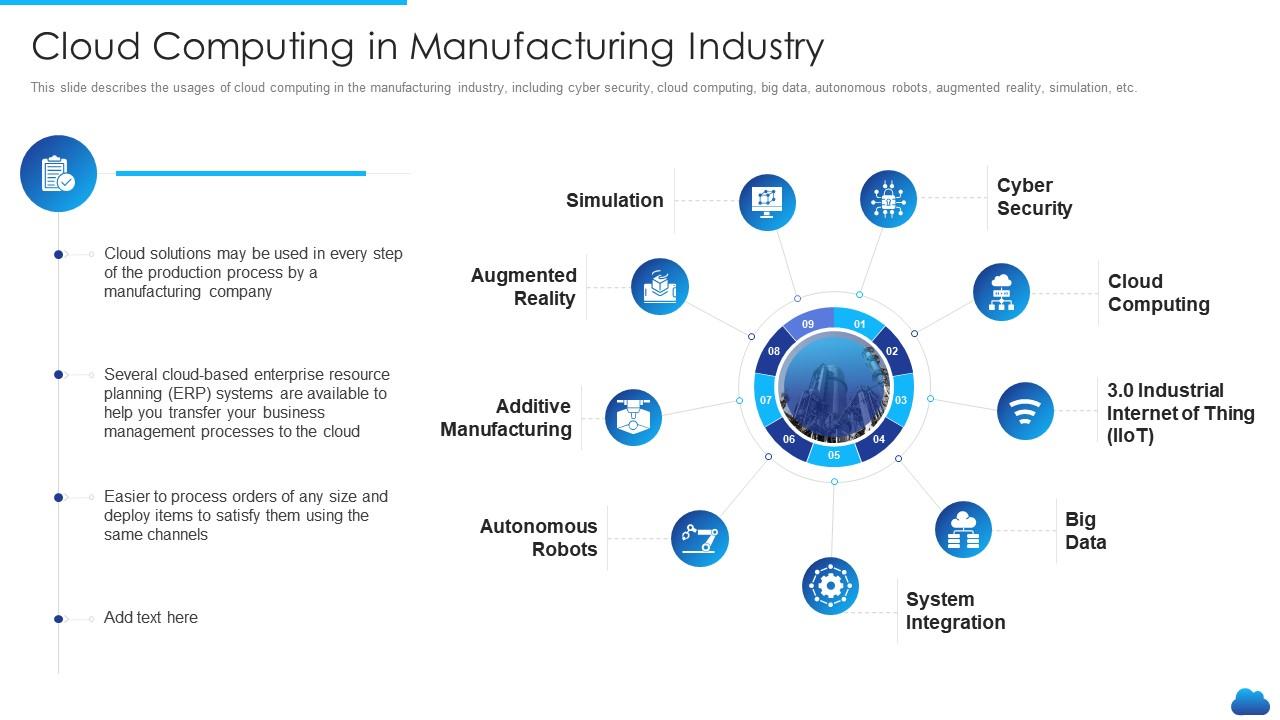
This slide describes the usages of cloud computing in the manufacturing industry, including cyber security, cloud computing, big data, autonomous robots, augmented reality, simulation, etc.
People who downloaded this PowerPoint presentation also viewed the following :
Cloud computing in manufacturing industry cloud service models it with all 9 slides:
Use our Cloud Computing In Manufacturing Industry Cloud Service Models It to effectively help you save your valuable time. They are readymade to fit into any presentation structure.
FAQs for Cloud computing in manufacturing industry cloud
Cloud computing enhances manufacturing data management by centralizing information storage, enabling real-time analytics, automating data backup processes, and facilitating seamless integration across production systems. Through cloud platforms, manufacturers streamline inventory tracking, quality control monitoring, and predictive maintenance scheduling, while reducing IT infrastructure costs and improving cross-facility collaboration, ultimately delivering faster decision-making and operational efficiency.
Cloud computing enables real-time monitoring by providing scalable data processing, instant connectivity across production facilities, centralized dashboard analytics, and seamless integration with IoT sensors and manufacturing equipment. Through cloud-based platforms, manufacturers streamline quality control, minimize downtime, and accelerate decision-making processes, with many automotive and electronics companies finding that cloud infrastructure ultimately delivers enhanced operational efficiency and competitive advantage.
Manufacturers ensure cloud security and compliance by implementing encryption protocols, multi-factor authentication, regular security audits, role-based access controls, and selecting certified cloud providers with industry-specific compliance standards. Through strategic partnerships with cloud vendors specializing in manufacturing environments, companies achieve enhanced data protection, streamlined regulatory reporting, and reduced cybersecurity costs, while maintaining operational flexibility and scalability in increasingly digital production landscapes.
Cloud-based manufacturing solutions deliver significant cost savings through reduced IT infrastructure expenses, minimized maintenance costs, lower energy consumption, eliminated hardware upgrades, and decreased staffing requirements. Manufacturing companies increasingly find that cloud transitions reduce operational costs by 20-30% while enabling scalable production management, predictive maintenance capabilities, and enhanced supply chain visibility, ultimately delivering competitive advantage through streamlined operations.
Cloud computing facilitates manufacturing collaboration by providing centralized data access, real-time communication platforms, and shared project management tools across departments and locations. Through cloud-based systems, engineering, production, quality control, and supply chain teams can simultaneously access design files, production schedules, and performance metrics, ultimately streamlining workflows and accelerating product development cycles.
Cloud computing revolutionizes manufacturing supply chain management by enabling real-time visibility, predictive analytics, enhanced collaboration, and automated inventory optimization across global networks. Through cloud-based platforms, manufacturers streamline procurement processes, reduce lead times, and improve demand forecasting accuracy, while suppliers gain seamless integration capabilities, ultimately delivering greater operational efficiency and competitive advantage.
Manufacturing operations benefit from all three cloud service models, each serving distinct operational needs. IaaS supports heavy computational workloads and data storage, PaaS enables custom application development for production systems, while SaaS delivers ready-made solutions for ERP, supply chain management, and quality control, with many manufacturers finding strategic combinations optimize both flexibility and efficiency.
Cloud computing enhances predictive maintenance by enabling real-time data processing, advanced analytics, and machine learning algorithms that analyze equipment patterns across manufacturing facilities. Through cloud platforms, manufacturers can predict failures more accurately, reduce unplanned downtime, and optimize maintenance schedules, with many finding that centralized data ultimately delivers significant cost savings and operational efficiency.
Manufacturers face integration challenges including legacy system compatibility, data security concerns, network connectivity requirements, employee training needs, and regulatory compliance issues. While these obstacles require strategic planning and investment, many manufacturing organizations find that phased implementation approaches, robust cybersecurity measures, and comprehensive staff development ultimately deliver enhanced operational efficiency and competitive advantage.
Machine learning and AI leverage cloud computing in manufacturing by enabling predictive maintenance, optimizing production schedules, and automating quality control processes through scalable data analytics. Through cloud-based AI platforms, manufacturers streamline operations, reduce downtime, and enhance product quality, with automotive and electronics companies finding that these technologies deliver significant cost reductions and competitive advantage.
Cloud computing in manufacturing delivers significant environmental benefits including reduced energy consumption, minimized hardware waste, optimized resource utilization, decreased carbon footprint, and enhanced operational efficiency. Through centralized data centers and virtualized infrastructure, manufacturers streamline operations while reducing physical server requirements, with many industrial companies finding that cloud adoption ultimately enables sustainable production practices and measurable environmental impact reductions.
Cloud computing enhances manufacturing customization by enabling real-time data analytics, scalable resource allocation, and seamless integration across production systems. Through cloud-based platforms, manufacturers can rapidly adjust production schedules, customize product configurations, and optimize supply chains, with automotive and electronics companies finding that cloud infrastructure delivers faster response times and competitive advantage.
**INPUT**: What are the best practices for migrating legacy manufacturing systems to the cloud? **OUTPUT**: Best practices include comprehensive system auditing, phased migration strategies, robust data backup protocols, security framework implementation, and staff training programs. These approaches streamline transitions by minimizing operational disruptions, ensuring data integrity, and maintaining production continuity, with many manufacturing organizations finding that strategic cloud migration ultimately delivers enhanced scalability and competitive advantage.
Cloud computing enhances manufacturing scalability by enabling flexible resource allocation, real-time data processing, and seamless integration across multiple facilities and supply chains. Through cloud-based platforms, manufacturers can rapidly expand production capacity, automate quality control processes, and optimize inventory management across global operations, ultimately delivering reduced operational costs and faster market responsiveness.
Future trends manufacturers should monitor include edge computing integration, AI-powered predictive analytics, hybrid multi-cloud strategies, enhanced cybersecurity protocols, and sustainable cloud infrastructure. These technologies streamline production processes, minimize downtime, and accelerate decision-making, with many manufacturing companies finding that early adoption of cloud innovations delivers significant operational efficiency and competitive advantage in increasingly digital markets.
-
Unique research projects to present in meeting.
-
Top Quality presentations that are easily editable.
-
Great product with effective design. Helped a lot in our corporate presentations. Easy to edit and stunning visuals.
-
Unique and attractive product design.