

Cmmi It Governance Framework Information And Communications Governance Ict Governance




Try Before you Buy Download Free Sample Product
 Impress Your
Audience
 100%
Editable
 Save Hours
of Time


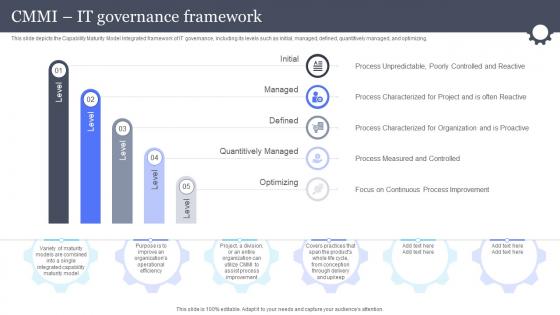
This slide depicts the Capability Maturity Model Integrated framework of IT governance, including its levels such as initial, managed, defined, quantitively managed, and optimizing.
People who downloaded this PowerPoint presentation also viewed the following :
Cmmi It Governance Framework Information And Communications Governance Ict Governance with all 6 slides:
Use our Cmmi It Governance Framework Information And Communications Governance Ict Governance to effectively help you save your valuable time. They are readymade to fit into any presentation structure.






FAQs for Cmmi It Governance Framework Information And Communications
CMMI's key components for IT governance include process standardization, capability maturity levels, continuous improvement frameworks, performance measurement systems, and organizational alignment structures. These components enhance governance by establishing clear accountability, streamlining decision-making processes, and ensuring consistent service delivery, with many financial institutions and healthcare organizations finding that higher CMMI maturity levels ultimately deliver reduced operational risks and improved regulatory compliance.
Organizations integrate CMMI practices into existing IT governance frameworks by aligning process improvement goals with governance objectives, mapping CMMI maturity levels to current governance structures, and establishing cross-functional teams to bridge methodologies. Through strategic integration, companies streamline compliance reporting, enhance risk management, and improve project visibility, with many financial services and healthcare organizations finding that this combination delivers stronger operational oversight and accelerated digital transformation outcomes.
CMMI facilitates risk management within IT projects by establishing structured identification processes, standardized assessment methodologies, and systematic mitigation strategies across all project phases. Through defined maturity levels, organizations can proactively monitor project vulnerabilities, implement consistent response protocols, and maintain comprehensive risk documentation, with many IT departments finding that this approach significantly reduces project failures while enhancing delivery predictability.
The CMMI maturity model enhances IT governance decision-making by establishing standardized processes, improving risk assessment capabilities, and creating data-driven evaluation frameworks that reduce subjective judgment errors. Through structured maturity levels, organizations streamline resource allocation, accelerate project approvals, and minimize operational risks, with many financial services and healthcare institutions finding that higher CMMI levels ultimately deliver faster strategic decisions and improved competitive positioning.
Stakeholder engagement in CMMI governance ensures alignment between IT initiatives and business objectives through systematic communication, feedback collection, and collaborative decision-making processes. This strategic involvement enables organizations to better prioritize resources, manage expectations, and deliver value-driven outcomes, with many enterprises finding that engaged stakeholders significantly improve project success rates and organizational maturity.
CMMI can effectively be applied to agile IT governance structures through adaptive frameworks that emphasize iterative process improvement, continuous feedback loops, and flexible governance models. Many organizations integrate CMMI's maturity levels with agile methodologies by implementing lightweight governance processes, cross-functional teams, and rapid decision-making structures, ultimately delivering enhanced operational efficiency while maintaining the strategic oversight and process discipline that competitive IT environments increasingly demand.
Organizations should track process compliance rates, defect reduction percentages, project delivery timelines, cost variance metrics, and customer satisfaction scores to measure CMMI effectiveness in IT governance. These metrics enable IT departments to demonstrate improved operational efficiency, reduced rework costs, and enhanced service delivery, with many financial services and healthcare organizations finding that systematic measurement ultimately delivers better risk management and competitive advantage.
CMMI addresses compliance and regulatory requirements through structured process documentation, standardized controls, and continuous monitoring frameworks that ensure adherence to industry standards like SOX, HIPAA, and ISO. These governance mechanisms streamline audit preparations, enhance risk management, and maintain regulatory transparency, with many financial services and healthcare organizations finding that CMMI's maturity levels significantly reduce compliance costs while strengthening operational oversight.
Organizations implementing CMMI for IT governance typically face resistance to process changes, resource allocation challenges, complex documentation requirements, and initial productivity slowdowns during transition periods. While these hurdles require significant organizational commitment, many enterprises find that systematic implementation through phased rollouts, comprehensive training programs, and executive sponsorship ultimately delivers enhanced operational efficiency, reduced project risks, and stronger regulatory compliance capabilities.
CMMI enhances IT service delivery by establishing structured governance frameworks that standardize processes, improve resource allocation, and ensure consistent quality metrics across all technology operations. Through these systematic approaches, organizations streamline incident management, accelerate project delivery, and minimize service disruptions, with many enterprises finding that standardized governance ultimately delivers faster resolution times and significantly improved customer satisfaction.
CMMI offers specialized adaptations including CMMI for Development (software engineering), CMMI for Services (IT service management), CMMI for Acquisition (vendor management), and sector-specific frameworks for healthcare, aerospace, and financial services. These adaptations enhance IT governance by addressing industry-specific compliance requirements, risk management protocols, and operational standards, with organizations finding improved regulatory adherence and streamlined processes.
CMMI promotes continuous improvement in IT governance through structured maturity levels, systematic process evaluation, and regular capability assessments that identify optimization opportunities. Through measurable benchmarks and standardized frameworks, organizations streamline governance oversight, enhance decision-making transparency, and minimize operational risks, with many IT departments finding that systematic capability building ultimately delivers more predictable project outcomes and strategic alignment.
CMMI supports IT-business alignment through structured process frameworks that establish clear requirements tracing, stakeholder engagement protocols, and performance measurement systems. These practices enable organizations to systematically validate project objectives against strategic goals, monitor delivery outcomes, and adjust resources accordingly, with many enterprises finding that CMMI's maturity levels ultimately deliver improved project success rates and enhanced business value realization.
CMMI implementation fundamentally transforms organizational culture by establishing systematic processes, clear accountability structures, and data-driven decision making frameworks within IT governance. This cultural shift enhances transparency, promotes continuous improvement mindsets, and enables cross-functional collaboration, with many organizations finding that teams become more proactive in risk management and strategic alignment, ultimately delivering stronger governance maturity and competitive advantage.
Organizations can adopt CMMI's process standardization, performance measurement frameworks, continuous improvement cycles, risk management protocols, and stakeholder engagement structures to strengthen IT governance. These practices enable systematic decision-making, enhanced operational transparency, and strategic alignment across IT functions, with many enterprises finding that structured maturity models ultimately deliver measurable efficiency gains and competitive advantage.
-
SlideTeam has helped me take my presentation to the next level. Everyone at the office is impressed! I’ll be using their designs for a long-long time.
-
I loved the hassle-free signup process. A few minutes and, I had this giant collection of beautiful designs.