

Cobit It Governance Framework Information And Communications Governance Ict Governance




Try Before you Buy Download Free Sample Product
 Impress Your
Audience
 100%
Editable
 Save Hours
of Time


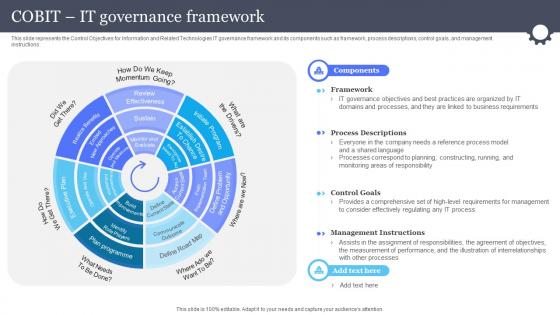
This slide represents the Control Objectives for Information and Related Technologies IT governance framework and its components such as framework, process descriptions, control goals, and management instructions.
People who downloaded this PowerPoint presentation also viewed the following :
Cobit It Governance Framework Information And Communications Governance Ict Governance with all 6 slides:
Use our Cobit It Governance Framework Information And Communications Governance Ict Governance to effectively help you save your valuable time. They are readymade to fit into any presentation structure.






FAQs for Cobit It Governance Framework Information And Communications
COBIT's primary goals include aligning IT with business objectives, managing IT-related risks, optimizing resource utilization, ensuring regulatory compliance, and delivering measurable value from technology investments. This framework enables organizations to establish governance structures that streamline decision-making, enhance operational efficiency, and maintain strategic control over IT processes, with many enterprises finding that it ultimately delivers competitive advantage through better-managed technology resources.
COBIT supports effective IT governance by providing structured frameworks for aligning IT objectives with business goals, establishing clear accountability, and implementing comprehensive risk management processes. Through its control objectives and maturity models, organizations can systematically evaluate IT performance, streamline decision-making processes, and ensure regulatory compliance, ultimately delivering improved operational efficiency and strategic competitive advantage.
COBIT 2019's key components include the governance system, governance framework, focus areas, design factors, and performance management. These components work together by enabling organizations to customize their IT governance approach, align technology investments with business objectives, and measure outcomes effectively, with many enterprises finding that this integrated approach delivers improved risk management, regulatory compliance, and strategic value realization.
COBIT facilitates risk management by providing structured frameworks for identifying, assessing, and mitigating IT-related risks while aligning governance with business objectives. Through its comprehensive risk assessment processes, organizations can systematically evaluate cybersecurity threats, operational vulnerabilities, and compliance gaps, ultimately delivering enhanced security posture and strategic risk oversight across enterprise operations.
Performance metrics in COBIT serve as essential measurement tools for evaluating IT governance effectiveness, tracking goal achievement, and ensuring alignment between IT and business objectives. These metrics enable organizations to monitor process maturity, assess resource utilization, and demonstrate value delivery, with many enterprises finding that systematic measurement drives continuous improvement and strategic decision-making across their governance frameworks.
Organizations align COBIT with frameworks like ITIL and ISO through strategic mapping of overlapping controls, shared governance structures, and integrated risk management processes. By harmonizing COBIT's governance focus with ITIL's service management and ISO's quality standards, companies streamline compliance efforts, reduce audit redundancies, and create comprehensive governance ecosystems that ultimately deliver enhanced operational efficiency and regulatory confidence.
COBIT implementation delivers enhanced IT governance through improved risk management, regulatory compliance, strategic alignment with business objectives, and streamlined operational efficiency. Organizations across sectors like banking and healthcare find that COBIT frameworks enable better resource allocation, faster decision-making processes, and stronger audit capabilities, ultimately providing competitive advantage through optimized IT performance.
COBIT addresses digital transformation demands by providing adaptive governance frameworks that align IT investments with business strategy, enable agile decision-making, and support emerging technologies like cloud computing and AI. Through its flexible design principles, organizations can streamline digital initiatives, enhance operational efficiency, and maintain regulatory compliance while accelerating innovation, with many enterprises finding that COBIT's scalable approach delivers competitive advantage in increasingly complex digital landscapes.
Organizations face challenges including resistance to change, resource constraints, complexity of implementation, lack of skilled personnel, and difficulty measuring ROI when adopting COBIT. While these obstacles can seem daunting, many enterprises find that strategic phased implementation, executive sponsorship, and comprehensive training enable successful governance transformation, ultimately delivering enhanced compliance, operational efficiency, and competitive advantage.
COBIT helps ensure regulatory compliance by establishing comprehensive governance frameworks, standardizing control processes, and creating audit-ready documentation that aligns with regulatory expectations. Through systematic risk management and continuous monitoring capabilities, organizations streamline compliance reporting, reduce regulatory violations, and demonstrate accountability to auditors, ultimately delivering operational transparency and competitive advantage in increasingly regulated business environments.
COBIT design factors enable organizations to customize governance frameworks based on their unique enterprise strategy, goals, risk profile, IT-related issues, and threat landscape. These factors ensure governance systems align with specific business contexts, regulatory requirements, and organizational maturity levels, with many enterprises finding that tailored approaches deliver significantly better outcomes than generic implementations, ultimately enhancing strategic alignment and operational effectiveness.
COBIT promotes stakeholder engagement through structured governance frameworks that establish clear communication channels, defined roles and responsibilities, and regular reporting mechanisms across all organizational levels. These frameworks enable organizations to align IT objectives with business goals, facilitate transparent decision-making processes, and ensure consistent stakeholder involvement in governance activities, ultimately delivering enhanced accountability and strategic alignment.
COBIT 2019 differs from COBIT 5 through enhanced design factors, expanded governance objectives, and streamlined implementation guidance, while incorporating updated focus areas like digital transformation and cybersecurity. The newer framework delivers improved customization capabilities, clearer performance management structures, and more comprehensive stakeholder alignment, with many organizations finding that COBIT 2019 enables faster governance implementation and better strategic outcomes.
Organizations measure COBIT implementation success through key performance indicators like improved governance maturity scores, enhanced regulatory compliance rates, reduced IT-related risks, and stronger alignment between IT investments and business objectives. Many enterprises track metrics such as faster audit processes, decreased security incidents, and improved stakeholder confidence, with financial services and healthcare sectors finding that measurable governance improvements ultimately deliver competitive advantage and operational efficiency.
COBIT drives value creation by aligning IT investments with business objectives, improving risk management, enhancing operational efficiency, and ensuring regulatory compliance. Through structured governance frameworks, organizations streamline decision-making processes, optimize resource allocation, and accelerate digital transformation initiatives, with many enterprises finding that COBIT ultimately delivers measurable ROI and sustainable competitive advantage.
-
I was never satisfied with my own presentation design but SlideTeam has solved that problem for me. Thank you SlideTeam!
-
I’ve been your client for a few years now. Couldn’t be more than happy after using your templates. Thank you!