

Collection Of Quality Control Seven Basic Quality Control Tools





Try Before you Buy Download Free Sample Product
 Impress Your
Audience
 100%
Editable
 Save Hours
of Time


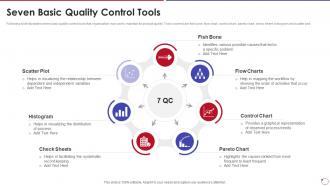
Following slide illustrates seven basic quality control tools that organization may use to maintain its product quality. Tools covered are fish bone, flow chart, control chart, pareto chart, check sheet, histogram and scatter plot.
People who downloaded this PowerPoint presentation also viewed the following :
Collection Of Quality Control Seven Basic Quality Control Tools with all 6 slides:
Use our Collection Of Quality Control Seven Basic Quality Control Tools to effectively help you save your valuable time. They are readymade to fit into any presentation structure.





FAQs for Collection Of Quality Control Seven Basic
Honestly, start with SPC charts - they catch problems before they get expensive. Control charts and checklists are everywhere too, basically the bread and butter of QC. Pareto charts are clutch when you're drowning in issues and need to prioritize. For digging deeper, fishbone diagrams work great for root cause stuff. Don't overlook basic tools like flowcharts and histograms either - sometimes simple works best. Most places now have automated inspection too, vision systems and all that fancy measuring equipment. But seriously, if you're just starting out, nail down SPC first. Everything else builds from there.
So Six Sigma gives your quality control a real game plan instead of just winging it when stuff breaks. You follow this DMAIC thing - Define, Measure, Analyze, Improve, Control - and it basically tells you which tools to grab at each step. Way better than guessing, honestly. The whole thing runs on actual data instead of just "this feels right" decisions. I'd start by figuring out what's driving you the most crazy quality-wise, then see which Six Sigma tools would actually fix it. My old manager swore by this approach and it really did cut down on the chaos.
Think of SPC as your heads-up system for quality problems. You're monitoring processes live with control charts instead of just checking stuff after it's done - which honestly makes way more sense. When things start going off track, you'll catch it right away rather than finding defects later. Pick your most important process factors first and throw up some basic control charts. I was skeptical at first, but you'd be surprised how fast you start spotting issues. Way better than the old "inspect everything at the end" approach we used to do.
So QC is basically catching problems after you've made stuff - testing and inspecting finished products. QA's the opposite though, it's preventing issues by fixing your processes upfront. I always think of it like QC = "oops, this is broken" and QA = "let's make sure nothing breaks." One's reactive, the other's proactive. Honestly, most companies do better when they use both together instead of just one. I'd start by figuring out where you're already doing quality checks, then work backwards to see which earlier steps could use some process improvements.
Look, root cause analysis saves you from constantly fighting the same fires over and over. Why keep mopping up water when you could just fix the damn pipe, you know? The whole point is digging past surface symptoms to find what's actually broken underneath. Once you nail down the real problem, you stop wasting time and money on the same defects popping up again. My go-to trick is asking "why" five times in a row - sounds simple but it works surprisingly well. You'll end up with way stronger processes instead of just slapping temporary fixes on everything.
Honestly, QC tools are game-changers for keeping customers happy. They catch problems before stuff ships out, so you get way fewer angry calls and returns. Basic things like checklists or tracking your processes can cut complaints by like 40-60% - I've watched it happen. Happy customers leave better reviews and actually come back. Oh, and they tell their friends too, which is huge. Start simple though. Figure out where things usually go wrong in your process, then just pick one tool to tackle your worst problem. Don't overthink it.
Honestly, tech can be a game changer for QC - way faster and more accurate than doing everything manually. I'd start small though, maybe digitize your defect tracking first? Automated data collection saves you tons of time, and statistical software catches patterns you'd totally miss. Real-time monitoring is clutch because it alerts you immediately instead of finding problems later. Oh and digital dashboards are great since your whole team can see quality metrics instantly. Trust me, once you automate just one process you'll wonder why you waited so long to make the switch.
So defect rate and first-pass yield are your bread and butter - basically how many products bomb inspection vs. how many sail through without fixes. Customer complaints are huge too because honestly, they'll spot stuff you totally missed internally. Don't sleep on cost of quality either (prevention, appraisal, failure costs). Cycle time for quality checks matters but maybe track that later? I'd nail down these basics first, then you can dive into the fancy statistical control charts once you've got a solid foundation going.
Yeah, it totally depends on your industry's risks. Manufacturing uses statistical process control and Six Sigma to catch defects early. Healthcare? They're all about compliance audits and patient safety protocols - which honestly makes sense when people's lives are at stake. Food companies rely on HACCP systems for contamination tracking. Software teams do automated testing and code reviews. But the basic idea's always the same - stop problems before customers see them. I'd check out what the big players in your field are doing first, then build from there.
So Poka-Yoke is basically mistake-proofing your processes - you design things so errors can't happen in the first place. Way better than catching problems later. USB cables are the perfect example since they only go in one way (took them long enough to figure that out). Instead of inspecting for defects, you're preventing them entirely. Saves you tons of headaches and money. Look at where people mess up most in your process, then think of simple changes that make those mistakes literally impossible. It's honestly pretty satisfying once you get the hang of it.
Dude, team training is seriously what makes or breaks whether people actually use quality control tools. Everyone gets on the same page with processes, so you don't have those annoying mix-ups later. People won't fight new tools if they know how to use them - nobody wants to look clueless at work, you know? I'd start with hands-on workshops using the real tools they'll touch every day. That way they can mess around and ask stupid questions upfront. Honestly, I've seen so many rollouts fail just because they skipped proper training. Makes people way more likely to buy in too.
Oh man, people are gonna hate the change - that's like 90% of your problem right there. Everyone's stuck in their ways even when those ways suck. Training eats up so much time initially, plus you're basically juggling two systems at once which is a nightmare. Technical stuff will break - software won't play nice, data gets messy during migration. Honestly though? Don't go big right away. Pick one small area, nail it there first, then people will actually see it works. Way easier to convince the skeptics once you've got some wins under your belt.
Honestly, ISO standards basically tell you what tools you need by laying out what you're supposed to measure. Take ISO 9001 - you'll need something to track when things go wrong, measure if customers are happy, monitor how your processes are doing. Statistical software, feedback systems, that kind of stuff. The documentation requirements alone will determine if you go digital or stick with manual tracking (though who does manual anymore, right?). My advice? Figure out which ISO standards apply to you first. Then just pick tools that actually help you hit those specific quality goals. Makes way more sense than buying random software and hoping it works.
So quality control tools are pretty much what makes continuous improvement actually work - without them you're just guessing. Control charts, fishbone diagrams, Pareto analysis... they help you figure out what's really causing problems instead of just treating symptoms. Can't fix what you can't see, you know? The data shows you if your fixes are actually doing anything or if you're wasting time. Honestly, I've seen too many teams collect tons of metrics but never act on them. Pick tools that fit your specific mess and actually use what they tell you to make real decisions.
Track your defect rates and customer complaints - that's the obvious stuff. But honestly, if your team hates using the tools, you're screwed regardless of what the numbers say. Survey them monthly about whether this stuff actually helps or just creates more work. Compare everything to your baseline from like 6-12 months back. Cycle times matter too - good QC shouldn't slow you down. The real win? Catching problems way earlier instead of finding them at the end. I'd start with maybe 3 metrics max and check them monthly. Don't overcomplicate it.
-
Great quality slides in rapid time.
-
Great quality slides in rapid time.