

Common Conflict Scenarios And Strategies To Mitigate Powerpoint Presentation Slides





Try Before you Buy Download Free Sample Product
 Impress Your
Audience
 100%
Editable
 Save Hours
of Time


Workplace conflict is inevitable when employees of various backgrounds and work styles are brought together. Grab our Common Conflict Scenarios and Strategies to Mitigate template. It is efficiently designed to help you avoid such conflicts. Our Workplace conflict scenarios decks primary goal is to help companies resolve interpersonal disputes. This will ultimately strengthen team dynamics, boost employee morale, lower absenteeism, and increase output. It includes a section where managers can emphasize how unresolved team conflict affects the businesss financial success. There are also some typical job conflict situations and solutions for corporations. Additionally, our Interpersonal conflicts module can help companies resolve employee disputes by developing an internal plan or enlisting outside help. The module concludes by showcasing a key performance indicator KPI dashboard that enables businesses to assess the effects of dispute resolution tactics on their workforce and overall performance. Access this effective design right away.
People who downloaded this PowerPoint presentation also viewed the following :
Content of this Powerpoint Presentation
Slide 1: This slide introduces Common conflict scenarios and strategies to mitigate. Commence by stating Your Company Name.
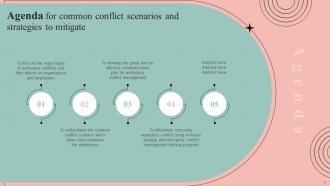
Slide 2: This slide depicts the Agenda of the presentation.
Slide 3: This slide incorporates the Table of Contents.
Slide 4: This slide highlights the Title for the Topics to be discussed next.
Slide 5: This slide deals with the Current trends related to workplace and interpersonal conflicts.
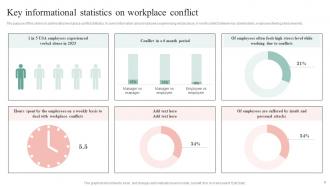
Slide 6: This slide outlines the Key informational statistics on workplace conflict.
Slide 7: This slide contains the Heading for the Components to be discussed further.
Slide 8: This slide Defines the phases of workplace conflict.
Slide 9: This slide continues Defining the phases of workplace conflict.
Slide 10: This slide shows the Title for the Ideas to be discussed next.
Slide 11: This slide addresses the various conflicts at workplace.
Slide 12: This is yet another slide continuing the various conflicts at workplace.
Slide 13: The purpose of this slide is to outline several reasons of workplace conflict.
Slide 14: This slide focuses on Identifying conflicts amongst various organizational departments.
Slide 15: This slide mentions the Heading for the Ideas to be discussed in the forth-coming template.
Slide 16: This slide elucidates the General consequences of unresolved workplace conflicts.
Slide 17: The purpose of this slide is to outline the consequences of workplace conflict on employees physical and mental health.
Slide 18: This slide talks about the conflict impact on organizational financial performance.
Slide 19: This slide focuses on Calculating the total cost of workplace conflict.
Slide 20: This slide indicates the Title for the Components to be covered in the upcoming template.
Slide 21: The purpose of this slide is to outline workplace conflict scenario highlighting the overview of starting on a bad terms with new co-worker.
Slide 22: The purpose of this slide is to portray a conflict scenario where co-worker send some piece of urgent work after office hours.
Slide 23: This slide presents a workplace conflict scenario where things get awkward between team members.
Slide 24: This slide exhibits the Heading for the Topics to be discussed next.
Slide 25: This slide deals with Selecting the goals for workplace conflict management.
Slide 26: This slide contains the Title for the Topics to be covered in the following template.
Slide 27: This slide emphasizes on Developing an effective communication plan to address workplace conflict.
Slide 28: This slide mentions the Heading for the Components to be covered in the following slide.
Slide 29: The purpose of this slide is to outline major conflict management skills which can be used by the manager to foster positive environment in the organization.
Slide 30: This slide reveals the Ways of improving conflict management skills.
Slide 31: This slide talks about Selecting the best conflict management strategy.
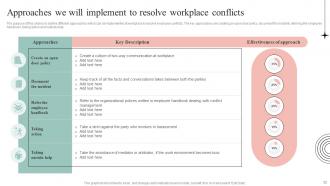
Slide 32: This slide highlights the Approaches we will implement to resolve workplace conflicts.
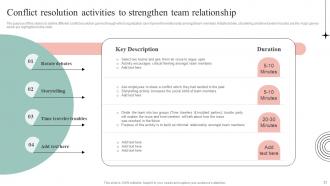
Slide 33: The purpose of this slide is to outline different conflict resolution games through which organization can improve the relationship amongst team members.
Slide 34: This slide represents the Management role in resolving workplace conflict.
Slide 35: This slide incorporates the Title for the Contents to be discussed next.
Slide 36: This slide exhibits the Need for third-party conflict management training program.
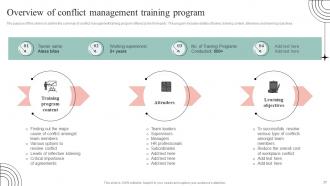
Slide 37: This slide depicts the Overview of conflict management training program.
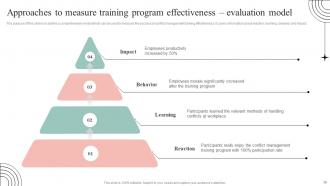
Slide 38: This slide showcases the Approaches to measure training program effectiveness – evaluation model.
Slide 39: This slide illustrates the Approaches to measure training program effectiveness – Survey form.
Slide 40: This slide mentions the Heading for the Topics to be covered in the following template.
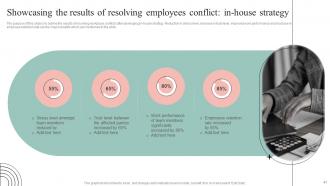
Slide 41: The purpose of this slide is to outline the results of resolving workplace conflicts after developing in-house strategy.
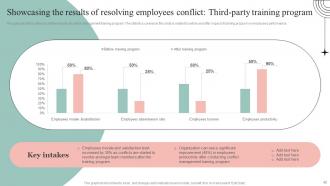
Slide 42: This slide focuses on Showcasing the results of resolving employees conflict: Third-party training program.
Slide 43: This slide elucidates the Title for the Ideas to be discussed further.
Slide 44: This slide portrays the Key benefits post resolving conflicts at workplace.
Slide 45: This slide elucidates the KPI metrics dashboard post resolving workplace conflict.
Slide 46: This is the Icons slide containing all the Icons used in the plan.
Slide 47: This slide presents some Additional information.
Slide 48: This slide highlights the Major types of workplace conflict.
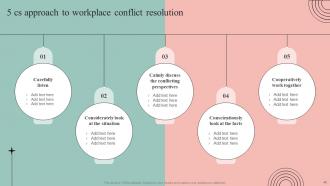
Slide 49: This slide exhibits the 5'cs approach to workplace conflict resolution.
Slide 50: This slide displays the Healthy vs unhealthy workplace conflict.
Slide 51: This slide reveals the Do’s and don’ts of resolving workplace dispute.
Slide 52: This slide depicts the SWOT analysis.
Slide 53: This slide portrays the Staked column chart.
Slide 54: This slide presents the Venn diagram slide.
Slide 55: This slide elucidates the Company Roadmap.
Slide 56: This slide contains the Post it notes.
Slide 57: This slide exhibits the Linear process.
Slide 58: This is the Thank You slide for acknowledgement.
Common Conflict Scenarios And Strategies To Mitigate Powerpoint Presentation Slides with all 63 slides:
Use our Common Conflict Scenarios And Strategies To Mitigate Powerpoint Presentation Slides to effectively help you save your valuable time. They are readymade to fit into any presentation structure.


















FAQs for Common Conflict Scenarios And Strategies To Mitigate
Common sources of team conflict include unclear roles and responsibilities, resource competition, communication breakdowns, differing work styles, and conflicting priorities or deadlines. These issues frequently emerge in cross-functional projects, remote teams, and matrix organizations, where overlapping responsibilities and competing demands create tension, ultimately requiring proactive management strategies to maintain productivity and collaboration.
Active listening techniques help resolve disputes by demonstrating respect, building trust, and ensuring all parties feel heard and understood. Through techniques like paraphrasing, asking clarifying questions, and maintaining eye contact, mediators and managers can de-escalate tensions, uncover underlying concerns, and facilitate collaborative solutions, ultimately transforming workplace conflicts into opportunities for stronger relationships.
Emotional intelligence enables effective conflict resolution by enhancing self-awareness, empathy, and communication skills, allowing individuals to manage their emotions while understanding others' perspectives. Through improved emotional regulation and social awareness, organizations streamline workplace disputes, reduce team tensions, and foster collaborative solutions, with many companies finding that emotionally intelligent leaders ultimately deliver stronger relationships and higher productivity.
Understanding cultural differences aids conflict resolution by revealing underlying communication styles, value systems, decision-making approaches, and relationship expectations that often drive disagreements. Through cultural competency training, organizations enhance cross-functional collaboration, reduce workplace tensions, and accelerate project timelines, with many multinational companies finding that culturally-informed mediation delivers faster resolutions and stronger team cohesion.
Effective negotiation strategies for conflict resolution include active listening, identifying shared interests, separating people from problems, generating multiple options, and using objective criteria for decisions. These approaches streamline resolution by building trust, reducing emotional tension, and creating collaborative solutions, with many organizations finding that structured negotiation ultimately delivers faster agreements and stronger long-term relationships.
Creating a collaborative environment involves establishing clear communication channels, defining shared goals and expectations, promoting psychological safety, and implementing regular feedback mechanisms. Through structured team-building activities and transparent decision-making processes, organizations enhance trust and mutual respect, while encouraging diverse perspectives and open dialogue, ultimately reducing misunderstandings and fostering productive workplace relationships.
The key steps in mediation include opening statements, issue identification, interest exploration, option generation, and agreement drafting. This structured approach enables organizations to resolve workplace disputes, contract negotiations, and stakeholder conflicts efficiently, with many companies finding that mediation reduces legal costs, preserves business relationships, and delivers faster resolutions than traditional litigation processes.
Body language significantly impacts conflict resolution by conveying openness, defensiveness, or aggression through posture, gestures, and facial expressions, often communicating more than words themselves. Open postures, maintained eye contact, and relaxed gestures help de-escalate tensions in workplace disputes, customer service interactions, and team negotiations, ultimately building trust and facilitating more productive dialogue outcomes.
Conflict resolution styles include competing, accommodating, avoiding, compromising, and collaborating approaches, each suited for different organizational scenarios and power dynamics. Competing works for urgent decisions requiring quick action, accommodating helps preserve relationships when stakes are low, avoiding suits minor issues, compromising enables mutual concessions, while collaborating delivers optimal outcomes when time allows, ultimately enhancing workplace efficiency and team cohesion.
Constructive feedback during conflicts requires focusing on specific behaviors rather than personal attributes, using "I" statements to express impact, and timing delivery when emotions are regulated. This approach enables clearer communication, reduces defensiveness, and facilitates mutual understanding, with many organizations finding that structured feedback processes ultimately enhance team collaboration and conflict resolution outcomes.
**INPUT**: What tools or frameworks can assist in analyzing conflicts? **OUTPUT**: Conflict analysis tools include stakeholder mapping, root cause analysis, conflict trees, SWOT analysis, and negotiation frameworks like Harvard's principled negotiation model. These methodologies streamline resolution processes by identifying underlying issues, mapping relationships, and structuring dialogue pathways, with many organizations finding that systematic analysis ultimately delivers faster resolutions and sustainable agreements. [Word count: 55 words]
Escalation becomes necessary when direct dialogue fails repeatedly, conflicts impact broader team productivity, or involve policy violations, harassment, or legal concerns. Through structured assessment of severity, duration, and stakeholder impact, managers can identify when situations require HR intervention, senior leadership involvement, or external mediation, ultimately preserving organizational harmony and preventing costly disruptions.
Effective conflict resolution delivers improved team collaboration, enhanced productivity, reduced employee turnover, stronger workplace relationships, and increased organizational trust. These outcomes streamline operations by minimizing disruptions, accelerating decision-making processes, and fostering innovation through diverse perspectives, with many organizations finding that sustained conflict management ultimately creates competitive advantages and higher employee satisfaction.
Technology facilitates conflict resolution through AI-powered mediation platforms, video conferencing systems, collaborative document sharing, sentiment analysis tools, and automated scheduling systems. These solutions streamline communication by enabling remote participation, tracking dialogue patterns, and providing neutral digital spaces, with many organizations finding that virtual mediation reduces costs while improving accessibility and outcomes.
Power dynamics significantly influence interpersonal conflicts by affecting communication patterns, decision-making authority, resource access, and negotiation leverage between parties. These imbalances often escalate tensions in workplace hierarchies, family relationships, and team environments, with many organizations finding that addressing power disparities through structured mediation, clear communication protocols, and equitable conflict resolution processes ultimately delivers improved relationships and enhanced collaborative outcomes.
-
I am really satisfied with their XYZ products. Used their slides for my business presentations and now I am taking their help for my son's high-school assignments. Super satisfied!!
-
Wow! The design and quality of templates on SlideTeam are simply the best.