

Communication Meetings Types And Agenda Plan





Try Before you Buy Download Free Sample Product
 Impress Your
Audience
 100%
Editable
 Save Hours
of Time


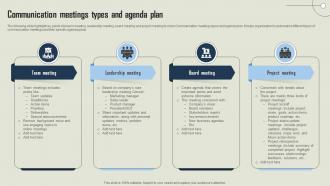
The following slide highlight key points like team meeting, leadership meeting, board meeting and project meeting to show Communication meetings types and agenda plan. It helps organization to understand different types of communication meetings and their specific agenda plans.
People who downloaded this PowerPoint presentation also viewed the following :
Communication Meetings Types And Agenda Plan with all 9 slides:
Use our Communication Meetings Types And Agenda Plan to effectively help you save your valuable time. They are readymade to fit into any presentation structure.








FAQs for Communication Meetings Types
Non-verbal communication significantly influences presentation effectiveness through body language, facial expressions, gestures, posture, and eye contact, often conveying more impact than spoken words alone. These elements enhance audience engagement, build speaker credibility, and reinforce key messages, with many presenters finding that confident posture and purposeful gestures ultimately deliver stronger connections and more persuasive outcomes.
Active listening enhances professional communication by demonstrating respect, building trust, reducing misunderstandings, and encouraging open dialogue between colleagues and clients. Through focused attention, thoughtful questioning, and reflective responses, professionals in sectors like consulting, healthcare, and finance create stronger relationships, resolve conflicts more effectively, and ultimately deliver better collaborative outcomes.
Tailoring messages to diverse audiences involves analyzing demographics, cultural backgrounds, communication preferences, literacy levels, and technological access patterns. These strategies enhance engagement by adapting tone, language complexity, visual elements, and delivery channels appropriately, with many organizations finding that personalized approaches significantly improve message retention, response rates, and ultimately deliver stronger stakeholder connections across varied demographic segments.
Technology revolutionizes workplace communication by enabling instant messaging, video conferencing, collaborative platforms, and real-time document sharing across global teams. Through cloud-based systems and mobile integration, organizations streamline information flow, reduce email dependency, and enhance remote collaboration, with many companies finding that these tools significantly improve productivity while reducing operational costs and communication delays.
Key components include clear messaging hierarchy, consistent visual design, compelling storytelling structure, audience-appropriate content, and strategic use of multimedia elements. These components work together by establishing credibility through professional aesthetics, enhancing comprehension through logical flow, and maintaining engagement through varied visual formats, with many presenters finding that strategic visual consistency ultimately delivers stronger audience retention and more persuasive outcomes.
Emotional intelligence enhances team communication by enabling members to recognize emotional cues, respond empathetically to concerns, and navigate interpersonal conflicts more effectively. Through improved self-awareness and social skills, teams experience reduced misunderstandings, stronger collaborative relationships, and increased psychological safety, with many organizations finding that emotionally intelligent teams deliver faster project outcomes and higher employee engagement.
Effective presentation anxiety techniques include thorough preparation, visualization exercises, controlled breathing methods, rehearsing with trusted colleagues, and reframing nervousness as excitement. These approaches streamline mental preparation by building confidence, reducing physical symptoms, and creating positive associations, with many professionals finding that consistent practice and strategic preparation ultimately deliver enhanced performance and stronger audience connections.
Storytelling enhances presentation communication by creating emotional connections, simplifying complex information, and improving audience retention through relatable narratives and memorable frameworks. Through structured storytelling techniques, presenters deliver more engaging content, facilitate better understanding of key messages, and ultimately achieve stronger audience buy-in, with many organizations finding that story-driven presentations significantly increase persuasion and recall rates.
Common communication barriers include language differences, cultural misunderstandings, technological limitations, hierarchical structures, and emotional biases. These challenges can be overcome by implementing clear communication protocols, providing cross-cultural training, and leveraging collaborative technologies, with many organizations finding that structured feedback systems and regular team meetings ultimately enhance transparency and operational efficiency.
Effective feedback integration requires establishing clear channels, timing feedback appropriately, creating psychological safety, and ensuring two-way dialogue throughout communication cycles. Organizations across sectors like healthcare, manufacturing, and financial services find that structured feedback loops, regular check-ins, and digital collaboration tools streamline communication flow, ultimately enhancing team alignment and operational efficiency.
Clarity and conciseness in verbal communication eliminate misunderstandings, enhance message retention, and accelerate decision-making processes across organizational levels. These principles streamline meetings, improve client interactions, and boost team productivity, with many businesses finding that clear, concise communication reduces project timelines and ultimately delivers stronger stakeholder engagement and competitive advantage.
Cultural differences significantly impact communication through varying directness levels, nonverbal interpretations, hierarchical expectations, and relationship-building approaches. While some cultures prioritize explicit messaging and efficiency, others emphasize context and diplomatic exchanges, with many multinational organizations finding that cultural awareness training and adaptive communication strategies ultimately enhance collaboration, reduce misunderstandings, and deliver stronger global partnerships.
Body language can either reinforce verbal messages through aligned gestures, posture, and facial expressions, or contradict them when physical cues signal different intentions. In professional settings like sales presentations, boardroom meetings, and client interactions, consistent body language enhances credibility and trust, while misaligned signals can undermine message effectiveness, ultimately impacting business relationships and communication outcomes.
Developing persuasive presentation skills involves mastering storytelling techniques, understanding audience psychology, using compelling visuals, practicing vocal variety, and structuring arguments with clear evidence. Through strategic narrative frameworks and data visualization, professionals enhance audience engagement, build stronger stakeholder buy-in, and ultimately deliver more impactful presentations that drive decision-making and business outcomes.
Effective remote team collaboration strategies include regular video check-ins, structured asynchronous communication channels, clear project documentation, virtual brainstorming sessions, and dedicated social interaction time. These approaches streamline workflows by establishing consistent touchpoints, maintaining transparency, and building personal connections, with many distributed organizations finding that combining scheduled and informal communication ultimately delivers stronger team cohesion and faster project outcomes.
-
I was really impressed with the presentation I created with their templates. I’ll be using their services moving forward.
-
Placing an order on SlideTeam is very simple and convenient, saves you a lot of your time.