


Community Bank Overview Powerpoint Presentation Slides




Try Before you Buy Download Free Sample Product
 Impress Your
 Audience
 100%
100% Editable
 Save Hours
 of Time


Showcase banking industry trends and statistics with the help of our content ready Community Bank Overview Powerpoint Presentation Slides. The commercial bank PowerPoint complete deck includes ready to use PPT slides such as US banking structure, banking organizational hierarchy, income statement, balance sheet, banking industry overview, key US banking industry statistics, major trends in the US banking industry, leading US banks by revenue, key growth drivers United States banking industry, federal bank regulation in the US, services offered to customers, loan categories, types of loans, headquarters and overseas location, banking SWOT analysis, banking environment PESTEL analysis, porter's five forces model, revenue projections, etc. Utilize the visually appealing banking industry outline to present banking services, loan categories and types of loans. Furthermore, financial institutions overview PPT visuals are completely customizable. You can add or delete the content if needed. Download this professionally designed presentation deck to present key growth drivers of the banking industry in an impressive manner. Hold your hand up with our Community Bank Overview Powerpoint Presentation Slides. Get hand-picked to accomplish the task.
People who downloaded this PowerPoint presentation also viewed the following :
Content of this Powerpoint Presentation
Slide 1: This slide introduces Community Bank Overview. State Your Company Name and begin.
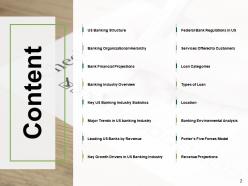
Slide 2: This slide shows Content of the presentation.
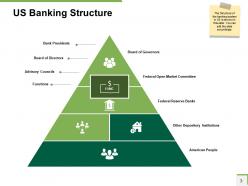
Slide 3: This slide presents US Banking Structure with related diagram.
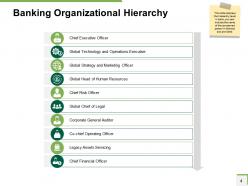
Slide 4: This slide displays Banking Organizational Hierarchy with designations.
Slide 5: This slide represents Income statement for FY 17-18. You can add values and variables accordingly.
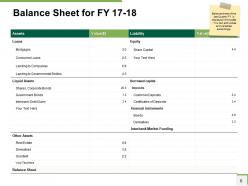
Slide 6: This slide showcases Balance Sheet for FY 17-18.
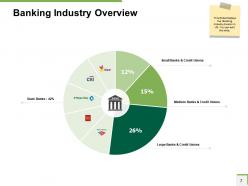
Slide 7: This slide shows Banking Industry Overview with the help of donut pie chart.
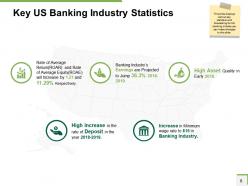
Slide 8: This slide presents Key US Banking Industry Statistics.
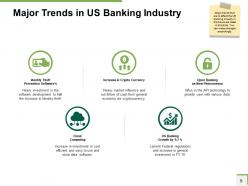
Slide 9: This slide displays Major Trends in US Banking Industry.
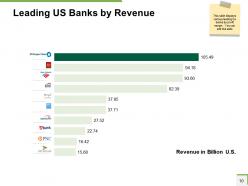
Slide 10: This slide represents Leading US Banks by Revenue in graphical form.
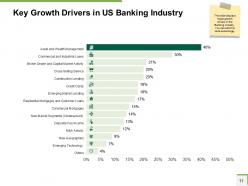
Slide 11: This slide showcases Key Growth Drivers in US Banking Industry.
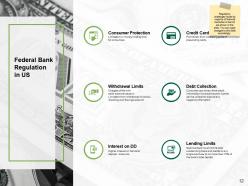
Slide 12: This slide shows Federal Bank Regulation in US describing- Credit Card, Debt Collection, Lending Limits, Interest on DD, Consumer Protection, Withdrawal Limits.
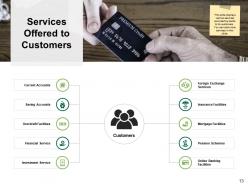
Slide 13: This slide displays various services provided by banks to its customers.
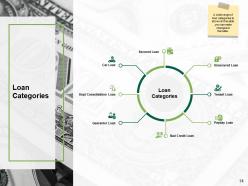
Slide 14: This slide presents wide range of Loan Categories.
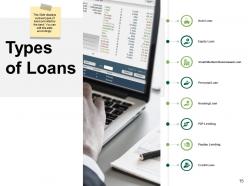
Slide 15: This slide represents Types of Loan including- Auto Loan, Housing Loan, Equity Loan, P2P Lending, Small Medium Businesses Loan, Payday Lending, Personal Loan, Credit Loan.
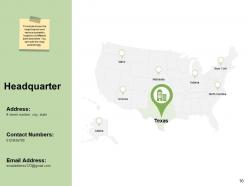
Slide 16: This slide showcases Headquarter of the bank with address, contact numbers and email address.
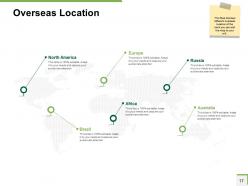
Slide 17: This slide shows Overseas Location of banks with map.
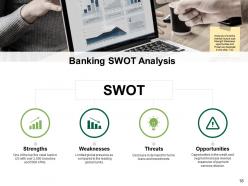
Slide 18: This slide presents Banking SWOT Analysis describing- Weaknesses, Threats, Opportunities, Strengths.
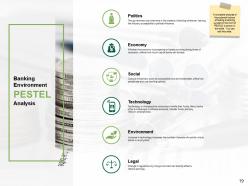
Slide 19: This slide displays Banking Environment PESTEL Analysis describing- Politics, Economy, Social, Technology, Environment, Legal.
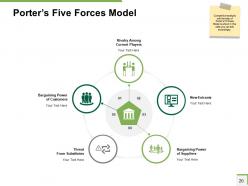
Slide 20: This slide represents Porter’s Five Forces Model as New Entrants, Threat form substitutes, Bargaining power of suppliers, Rivalry among current players, Bargaining power of customers.
Slide 21: This slide showcases Revenue Projections in graphical form.
Slide 22: This slide displays Banking Icons.
Slide 23: This slide reminds about a 15 minutes coffee break.
Slide 24: This slide is titled as Additional Slides for moving forward.
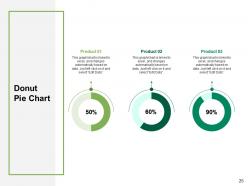
Slide 25: This slide displays Donut Pie Chart with data in percentage.
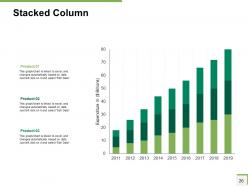
Slide 26: This slide shows Stacked Column chart with three products comparison.
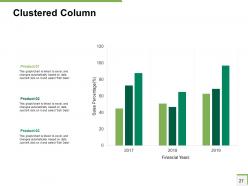
Slide 27: This slide presents Clustered Column chart with three products comparison.
Slide 28: This is Our Mission slide with related icons and text boxes.
Slide 29: This is Meet Our Team slide with names and designation.
Slide 30: This is About Us slide to show company specifications.
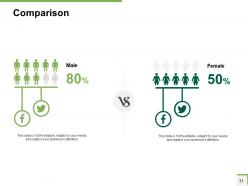
Slide 31: This is a Comparison slide to state comparison between commodities, entities etc.
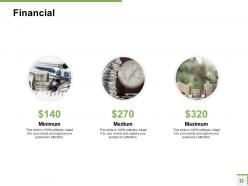
Slide 32: This is a Financial slide. Show your finance related stuff here.
Slide 33: This is a Quotes slide to convey message, beliefs etc.
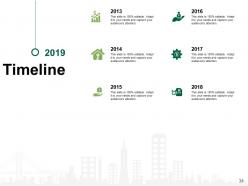
Slide 34: This is a Timeline slide to show information related with time period.
Slide 35: This slide is titled as Post It Notes. Post your important notes here.
Slide 36: This is a Puzzle slide with text boxes.
Slide 37: This is a Target slide. State your targets here.
Slide 38: This is a Venn slide with text boxes to show information.
Slide 39: This is a Lego slide with additional text boxes.
Slide 40: This is a Bulb or Idea slide to state a new idea or highlight information, specifications etc.
Slide 41: This slide shows Mind Map for representing entities.
Slide 42: This is a Thank You slide with address, contact numbers and email address.
Community Bank Overview Powerpoint Presentation Slides with all 42 slides:
Come across as a genuine champion with our Community Bank Overview Powerpoint Presentation Slides. Be able to brave all the difficulties.









FAQs for Community Bank Overview
Community banks prioritize serving local communities through personalized financial services, relationship-based banking, and supporting regional economic development, unlike larger institutions focused on maximizing shareholder returns and national market share. These banks deliver tailored lending solutions, faster decision-making, and deeper customer relationships, with many communities finding that local banks better understand regional business needs and provide more flexible, responsive financial services.
Community banks contribute to local economic development by providing accessible credit to small businesses, supporting local entrepreneurs, and reinvesting deposits within their communities through targeted lending programs. These institutions foster economic growth by financing local real estate projects, agricultural ventures, and startup enterprises that larger banks often overlook, ultimately strengthening regional employment and enabling community-based businesses to expand and thrive.
Community banks offer personalized relationship banking, local decision-making on loans, customized financial solutions for small businesses, agricultural lending expertise, and deep community involvement through local sponsorships. These institutions streamline services by understanding regional economic needs, providing faster loan approvals, and delivering tailored customer experiences, with many small businesses finding that community banks offer more flexible terms and responsive support than larger institutions.
Community banks engage through local lending to small businesses and residents, sponsoring community events, participating in economic development initiatives, supporting local nonprofits, and maintaining personalized customer relationships. These institutions strengthen their communities by keeping deposits local, funding hometown projects, and providing accessible financial education, with many community banks finding that deep local involvement creates lasting customer loyalty and drives sustainable growth.
Community banks emphasize relationship-based lending, focusing on local market knowledge, personalized service, and flexible underwriting criteria that consider borrower character and circumstances beyond standard metrics. While commercial banks rely heavily on automated systems and standardized criteria, community banks leverage personal relationships and local expertise to make nuanced lending decisions, ultimately delivering faster approvals and customized solutions for small businesses and individuals.
Community banks face challenges including regulatory compliance costs, competition from fintech companies, cybersecurity threats, talent acquisition difficulties, and pressure to modernize legacy technology systems. These institutions must balance maintaining personalized customer relationships with operational efficiency, while many smaller banks find that strategic partnerships with technology providers and focused community engagement ultimately deliver sustainable competitive advantages.
Technology has revolutionized community bank operations by automating loan processing, enhancing customer service through digital platforms, streamlining regulatory compliance, and enabling data-driven decision making. These digital transformations allow smaller institutions to compete effectively with larger banks, delivering faster loan approvals, 24/7 banking services, and personalized financial solutions while significantly reducing operational costs.
Community banks promote financial literacy through personalized financial counseling, educational workshops, youth savings programs, small business mentoring, and digital literacy training. These institutions leverage their deep community connections and local expertise to deliver tailored financial education, with many community banks finding that enhanced financial literacy ultimately strengthens their client relationships while fostering long-term economic development within their local markets.
Community banks assess small business loan risk through comprehensive credit analysis, cash flow evaluation, collateral assessment, management team review, and local market knowledge. These institutions leverage their deep community relationships and understanding of local economic conditions to make nuanced decisions, often considering factors like business reputation and community ties alongside traditional metrics, ultimately delivering more personalized lending approaches.
Community banks face unique regulatory challenges including complex compliance requirements relative to their size, limited resources for regulatory staff, frequent examination cycles, and disproportionate costs for implementing new regulations designed for larger institutions. These challenges often require community banks to allocate significant operational resources toward compliance rather than customer service and lending, with many institutions finding strategic partnerships and technology solutions help streamline regulatory processes while maintaining competitive advantages.
Community banks tailor their products by conducting local market research, offering flexible lending criteria, providing personalized customer service, and developing region-specific financial solutions. Through direct community engagement and relationship-based banking, these institutions create customized loan programs, specialized savings accounts, and targeted business services, ultimately delivering more responsive financial products that reflect local economic conditions and consumer preferences.
Community banks can foster stronger relationships through personalized service, local decision-making, community involvement, flexible lending approaches, and direct access to senior management. These strategies enable banks to understand individual customer needs, respond quickly to local market conditions, and build trust through consistent face-to-face interactions, ultimately delivering enhanced customer loyalty and competitive advantage in an increasingly digital banking landscape.
Community banks ensure local business sustainability by offering personalized lending services, flexible loan terms, relationship-based banking, local market expertise, and tailored financial solutions. Through deep community connections and streamlined decision-making processes, these institutions enable faster loan approvals, customized credit arrangements, and ongoing financial guidance, ultimately delivering enhanced cash flow management and strategic growth support that larger banks often cannot match.
Community banks play a crucial role in financial inclusion by serving underbanked populations, offering personalized lending decisions, providing accessible branch locations in rural areas, and maintaining flexible underwriting standards. These institutions bridge gaps that larger banks often overlook, with many community banks finding that their local market knowledge and relationship-focused approach enables them to extend credit and banking services to small businesses and individuals who might otherwise lack access to traditional financial services.
Community banks support sustainable and ethical investing by offering ESG-focused investment products, partnering with local renewable energy projects, and providing financing for environmentally responsible businesses. Through personalized advisory services, these institutions help clients align portfolios with values while supporting community development initiatives, ultimately delivering competitive returns alongside positive social impact for local stakeholders.
No Reviews