

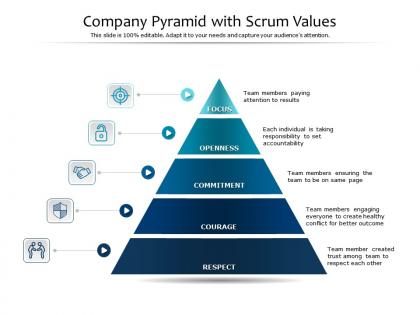
Company pyramid with scrum values




Try Before you Buy Download Free Sample Product
 Impress Your
 Audience
 100%
100% Editable
 Save Hours
 of Time


Our Company Pyramid With Scrum Values are topically designed to provide an attractive backdrop to any subject. Use them to look like a presentation pro.
People who downloaded this PowerPoint presentation also viewed the following :
Company pyramid with scrum values with all 2 slides:
Use our Company Pyramid With Scrum Values to effectively help you save your valuable time. They are readymade to fit into any presentation structure.
FAQs for Company pyramid
The core Scrum values include commitment, courage, focus, openness, and respect, which collectively shape how teams collaborate and deliver value. These values influence team dynamics by fostering transparent communication, encouraging calculated risk-taking, and promoting shared accountability, with many organizations finding that teams practicing these principles demonstrate enhanced productivity, stronger collaboration, and ultimately deliver higher-quality products.
Transparency within a company pyramid enhances Scrum practices by enabling clear communication across hierarchical levels, fostering trust between teams and leadership, and ensuring alignment on project goals and priorities. This openness streamlines decision-making processes, reduces organizational silos, and empowers teams with better visibility into business objectives, ultimately delivering faster sprint cycles and more effective stakeholder collaboration.
Courage manifests in Scrum teams through transparent communication about project risks, challenging unrealistic deadlines, admitting knowledge gaps, and making difficult technical decisions under pressure. Team members demonstrate courage by providing honest sprint retrospectives, escalating impediments to stakeholders, and pushing back on scope creep, ultimately enabling better project outcomes and fostering organizational trust.
Respect among team members enhances Scrum productivity by fostering open communication, encouraging diverse perspectives, and creating psychological safety for risk-taking and innovation. Through mutual respect, Scrum teams collaborate more effectively on complex problem-solving, reduce time spent on conflict resolution, and maintain higher engagement levels, ultimately delivering faster sprint completions and higher-quality products.
Commitment ensures team dedication to sprint goals while aligning individual efforts with broader organizational objectives, creating accountability throughout the company pyramid. This Scrum value enables consistent delivery by fostering ownership at every level, from development teams to executive leadership, ultimately streamlining goal achievement and enhancing organizational transparency across departments.
Companies foster openness by encouraging transparent communication, creating psychological safety for sharing failures, and implementing regular feedback mechanisms like retrospectives and open forums. Through structured practices such as daily standups, sprint reviews, and cross-functional collaboration, organizations enable honest dialogue about challenges and improvements, ultimately delivering enhanced team trust and more effective Scrum outcomes.
Common challenges include resistance to transparency from middle management, difficulty shifting from command-and-control to servant leadership, conflicts between traditional approval processes and Scrum's iterative approach, and cultural misalignment with self-organizing teams. These integration obstacles often surface in established organizations like financial services and manufacturing, where hierarchical decision-making clashes with Scrum's collaborative values, ultimately requiring strategic change management and leadership commitment.
Leadership actively promotes Scrum values by modeling transparency through open communication, demonstrating respect in team interactions, showing courage in difficult decisions, maintaining focus on strategic priorities, and fostering commitment through consistent support. Through regular coaching sessions, removing organizational impediments, and celebrating team achievements, leaders create psychological safety that enables teams to embrace these values naturally, ultimately delivering enhanced collaboration, faster problem resolution, and stronger organizational agility in increasingly complex project environments.
Daily Scrum practices include transparent sprint reviews, collaborative retrospectives, open cross-functional communication, regular stakeholder feedback sessions, and continuous team self-organization. These approaches streamline value delivery by fostering accountability, encouraging honest problem-solving, and maintaining focus alignment, with many organizations finding that consistent daily standups and visible progress tracking ultimately enhance team cohesion and accelerate project outcomes.
Scrum values align with company mission and vision by fostering transparency, respect, and commitment that directly support organizational goals, creating a unified culture where teams work collaboratively toward shared objectives. When companies integrate courage, focus, and openness into their strategic framework, they enable faster decision-making, improved innovation, and enhanced customer satisfaction, ultimately delivering competitive advantage in increasingly dynamic markets.
Applying Scrum values at different company levels enhances collaboration, transparency, and adaptability across the organizational hierarchy, from executive leadership to front-line teams. This strategic implementation streamlines decision-making processes, improves cross-functional communication, and accelerates project delivery, with many organizations finding that consistent value application ultimately delivers better customer experiences and competitive advantage.
Accountability within Scrum teams drives company success by fostering ownership of deliverables, transparent progress reporting, and commitment to sprint goals and quality standards. This creates a cascading effect throughout organizational hierarchies, with teams consistently delivering value, reducing project risks, and enabling faster time-to-market, ultimately enhancing competitive advantage and operational efficiency.
Training to reinforce Scrum values includes interactive workshops, role-playing exercises, retrospective sessions, cross-functional team collaborations, and mentoring programs with experienced Scrum practitioners. These approaches enhance understanding by combining theoretical knowledge with practical application, enabling employees to embody commitment, courage, focus, openness, and respect while ultimately delivering improved project outcomes and stronger team dynamics.
Scrum values can be assessed through team retrospectives, peer feedback surveys, sprint review evaluations, stakeholder satisfaction metrics, and behavioral observation frameworks that measure commitment, courage, focus, openness, and respect. Through regular pulse surveys and performance indicators, organizations streamline value alignment across teams, enhance collaboration effectiveness, and deliver improved project outcomes, with many companies finding that systematic measurement ultimately strengthens their agile transformation and competitive advantage.
Companies like Spotify, ING Bank, and Microsoft have successfully transformed their cultures through Scrum values, with Spotify's autonomous squads demonstrating commitment and courage, while ING's agile transformation enhanced transparency and respect across teams. These organizations achieved faster product delivery, improved employee engagement, and enhanced customer satisfaction, with many finding that embedding openness and focus throughout their corporate hierarchy ultimately delivers competitive advantage and operational efficiency.
No Reviews