

Comparative Analysis Of OT Cyber Security Solutions




Try Before you Buy Download Free Sample Product
 Impress Your
Audience
 100%
Editable
 Save Hours
of Time


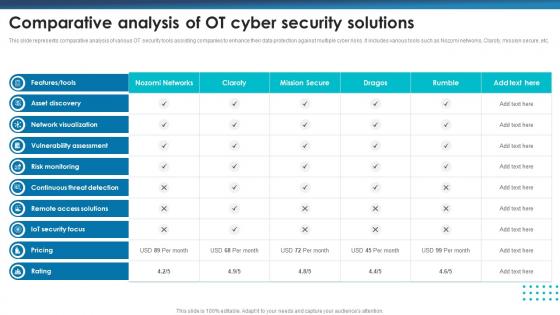
This slide represents comparative analysis of various OT security tools assisting companies to enhance their data protection against multiple cyber risks. It includes various tools such as Nozomi networks, Claroty, mission secure, etc.
People who downloaded this PowerPoint presentation also viewed the following :
Comparative Analysis Of OT Cyber Security Solutions with all 9 slides:
Use our Comparative Analysis Of OT Cyber Security Solutions to effectively help you save your valuable time. They are readymade to fit into any presentation structure.









FAQs for Comparative Analysis Of OT
IT cybersecurity frameworks focus on data confidentiality and network protection, while OT frameworks prioritize operational continuity, safety, and real-time system availability. OT environments require specialized approaches for legacy systems, air-gapped networks, and critical infrastructure protocols, with manufacturing plants and power grids finding that traditional IT security models can disrupt essential operations.
Organizations can assess their OT cybersecurity posture through comprehensive network discovery, vulnerability assessments, asset inventories, risk evaluations, and security maturity benchmarking. These assessments enable manufacturers, utilities, and energy companies to identify critical gaps, prioritize remediation efforts, and establish baseline security metrics, ultimately delivering enhanced operational resilience and regulatory compliance in increasingly connected industrial environments.
Primary threats facing operational technology environments include advanced persistent threats, ransomware attacks, insider threats, legacy system vulnerabilities, and supply chain compromises. These cybersecurity challenges significantly impact critical infrastructure sectors like manufacturing, energy, and utilities, with many organizations finding that outdated systems and network convergence create expanding attack surfaces, ultimately requiring comprehensive security frameworks to protect operational continuity and business resilience.
IoT integration significantly expands OT attack surfaces by introducing numerous connected endpoints, creating new vulnerabilities through diverse protocols, and increasing data transmission points across networks. While this connectivity enhances operational visibility and automation capabilities, organizations must implement robust segmentation, continuous monitoring, and updated security frameworks to protect critical infrastructure, with many manufacturers finding that strategic IoT deployment ultimately delivers competitive operational advantages.
Employee training plays a crucial role in OT cybersecurity by building awareness of industrial-specific threats, establishing proper security protocols, and creating human firewalls against social engineering attacks. Through comprehensive education programs, manufacturing plants, power grids, and water treatment facilities significantly reduce security incidents, enhance incident response capabilities, and strengthen overall operational resilience, ultimately delivering safer industrial environments and improved business continuity.
Real-time monitoring solutions enhance OT cybersecurity by providing continuous network visibility, instant threat detection, and automated anomaly identification across industrial systems. Through advanced analytics and machine learning, manufacturers and utilities can detect unauthorized access, unusual device behavior, and potential cyberattacks within minutes rather than weeks, ultimately minimizing operational disruptions and protecting critical infrastructure.
Best practices for incident response in OT environments include establishing dedicated response teams, implementing network segmentation, maintaining offline backups, developing communication protocols, and conducting regular tabletop exercises. These practices enable organizations to quickly isolate affected systems, maintain critical operations, and restore services with minimal downtime, with many industrial facilities finding that proactive incident planning significantly reduces recovery time and operational impact.
Regulatory standards significantly influence OT cybersecurity by mandating specific security frameworks, compliance protocols, and risk assessment procedures across critical infrastructure sectors. Industries like energy, manufacturing, and utilities must implement stringent cybersecurity measures to meet standards such as NERC CIP and IEC 62443, ultimately driving enhanced operational resilience and regulatory compliance.
Essential technologies for securing legacy OT systems include network segmentation solutions, protocol gateways, intrusion detection systems, asset discovery tools, and security monitoring platforms. These technologies enhance protection by creating isolated network zones, translating between legacy and modern protocols, and providing continuous visibility into OT environments, with many manufacturing and utility organizations finding that strategic implementation significantly reduces cyber risk while maintaining operational continuity.
Collaboration between IT and OT security teams is crucial for comprehensive industrial cybersecurity, as converged networks require unified threat detection, incident response protocols, and risk management strategies. This partnership enables organizations to address vulnerabilities spanning enterprise systems and industrial controls, ultimately delivering enhanced operational resilience, faster threat mitigation, and stronger protection against sophisticated attacks targeting critical infrastructure.
Organizations can protect against OT ransomware through network segmentation, regular system backups, employee training, vulnerability assessments, and incident response planning. These comprehensive security measures work by isolating critical systems, ensuring rapid recovery capabilities, and maintaining operational continuity, with many manufacturing and energy companies finding that layered defenses significantly reduce attack success rates while preserving business operations.
Securing multi-vendor OT environments presents challenges including incompatible security protocols, fragmented visibility across systems, inconsistent patch management cycles, and diverse communication standards. These complexities often create security gaps, with many manufacturing and energy organizations finding that strategic integration platforms and unified monitoring solutions help streamline oversight, enhance threat detection, and ultimately deliver comprehensive protection across heterogeneous industrial networks.
Risk assessments identify critical vulnerabilities, operational dependencies, and potential business impacts across industrial systems, enabling organizations to allocate security resources strategically. Through comprehensive evaluation of legacy equipment, network architectures, and safety protocols, manufacturing facilities, power plants, and chemical processing companies can focus investments on high-priority assets, ultimately delivering enhanced operational resilience and regulatory compliance.
Emerging technologies shaping OT cybersecurity include AI-driven threat detection, zero-trust network architectures, edge computing security frameworks, quantum-resistant encryption, and behavioral analytics platforms. These technologies enhance operational resilience by providing real-time monitoring, automated incident response, and predictive threat intelligence, with manufacturing and energy sectors finding that integrated approaches significantly reduce vulnerability windows while maintaining critical system availability.
Organizations implement zero-trust principles in OT networks by establishing micro-segmentation, continuous device authentication, and least-privilege access controls across all industrial systems. Through network segmentation and real-time monitoring, manufacturing facilities and power plants enhance operational security, minimize breach impacts, and maintain production continuity while protecting critical infrastructure assets.
-
“I required a slide for a board meeting and was so satisfied with the final result !! So much went into designing the slide and the communication was amazing! Can’t wait to have my next slide!”
-
I was able to find the right choice of PPT template for my thesis with SlideTeam. Thank you for existing.