Comparing Business Process Management Software Business Process Reengineering Operational Efficiency

Rating:
100%
Comparing Business Process Management Software Business Process Reengineering Operational Efficiency
Slide 1 of 6
Favourites Favourites

Try Before you Buy Download Free Sample Product

Audience Impress Your
Audience
Editable 100%
Editable
Time Save Hours
of Time
The Biggest Sale is ending soon in
0
0
:
0
0
:
0
0
AI-Ready
Upload this template to AI and ask it to make any changes to content or color
100% editable Powerpoint Template for AI-assisted presentations. Finish your work in less time. Download Prompt Kit ​
Works with
Microsoft PowerPoint
Microsoft 365
Claude for PowerPoint
ChatGPT
Google Slides
Microsoft Copilot
Rating:
100%
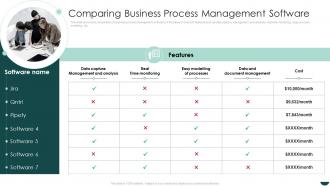
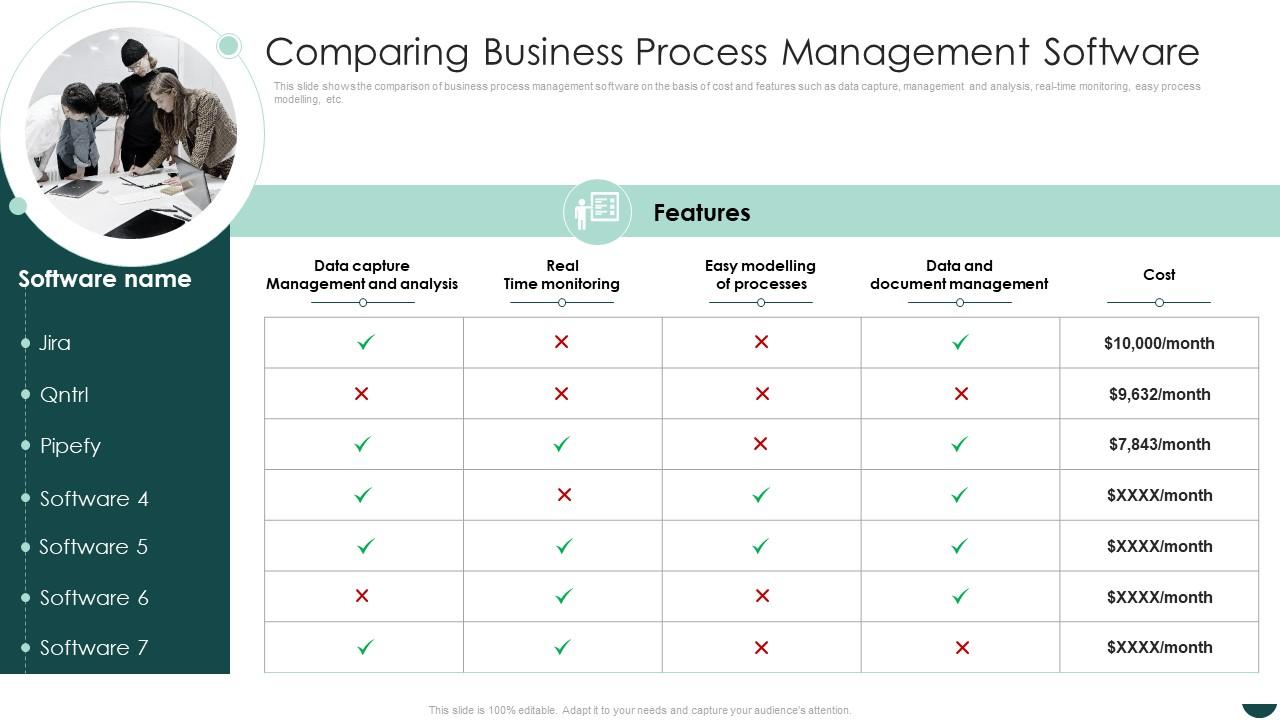
This slide shows the comparison of business process management software on the basis of cost and features such as data capture, management and analysis, real time monitoring, easy process modelling, etc. Present the topic in a bit more detail with this Comparing Business Process Management Software Business Process Reengineering Operational Efficiency. Use it as a tool for discussion and navigation on Business, Process, Management. This template is free to edit as deemed fit for your organization. Therefore download it now
FAQs for Comparing Business Process Management Software Business Process

Effective Business Process Management includes process mapping, performance monitoring, automation tools, stakeholder alignment, and continuous improvement frameworks. These components work together by standardizing workflows, reducing operational costs, and enhancing customer experiences, with many organizations finding that strategic BPM implementation delivers measurable efficiency gains and competitive advantage.

Organizations can identify improvement opportunities through process mapping, performance metrics analysis, customer feedback assessment, employee input gathering, and cost-benefit evaluation. These methods enable systematic prioritization by targeting high-impact areas like customer-facing operations, resource-intensive workflows, and compliance-critical processes, with many companies finding that addressing bottlenecks first delivers immediate efficiency gains and competitive advantage.

Technology serves as the backbone for optimizing business processes through automation, data analytics, artificial intelligence, cloud computing, and workflow management systems. These technologies streamline operations by eliminating manual tasks, providing real-time insights, and enabling seamless integration across departments, with many organizations finding that strategic technology adoption delivers faster decision-making, reduced costs, and enhanced competitive advantage.

Businesses measure process management success through key performance indicators like cycle time reduction, cost savings, error rates, customer satisfaction scores, and employee productivity metrics. Organizations typically track these measurements using dashboard analytics and regular audits, with many finding that combining quantitative data with qualitative feedback delivers comprehensive insights into operational efficiency and competitive advantage.

**INPUT**: What are the common challenges faced in implementing Business Process Management? **OUTPUT**: Common BPM implementation challenges include resistance to change, inadequate stakeholder buy-in, poor process documentation, insufficient technology integration, and lack of clear governance structures. While these obstacles present initial hurdles, organizations increasingly find that strategic change management, comprehensive training programs, and phased rollouts ultimately deliver streamlined operations and enhanced efficiency across departments.

Organizations secure stakeholder buy-in through clear communication of benefits, involving key personnel in planning phases, and demonstrating quick wins with pilot programs. By showcasing measurable outcomes like reduced processing times, cost savings, and improved customer satisfaction, companies build momentum for broader adoption, with many finding that transparent change management and regular progress updates ultimately deliver sustained organizational commitment.

Strategies include regular process audits, employee feedback systems, cross-functional improvement teams, performance metrics tracking, and innovation incentives. These approaches streamline organizational efficiency by encouraging proactive problem-solving, enhancing employee engagement, and establishing systematic review cycles, with many organizations finding that empowering staff to identify bottlenecks ultimately delivers sustained competitive advantage and operational excellence.

Process automation significantly enhances business efficiency by eliminating manual tasks, reducing human error, and accelerating workflow completion times. Through intelligent automation technologies, organizations streamline operations like invoice processing, customer onboarding, and inventory management, while freeing employees for strategic work, ultimately delivering faster service delivery and reduced operational costs.

Common BPM methodologies include Lean Six Sigma, BPMN (Business Process Model and Notation), Agile BPM, Kaizen, and Total Quality Management. These frameworks streamline operations by eliminating waste, standardizing workflows, and enhancing efficiency, with many organizations finding that strategic combinations deliver faster cycle times, reduced costs, and improved customer experiences.

Data analytics enhances process decision-making by providing real-time insights, predictive modeling, and performance metrics that identify bottlenecks and optimization opportunities. Through advanced analytics platforms, organizations streamline operations, reduce costs, and accelerate response times, with many financial services and healthcare institutions finding that data-driven processes ultimately deliver competitive advantage and improved customer experiences.

Business Process Management significantly enhances customer experience by streamlining service delivery, reducing response times, and ensuring consistent quality across all touchpoints. Through automated workflows and standardized procedures, organizations like banks and retail companies deliver faster loan approvals, seamless omnichannel interactions, and personalized services, ultimately creating competitive advantage through superior customer satisfaction.

Businesses leverage BPM to achieve regulatory compliance through automated workflows, standardized procedures, real-time monitoring, audit trail documentation, and risk assessment protocols. These processes enable organizations to maintain consistent compliance across departments, automatically flag violations, and streamline reporting requirements, with financial institutions and healthcare organizations finding that systematic BPM approaches significantly reduce compliance costs while enhancing regulatory transparency.

Process mapping enhances process management by visualizing workflows, identifying bottlenecks, standardizing procedures, and establishing clear accountability measures across teams. Through detailed mapping, organizations streamline operations, reduce redundancies, and accelerate decision-making, with many companies finding that visual documentation enables faster onboarding, improved compliance, and ultimately delivers measurable efficiency gains.

Future BPM trends include AI-driven process automation, low-code/no-code platforms, hyperautomation, cloud-native solutions, and real-time process analytics. These technologies streamline operations by enabling faster adaptation, reducing development costs, and enhancing decision-making capabilities, with many organizations finding that integrated approaches deliver significant competitive advantages in increasingly dynamic markets.

Small businesses can implement BPM strategies cost-effectively by starting with free process mapping tools, prioritizing high-impact workflows like customer onboarding or inventory management, and leveraging affordable cloud-based automation platforms. Many small retailers and service providers find that focusing on one core process initially, training existing staff rather than hiring specialists, and using templates for documentation delivers significant efficiency gains while building momentum for broader BPM adoption.

Ratings and Reviews

100% of 100
Review Form
Write a review
Most Relevant Reviews
  1. 100%

    by Don Hansen

    Nice and innovative design.
  2. 100%

    by Roberts Roberts

    This visual representation is stunning and easy to understand. I like how organized it is and informative it is. 

2 Item(s)

per page: