

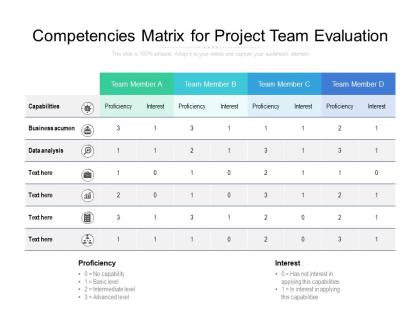
Competencies matrix for project team evaluation




Try Before you Buy Download Free Sample Product
 Impress Your
Audience
 100%
Editable
 Save Hours
of Time


Elucidate on your views on any subject. Our Competencies Matrix For Project Team Evaluation will put the spotlight on all.
People who downloaded this PowerPoint presentation also viewed the following :
Competencies matrix for project team evaluation with all 2 slides:
Catch that elusive idea with your thought process. Bring it to book with our Competencies Matrix For Project Team Evaluation.


FAQs for Competencies matrix for
**INPUT**: What are the key components of a competencies matrix? **OUTPUT**: Key components of a competencies matrix include job roles, required competencies, proficiency levels, assessment criteria, and development pathways. These elements work together by mapping skills against positions, defining performance standards, and identifying training needs, with many organizations finding that this strategic approach streamlines talent management and enhances workforce planning.
A competencies matrix enhances team performance by identifying skill gaps, optimizing resource allocation, and enabling strategic project assignments based on individual strengths and expertise. Through clear competency mapping, organizations streamline collaboration by matching the right skills to specific tasks, reducing project timelines and improving quality outcomes, while teams gain transparency in development paths and cross-functional opportunities.
Competencies matrices are most commonly utilized in healthcare, technology, manufacturing, financial services, and consulting industries where specialized skills and regulatory compliance are critical. These sectors leverage competency frameworks to ensure workforce capabilities align with complex operational demands, safety requirements, and evolving market needs, ultimately delivering enhanced performance standards and competitive advantage.
Organizations can assess employee competencies through performance reviews, skills assessments, 360-degree feedback, behavioral interviews, competency-based evaluations, and peer assessments. These methods enable managers to identify skill gaps, track professional development, and align talent with strategic objectives, with many companies finding that systematic competency mapping ultimately enhances workforce planning and drives competitive advantage.
Organizations should update their competencies matrix quarterly or biannually to reflect evolving business needs, emerging technologies, and changing market demands. Many companies in sectors like technology, healthcare, and financial services find that regular updates enable better talent development, more strategic hiring decisions, and enhanced workforce planning, ultimately delivering competitive advantage in an increasingly dynamic business environment.
A competencies matrix identifies skill gaps, guides targeted training programs, tracks employee development progress, and aligns learning initiatives with organizational goals and career advancement pathways. Through systematic competency mapping, organizations streamline resource allocation for training investments, enhance performance management processes, and accelerate talent development, with many companies finding that structured competency frameworks ultimately deliver improved employee engagement and strategic workforce planning capabilities.
A competencies matrix aligns with strategic goals by identifying critical skills needed for future growth, mapping current workforce capabilities against these requirements, and highlighting development priorities that support business objectives. Organizations use this strategic alignment to guide recruitment decisions, targeted training programs, and succession planning initiatives, ultimately ensuring their talent capabilities directly enable competitive advantage and long-term organizational success.
Several digital tools streamline competencies matrix creation and maintenance, including HR management systems like BambooHR and Workday, specialized skills tracking platforms such as AG5 and Skills Base, and versatile solutions like Microsoft Excel, Google Sheets, or project management software. These platforms enhance accuracy and efficiency by automating assessments, tracking skill gaps, and generating real-time analytics, with many organizations finding that integrated systems deliver better workforce planning and development outcomes.
In a competencies matrix, hard skills represent measurable, technical abilities like programming, financial analysis, or equipment operation, while soft skills encompass interpersonal qualities such as communication, leadership, and adaptability. Organizations typically categorize these separately within their matrices, with hard skills assessed through certifications or performance metrics, and soft skills evaluated through behavioral indicators, ultimately enabling more strategic talent development and targeted training programs.
Common challenges include resistance to change, lack of management support, unclear competency definitions, time-intensive implementation processes, and inadequate training resources. Organizations often find that overcoming these obstacles requires strategic communication, comprehensive stakeholder engagement, and phased rollouts, with many companies discovering that investing in proper change management ultimately delivers smoother adoption and enhanced workforce development outcomes.
A competencies matrix supports succession planning by identifying skill gaps, mapping current capabilities against future leadership requirements, and highlighting development opportunities for potential successors. Through systematic competency assessment, organizations streamline talent pipeline management, accelerate leadership development programs, and ensure business continuity, with many companies finding that structured matrices significantly reduce succession risks while enhancing strategic workforce planning.
Effectiveness metrics include competency gap closure rates, employee performance improvements, training ROI measurements, promotion readiness scores, and skill development timelines. Organizations track these through performance reviews, assessment scores, and career progression data, with many companies finding that regular matrix updates correlate with enhanced talent retention and accelerated skill development across departments.
Cultural differences significantly impact competencies matrix development by influencing communication styles, leadership expectations, collaboration approaches, and performance evaluation criteria across different regions and teams. Organizations must adapt their frameworks to accommodate varying cultural values, with many multinational companies finding that localized competency definitions while maintaining core global standards ultimately delivers more effective talent management and employee engagement.
A competencies matrix can effectively be applied to project management by identifying essential skills like risk assessment, stakeholder communication, resource allocation, timeline management, and technical expertise required for specific project roles. This strategic approach enables organizations to match team members with appropriate project responsibilities, identify skill gaps before project initiation, and develop targeted training programs, ultimately delivering improved project outcomes and enhanced team performance across complex initiatives.
Best practices include clearly explaining how the matrix supports career development, aligns performance expectations, and identifies skill gaps for targeted training opportunities. Organizations should emphasize that competency matrices enable transparent promotion pathways, facilitate objective performance reviews, and enhance professional growth planning, with many companies finding that employees embrace these tools when positioned as development resources rather than evaluation mechanisms.
No Reviews