

Competitive Brand Analysis Comparison Matrix Executing Competitor Analysis To Assess




Try Before you Buy Download Free Sample Product
 Impress Your
 Audience
 100%
100% Editable
 Save Hours
 of Time


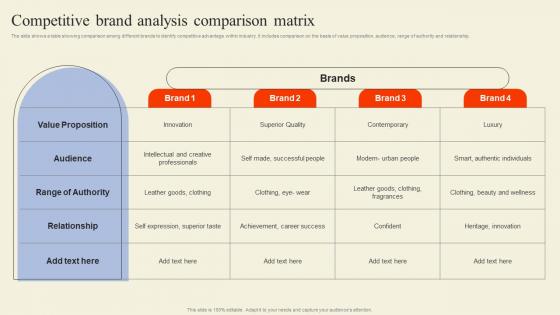
The slide shows a table showing comparison among different brands to identify competitive advantage within industry. It includes comparison on the basis of value proposition, audience, range of authority and relationship.
People who downloaded this PowerPoint presentation also viewed the following :
Competitive Brand Analysis Comparison Matrix Executing Competitor Analysis To Assess with all 9 slides:
Use our Competitive Brand Analysis Comparison Matrix Executing Competitor Analysis To Assess to effectively help you save your valuable time. They are readymade to fit into any presentation structure.








FAQs for Competitive Brand Analysis Comparison Matrix Executing Competitor
Key metrics for competitor brand analysis include market share, brand awareness, customer satisfaction scores, social media engagement rates, and pricing strategies. These metrics enable businesses to benchmark performance, identify market gaps, and refine positioning strategies, with many organizations finding that comprehensive competitor analysis ultimately delivers enhanced market understanding and sustainable competitive advantage.
Brand positioning significantly influences competitive analysis by determining market perception frameworks, differentiation strategies, target audience segmentation, and value proposition comparisons that analysts must evaluate. Through strategic positioning assessment, companies can identify competitive gaps, market opportunities, and repositioning strategies, while understanding how competitors' messaging resonates with shared audiences, ultimately enabling more targeted competitive responses and strategic advantage.
Effective competitor analysis tools include SEMrush, Ahrefs, SimilarWeb, Brandwatch, and Hootsuite Insights for digital monitoring, alongside traditional methods like mystery shopping and customer surveys. These platforms enable businesses to track competitor pricing strategies, social media engagement, and market positioning, while many organizations find that combining automated data collection with human insights delivers comprehensive competitive intelligence and strategic advantages.
Customer sentiment analysis enhances brand competitive assessment by revealing real-time consumer perceptions, identifying competitor strengths and weaknesses, and uncovering market positioning gaps through social media monitoring, review analysis, and customer feedback evaluation. This strategic approach enables businesses to benchmark emotional connections, track brand reputation shifts, and discover competitive advantages, with many organizations finding that sentiment insights drive more targeted marketing strategies and ultimately deliver stronger market differentiation.
Social media metrics provide crucial insights into competitor engagement rates, audience growth, content performance, and brand sentiment analysis. These metrics enable businesses to benchmark their social presence against competitors, identify successful content strategies, and discover market gaps, ultimately helping organizations refine their social media approach and enhance competitive positioning.
Brand values and ethos significantly shape competitive positioning by influencing customer loyalty, market differentiation, and brand perception across target audiences. Companies analyzing competitors must evaluate how authentic brand messaging, corporate social responsibility initiatives, and cultural alignment drive consumer choice, with many organizations finding that strong values-based positioning ultimately delivers sustainable competitive advantage and deeper market penetration.
Trends to monitor include market share fluctuations, pricing strategy changes, product innovation cycles, customer sentiment shifts, and digital engagement metrics. Through social listening, financial analysis, and market research, organizations can identify emerging competitors, evolving consumer preferences, and strategic pivots, ultimately enabling proactive positioning adjustments and competitive advantage preservation.
Visual identity significantly shapes competitor brand perception by influencing customer trust, market positioning, and purchase decisions through consistent color schemes, typography, and design elements. Companies like Apple and Microsoft demonstrate how strategic visual branding creates distinct market personas, with cohesive visual systems ultimately delivering stronger brand recognition, customer loyalty, and competitive differentiation in crowded marketplaces.
SWOT analysis delivers comprehensive competitive brand evaluation by identifying internal strengths, weaknesses, and external opportunities and threats simultaneously. This strategic framework enables organizations to benchmark against competitors, uncover market gaps, and develop targeted positioning strategies, with many retail and financial services companies finding that structured SWOT assessments ultimately enhance competitive advantage and strategic decision-making.
Brand loyalty metrics inform competitive strategies by revealing customer retention patterns, purchase frequency data, Net Promoter Scores, and switching behaviors across market segments. These insights enable companies to identify competitor vulnerabilities, optimize retention programs, and develop targeted acquisition campaigns, with many retail and financial services organizations finding that loyalty analysis delivers improved market positioning and sustainable competitive advantage.
Pricing strategies differentiate brands through premium positioning, value-based pricing, penetration pricing, psychological pricing, and dynamic pricing models. These approaches enable companies to target specific customer segments, communicate brand value, and establish market positioning, with luxury brands leveraging premium pricing while discount retailers use competitive pricing to capture broader market share and drive customer loyalty.
Competitive benchmarking methods include market share analysis, pricing comparisons, customer satisfaction surveys, social media monitoring, and financial performance evaluation. These approaches enable organizations to identify gaps in their strategies, optimize pricing models, and enhance customer experiences, with many companies finding that systematic competitor analysis ultimately delivers improved market positioning and sustainable competitive advantage.
Product innovation significantly influences competitive brand analysis by reshaping market positioning, revealing differentiation opportunities, and highlighting gaps in competitor offerings. Through tracking innovation cycles, patent filings, and feature releases, companies identify emerging threats and strategic advantages, with many organizations finding that innovation-focused analysis enables faster market responses, enhanced product development strategies, and ultimately stronger competitive positioning in rapidly evolving markets.
Market share directly influences competitive brand positioning by determining pricing power, distribution leverage, resource allocation capabilities, and consumer perception strength. Companies with higher market share, like Apple in smartphones or Amazon in e-commerce, can invest more in innovation and marketing while commanding premium positioning, ultimately delivering stronger brand equity and competitive advantages over smaller rivals.
Qualitative insights from customer interviews complement quantitative data by revealing the "why" behind consumer behaviors, uncovering emotional drivers, brand perceptions, and unmet needs that numbers alone cannot capture. Through in-depth conversations, businesses gain context for statistical trends, identify emerging opportunities, and develop more nuanced competitive strategies, with many companies finding that this combination delivers deeper market understanding and more effective positioning decisions.
-
Kudos to SlideTeam for achieving the high success rate in delivering the top-notch slides.
-
“Superb. What a great finding. Thankful for SlideTeam. We were paying people to make slides which went all in vain. We are so happy to have found you.”