


Competitive Intelligence Analysis Techniques Powerpoint Presentation Slides





Try Before you Buy Download Free Sample Product
 Impress Your
 Audience
 100%
100% Editable
 Save Hours
 of Time


A competitive spirit is something that is common with winners, whether it's competing with one's self for intramural growth or standing out in the business world to sustain your uniqueness. It's an important component when it comes to problem-solving techniques and dealing with eligible competitors. SlideTeam provides you with a comprehensive approach through our Competitive Intelligence analysis techniques PowerPoint presentation slides which cover up significant phases of assessment. With intrinsic visuals, we have included smart plots for identification by estimating your local, international & probable preeminent competitors. Covering up the trademarks, global ranking, sales, revenue & profit graphs, we have designed PPTs for both interior and exterior portfolio analysis. Delightful combinations of color schemes have been used here for both a visual effect and professional expertise. These PowerPoint slides will give you a chance to probe in the business process, making it easier to explain the viability of your methods. Assure easy depiction of tangible work and link among different ingredients of data by downloading. Don't allow folks to feel jaded with our Competitive Intelligence Analysis Techniques Powerpoint Presentation Slides. Address dull and boring aspects.
People who downloaded this PowerPoint presentation also viewed the following :
Content of this Powerpoint Presentation
Slide 1: This slide introduces Competitive Intelligence Analysis Techniques. State the name of the company and begin.
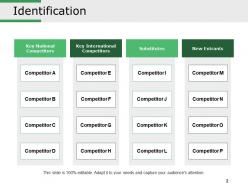
Slide 2: This is an Identification slide showing- Key National Competitors, Key International Competitors, Substitutes, New Entrants.
Slide 3: This slide shows Logos of Competitors. Add them here.
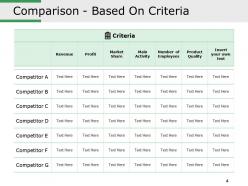
Slide 4: This slide presents Comparison - Based On Criteria. in a tabular form.
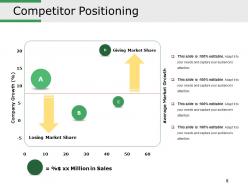
Slide 5: This slide shows Competitor Positioning with Average Market Growth, Company Growth (%).
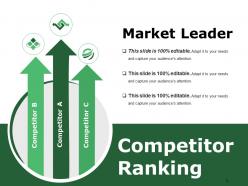
Slide 6: This slide shows Competitor Ranking with Market Leader.
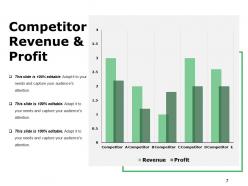
Slide 7: This slide shows Competitor Revenue & Profit graph. Add in your competitors and this graph and use it accordingly.
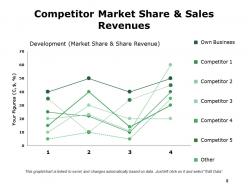
Slide 8: This slide shows Competitor Market Share & Sales Revenues graph with the following to be displayed- Competitor, Own Business, Other.
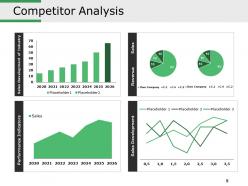
Slide 9: This slide displays Competitor Analysis dashboard which further shows- Sales Development of Industry, Performance Indicators, Sales Development, Revenue, Sales.
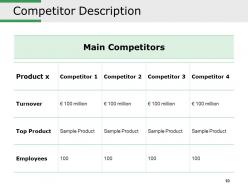
Slide 10: This slide presents Competitor Description which shows the Main Competitors.
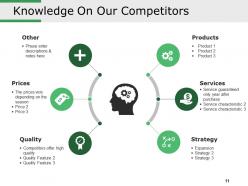
Slide 11: This slide presents Knowledge On Our Competitors. It shows the key aspects which provide knowledge about the competitors. These include- Services, Strategy, Quality, Prices, Other, Products.
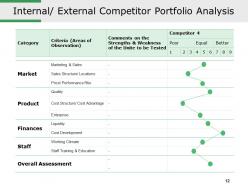
Slide 12: This slide presents Internal/ External Competitor Portfolio Analysis in a tabular form.
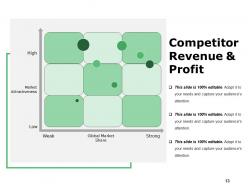
Slide 13: This slide shows Competitor Revenue & Profit with a matrix form which ranges form High to Low and Weak to Strong.
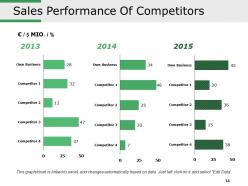
Slide 14: This slide displays a graph which shows the Sales Performance Of Competitors.
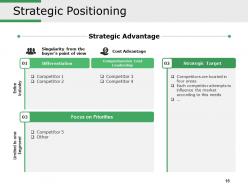
Slide 15: This slide shows Strategic Positioning with Strategic Advantage as its main sub heading and Strategic Target, Other, Differentiation, Cost Advantage. as its sub points.
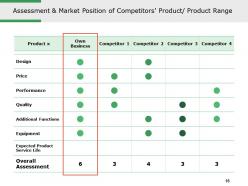
Slide 16: This slide shows Assessment & Market Position of Competitors’ Product/ Product Range.
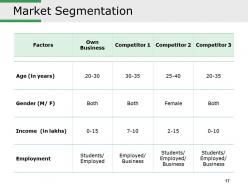
Slide 17: This slide shows Market Segmentation table with the following sub headings to be displayed- Factors, Own Business, Competitor.
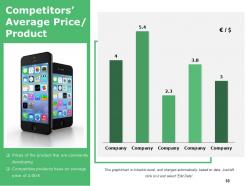
Slide 18: This slide shows Competitors’ Average Price/ Product. It also shows a bar graph/ chart to add the stats of different companies.
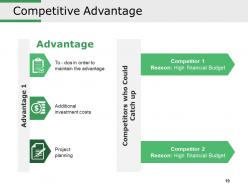
Slide 19: This is a Competitive Advantage slide stating three of the following advantages- To - dos in order to maintain the advantage, Additional investment costs, Project planning.
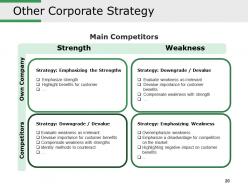
Slide 20: This slide shows Other Corporate Strategy mentioning the stengths and weaknesses of the Main Competitors.
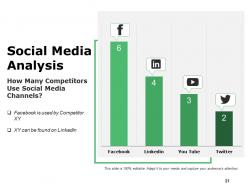
Slide 21: This slide presents the stats of Social Media Analysis in a graphical form. This graph mainly shows How Many Competitors Use Social Media Channels. You can alter these channels as per your own business need.
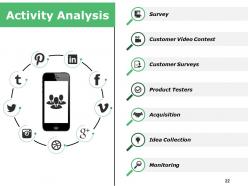
Slide 22: This slide sows the following elements of Activity Analysis- Monitoring, Survey, Customer Video Contest, Customer Surveys, Product Testers, Acquisition, Idea Collection.
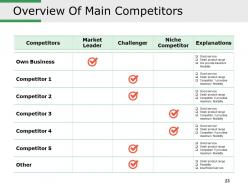
Slide 23: This slide presents an Overview Of Main Competitors in a tabular form with the following sub headings- Competitors, Market Leader, Challenger, Niche Competitor, Explanations.
Slide 24: This is a Coffee Break image slide to halt. You can change the slide content as per need.
Slide 25: This slide shows Charts & Graphs to move forward. You can change the slide content as per need.
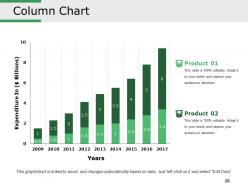
Slide 26: This is a Column Chart for showing product/ entity comparison, information etc.
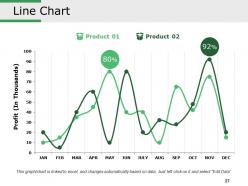
Slide 27: This slide presents a Line Chart slide to show product/ entity comparison, specifications etc.
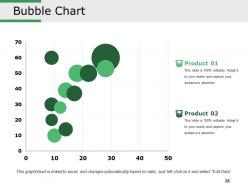
Slide 28: This slide shows a Bubble Chart for product/ entity comparison.
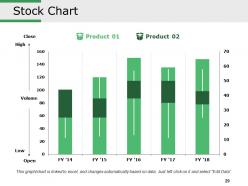
Slide 29: This slide showcases a Stock Chart with Open, Low, High, Close as parameters to calculate.
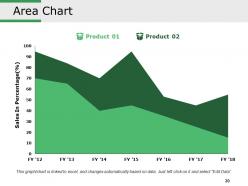
Slide 30: This is an Area Chart slide to show product/ entity growth, comparison, specifications etc.
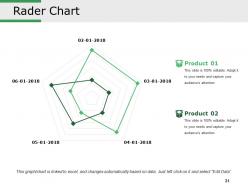
Slide 31: This is a Radar Chart slide to show product/ entity comparison, specifications etc.
Slide 32: This slide is titled Additional Slides to move forward. You can change the slide content as per need.
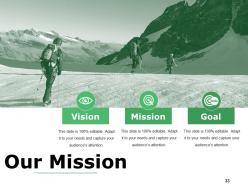
Slide 33: This slide shows Our Mission. State your company mission goals etc. here.
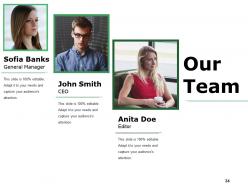
Slide 34: This is Our team slide with names and designation.
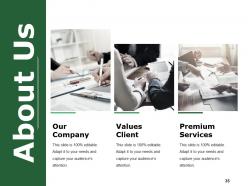
Slide 35: This is an About Us slide showing Our Company, Values Client, and Premium services as examples.
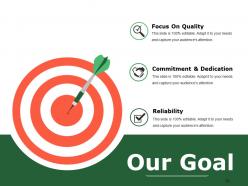
Slide 36: This is Our Goal slide showing-Focus On Quality, Commitment & Dedication and Reliability as examples.
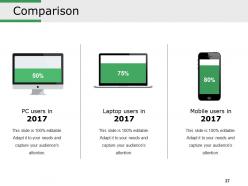
Slide 37: This slide shows Comparison of users who use different mediums such as- Laptop, Mobile and PC.
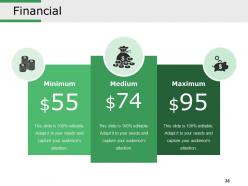
Slide 38: This slide is titled as Financials. Show finance related stuff with minimum, medium and maximum parameters.
Slide 39: This slide shows a famous Quote of Albert Einstein. You can add your own quote or state anything you beleive in.
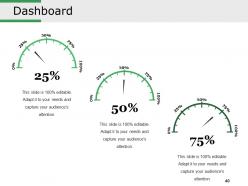
Slide 40: This is a Dashboard slide to state metrics, KPIs etc.
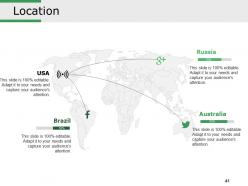
Slide 41: This is a Location slide on a world map image to show global presence, growth etc.
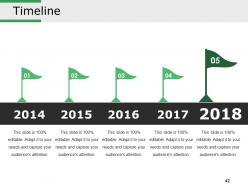
Slide 42: This is a Timeline slide with flag imagery to show company growth, journey, milestones etc.
Slide 43: This slide showcases Important Notes to be displayed. Show events, important piece of information, events etc. here.
Slide 44: This is a Puzzle image slide to show information, specifications etc.
Slide 45: This is Our Target slide to state your targets, goals etc.
Slide 46: This is a Circular image slide to show information, specifications etc.
Slide 47: This is Venn diagram image slide to show information, specifications etc.
Slide 48: This is a Mind Map slide with creative imagery to show behavioral segmentation, information or anything relative.
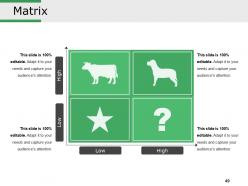
Slide 49: This slide presents a Matrix with high, low and vice versa. You can add or modify text as per need.
Slide 50: This is a Lego slide to present information, specification etc.
Slide 51: This is a Silhouettes slide to present people specific information, specifications etc.
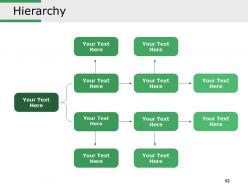
Slide 52: This slide presents a Hierarchy showing team information, specification etc.
Slide 53: This slide presents a Magnifying Glass image to showcase information, specifications etc.
Slide 54: This is a Bulb & Idea image slide to show ideas, innovative information etc.
Slide 55: This is a Thank You slide with Address# street number, city, state, Contact Numbers, Email Address to be put and displayed.
Competitive Intelligence Analysis Techniques Powerpoint Presentation Slides with all 55 slides:
Conceive and execute with our Competitive Intelligence Analysis Techniques Powerpoint Presentation Slides. They are excellent for a ' bud to bloom ' approach.





FAQs for Competitive Intelligence Analysis Techniques
Honestly, you just need to get organized about tracking your competitors. Pull data from everywhere - their sites, financials, social media, customer reviews, industry stuff. Then dig into patterns and figure out their strengths and weak spots. The real gold happens when you turn all that info into actual insights about pricing, positioning, threats, whatever. Pick your top 3-5 competitors first (don't go crazy with too many). Set up some kind of dashboard to monitor them regularly - I learned this the hard way after missing a major competitor's pivot last year.
SWOT analysis is perfect for this stuff. Pick your top 3 competitors first - don't overwhelm yourself with too many. Build out their strengths, weaknesses, opportunities, and threats, then compare them side by side with your own. Honestly, it's like making a battle map (sounds cheesy but whatever, it works). You'll start seeing patterns super quickly - where they're vulnerable, where you should probably avoid going head-to-head, and those sweet spots where nobody's really competing yet. The side-by-side comparison is where the magic happens. You can literally see gaps in the market just by looking at everyone's weaknesses lined up together.
Honestly, data mining is a game-changer for tracking competitors. You can dig through tons of info - social media posts, news articles, patent filings, job listings - and actually spot patterns that would take your team forever to find manually. The algorithms handle way more data than humans can process and catch subtle signals about competitor moves or market shifts. I'd start by figuring out exactly what competitor stuff you want to monitor first, then hunt for datasets that might show those patterns. It's not quite a crystal ball, but it's pretty close since you're working with real data trends.
Honestly, AI crushes this stuff - you can scrape competitor pricing, social posts, even their job listings way faster than doing it manually. The pattern recognition is where it gets cool though. Algorithms catch things like seasonal pricing shifts that you'd totally miss. Don't get me wrong, I've watched teams blow money on complex tools when a basic Google Alert would've worked fine! Natural language processing is clutch for analyzing their communications. My advice? Start simple with automated data collection first. Then add the fancy pattern-spotting later once you've got that foundation down.
Look, just stick to public info and don't lie about who you are when you're digging around. Trying to trick people into giving you insider stuff? That's gonna bite you in the ass legally. Be honest at trade shows and when you're networking - tell them your company and role upfront. Also respect IP and NDAs, obviously. I always think about it this way: would I be cool with competitors doing this to us? If yes, you're probably fine. Oh and keep good records of where you got everything, just in case someone questions your methods later.
Honestly, social media monitoring is like having a window into everything your competitors are doing. Track their product launches, pricing updates, and campaigns in real-time. I'd set up alerts for their brand mentions and key executives - you'll catch potential partnerships before they go public. The real gold though? Comments sections. That's where customers vent about what sucks and rave about what works. It's basically free market research since people share completely unfiltered opinions about features and service quality. Don't forget industry hashtags either - tons of insight there about market positioning and customer sentiment.
So for competitive intel stuff, I'd go with **Tableau** or **Power BI** first - they're ridiculously good at spotting trends you'd miss otherwise. **Lucidchart** and **Miro** are perfect for those positioning maps. Google Data Studio works fine if you just need basic competitor tracking (though honestly it feels a bit clunky sometimes). Oh, and **Gephi** is great for mapping company relationships if you're into that network analysis thing. I'd start with Power BI though - especially if you've got Excel files lying around since it pulls them in super easily.
Honestly, just grab a tool like Prisync or Competera - they'll track competitor prices automatically across all their sites. Way easier than doing it manually. Sign up for their newsletters too and follow their social accounts so you catch flash sales early. If you're on a tight budget though, a simple spreadsheet works fine for tracking a few competitors. I'd set up alerts for big price drops so you can react fast. The trick is checking their discount patterns regularly - like do they always run sales on Fridays or whatever. Once you spot the trends, you'll stay ahead of them instead of always playing catch-up.
Look at market share, revenue growth, and customer acquisition costs first - that's where the real story is. Pricing moves and how often they drop new products matter too. Social media engagement shows if they've got actual momentum or just noise. Customer satisfaction scores are pure gold but good luck getting reliable data there. Honestly, don't waste time on follower counts and that stuff. Focus on metrics that actually tell you if they're about to poach your customers or pull some strategic move. Pick 3-4 you can track without going crazy.
So take your competitor intel and build out 3-4 "what if" stories around it. Market crashes, new regulations drop, competitors pivot - stuff like that. Honestly, this is way better than just tracking what they're doing right now. Each scenario should mess with your assumptions about where things are headed. Then test your strategic moves against all of them. See what still works when everything changes. We do this quarterly and it's been a game changer - though sometimes we get carried away with the doom scenarios lol. Makes you way more prepared.
So basically, legal regs are like the boundaries for competitive intel gathering. You've gotta stick to public info only - no corporate espionage or stealing trade secrets, obviously. Finance and healthcare have extra compliance stuff to deal with too, which is honestly a pain. Always document where you got everything and how you found it. That way if someone questions you later, you're covered. My advice? When you're not sure about something, just check with legal first. Way better than dealing with the mess afterward.
Oh man, cultural stuff totally changes the competitive intelligence game. Normal business transparency in the US might be seen as sketchy elsewhere. Your research tactics that work here could bomb somewhere else - like that LinkedIn deep-diving thing works in Silicon Valley but would be weird as hell in more buttoned-up cultures. Different countries have their own communication styles and business etiquette you've gotta figure out. Honestly, find local contacts who actually know the scene. They'll save you from looking like a total amateur when you're trying to scope out competitors.
Honestly, financial ratio stuff is your best starting point - dig into their profit margins and revenue growth from public filings. SWOT analysis works great for side-by-side comparisons. Mystery shopping is actually kinda fun and you'll get real insights into what customers experience. Tools like SimilarWeb can show you their website traffic and digital performance, plus don't sleep on pricing analysis. Oh, and compare product features obviously. Here's the thing though - pick maybe 3-4 metrics that actually move the needle for your business instead of trying to track everything. Way more manageable that way.
So numbers tell you what happened, but talking to actual people tells you why. Like if a competitor drops prices 15%, your data won't tell you if they're panicking or being strategic. But customer interviews might reveal they're just dealing with supply chain stuff. That context is huge for figuring out their next move. I always try to back up big data findings with some kind of human insight - even if it's just chatting with industry people. You'll catch trends way before they show up in the hard numbers too.
Honestly, competitive intelligence is a lifesaver for avoiding stupid mistakes. Look at what your competitors are doing - their features, pricing, customer complaints. I've watched entire teams scrap months of work after realizing someone else already tried their "brilliant" idea and it flopped hard. Check their failed experiments too, not just successes. That shows you what doesn't work. You'll spot market gaps they missed or tech approaches nobody's tried yet. Just don't get obsessed and copy everything - set up some regular monitoring so you're not flying blind when making product decisions.
-
Best Representation of topics, really appreciable.
-
Top Quality presentations that are easily editable.