

Competitor Analysis Market Positioning Product Development Business Strategy





Try Before you Buy Download Free Sample Product
 Impress Your
Audience
 100%
Editable
 Save Hours
of Time


Our Competitor Analysis Market Positioning Product Development Business Strategy are topically designed to provide an attractive backdrop to any subject. Use them to look like a presentation pro.
People who downloaded this PowerPoint presentation also viewed the following :
Content of this Powerpoint Presentation
Slide 1: This slide introduces Competitor Analysis. State Your Company Name and begin.
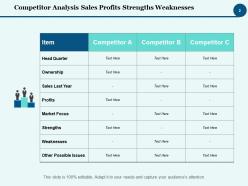
Slide 2: This slide shows Competitor Analysis with Sales, Profits, Strengths, Weaknesses.
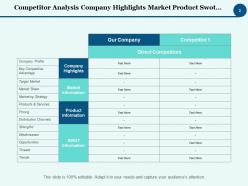
Slide 3: This slide presents Competitor Analysis with Company Highlights, Market Product, Swot Information.
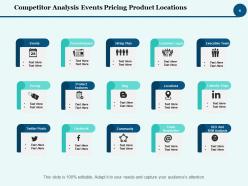
Slide 4: This slide displays Competitor Analysis with Events, Pricing, Product, Locations.
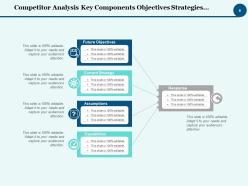
Slide 5: This slide represents Competitor Analysis with Key Components, Objectives, Strategies, Capabilities.
Slide 6: This slide showcases Competitor Analysis Framework with Market Positioning, Business Strategy etc.
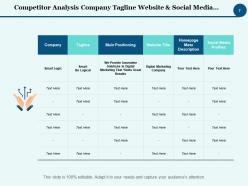
Slide 7: This slide shows Competitor Analysis Company Tagline Website & Social Media Profiles.
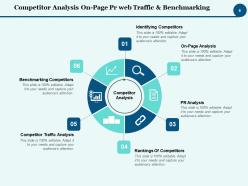
Slide 8: This slide presents Competitor Analysis On-Page Pr web Traffic & Benchmarking.
Slide 9: This slide displays Competitor Analysis Objectives, Strategy, Capabilities, Assumptions.
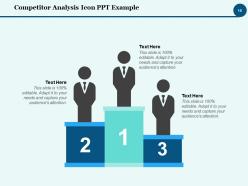
Slide 10: This slide showcases Competitor Analysis Icon PPT Example.
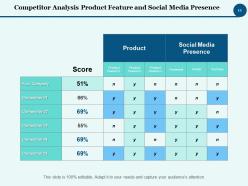
Slide 11: This slide represents Competitor Analysis Product Feature and Social Media Presence.
Slide 12: This is a Thank You slide with address, contact numbers and email address.
Competitor Analysis Market Positioning Product Development Business Strategy with all 12 slides:
Use our Competitor Analysis Market Positioning Product Development Business Strategy to effectively help you save your valuable time. They are readymade to fit into any presentation structure.




FAQs for Competitor Analysis Market Positioning Product
**INPUT**: What techniques can be used to identify main competitors in the presentation template market? **OUTPUT**: Competitor identification techniques include market research analysis, keyword tracking, customer surveys, industry reports, and social media monitoring. These methods streamline competitive intelligence by revealing market positioning, pricing strategies, and customer preferences, with many businesses finding that combining multiple approaches delivers comprehensive insights, ultimately enabling strategic differentiation and enhanced market positioning.
Competitors differentiate through unique visual aesthetics, intuitive user interfaces, advanced feature sets, personalized customization options, and seamless integration capabilities. Companies like Apple emphasize minimalist design while Tesla focuses on cutting-edge functionality, with many organizations finding that strategic combinations of both design excellence and robust features ultimately deliver enhanced customer experiences and sustained competitive advantage.
Key factors influencing customer preferences for presentation templates include design aesthetics, industry relevance, customization flexibility, brand alignment, and ease of use. These elements work together by ensuring visual appeal, meeting specific sector requirements, and enabling seamless personalization, with many organizations finding that templates combining professional aesthetics with intuitive functionality deliver faster content creation and stronger audience engagement.
Analyzing competitor template pricing involves examining their pricing tiers, package structures, subscription models, licensing terms, and value propositions across different customer segments. Compare their per-template costs, bulk pricing, premium features, and market positioning against similar providers like Envato, Creative Market, and Canva Pro, ultimately identifying pricing gaps and competitive advantages for strategic positioning.
Customer reviews and testimonials serve as critical social proof indicators that significantly influence competitor positioning, brand perception, market credibility, and consumer decision-making processes. Through authentic customer feedback, businesses can identify competitive advantages, address service gaps, enhance product offerings, and strategically differentiate themselves, with many organizations finding that positive testimonials ultimately deliver stronger market positioning and increased customer acquisition rates.
Competitors typically rely on digital marketing channels including social media advertising, search engine optimization, content marketing, email campaigns, and paid search advertising. Through comprehensive competitor analysis, organizations can identify successful channel strategies across industries like retail, financial services, and healthcare, ultimately enabling strategic resource allocation and competitive positioning while discovering untapped audience segments.
Competitors leverage social media through visual showcases of template designs, customer success stories, behind-the-scenes content creation processes, and interactive polls for audience engagement. Through platforms like Instagram and LinkedIn, template providers demonstrate real-world applications across industries like marketing agencies and corporate training, while building community engagement that ultimately drives brand awareness and customer acquisition.
Emerging presentation trends include interactive elements with embedded polls and clickable navigation, dynamic data visualization through real-time charts and infographics, minimalist designs with bold typography, and mobile-first responsive layouts. These innovations enhance audience engagement, streamline complex information delivery, and enable seamless cross-platform accessibility, with many organizations finding that modern templates significantly improve presentation effectiveness and professional credibility.
Competitor branding significantly shapes market perception by establishing benchmarks for quality, innovation, and customer experience, while influencing consumer expectations and trust thresholds across entire industries. Strong competitor brands elevate overall market standards, with sectors like smartphones and automotive finding that leading brands drive consumer education and category credibility, ultimately benefiting well-positioned competitors through increased market legitimacy.
Competitor template portfolios often reveal strengths like comprehensive industry coverage, strong visual design consistency, and specialized niche expertise, while weaknesses typically include outdated content, limited customization options, and poor user experience navigation. Through systematic analysis, organizations can identify market gaps, benchmark design standards, and develop strategic advantages by addressing competitors' limitations while enhancing their own offerings with superior functionality and user-focused features.
Competitors engage with users through social media monitoring, customer surveys, user testing sessions, support ticket analysis, and community forums to gather comprehensive feedback. Through strategic feedback incorporation, organizations streamline product development cycles, enhance user experiences, and minimize costly redesign efforts, with many technology companies finding that systematic feedback integration delivers faster innovation and stronger competitive positioning in increasingly dynamic markets.
Competitors are employing AI-powered design automation, interactive elements like embedded videos and clickable prototypes, responsive layouts for multi-device compatibility, and advanced collaboration tools with real-time editing capabilities. These innovations streamline template creation, enhance audience engagement, and improve workflow efficiency, with many organizations finding that technologically advanced templates deliver more impactful presentations and competitive advantage.
Competitor update frequencies vary significantly by industry, with fashion and tech companies refreshing offerings seasonally or quarterly, while automotive and healthcare sectors follow longer cycles. Through competitive intelligence and market monitoring, businesses track these patterns to anticipate shifts, adjust their own development timelines, and maintain strategic positioning, ultimately enabling more responsive product strategies and sustained competitive advantage.
Assessing competitor SEO effectiveness involves analyzing their organic keyword rankings, backlink profiles, content performance, and estimated traffic volumes through tools like SEMrush, Ahrefs, and SimilarWeb. These insights enable businesses to identify successful content gaps, high-performing keywords, and link-building opportunities, ultimately delivering strategic advantages and improved search visibility in competitive markets.
Competitors typically leverage strategic technology partnerships, distribution alliances, joint ventures with complementary businesses, supplier collaborations, and cross-industry partnerships to expand market reach. These strategic combinations enable organizations to access new customer segments, enhance product offerings, and share resources, with many companies finding that collaborative approaches deliver faster market penetration and competitive advantages than standalone strategies.
-
Excellent template with unique design.
-
Good research work and creative work done on every template.