

Complete Overview Of The Role Of Display Advertising In Online Marketing Complete Deck MKT CD





Try Before you Buy Download Free Sample Product
 Impress Your
Audience
 100%
Editable
 Save Hours
of Time


Display advertising emerges on third party websites and uses video, image, or text segments for advertising products or services. There are multiple types of display advertising, such as banner ads and desktop and mobile leaderboard ads. Display advertising campaigns can be run through advertising networks such as Facebook or Google ads that provide effective user targeting features and advertising formats. This deck Complete overview of the role of display advertising in online marketing is a complete guide to understanding display advertising and its role in digital marketing. It provides an overview of display advertising, its need for implementation, and major implementation challenges. It provides an overview of display adverting types, such as paid search advertising, native ads, display ads, and programmatic display advertising, and their comparative analysis. This deck also includes buying models, buying options, and bidding process models of display advertising. It incorporates a strategy and implementation plan for display advertising campaigns. In the end, this deck also provides a couple of dashboards to measure the performance of display advertising campaigns. Download it now.
People who downloaded this PowerPoint presentation also viewed the following :
Content of this Powerpoint Presentation
Slide 1: This slide displays the title Complete Overview of the Role of Display Advertising in Online Marketing.
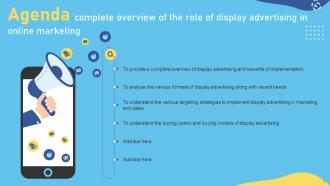
Slide 2: This slide displays the title Agenda complete overview of the role of display advertising in online marketing.
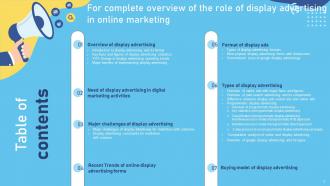
Slide 3: This slide exhibit table of content.
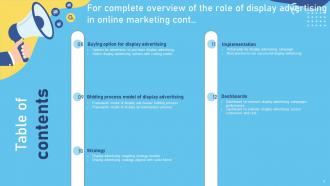
Slide 4: This slide exhibit table of content.
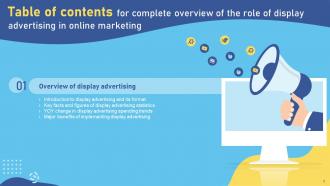
Slide 5: This slide exhibit table of content- Overview of display advertising.
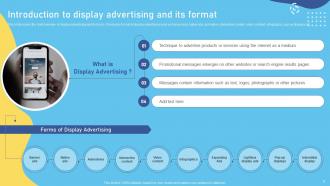
Slide 6: This slide covers the brief overview of display advertising and its forms.
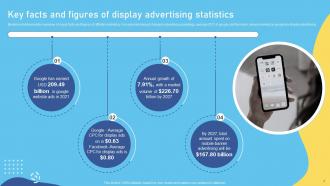
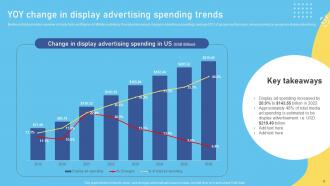
Slide 7: Mentioned slide provides overview of major facts and figures of affiliate marketing.
Slide 8: Mentioned slide provides overview of major facts and figures of affiliate marketing.
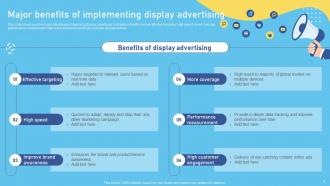
Slide 9: This slide showcases the major advantages of deploying display advertising.
Slide 10: This slide exhibit table of content- Need of display advertising in digital marketing activities.
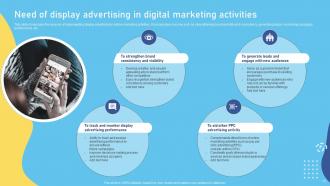
Slide 11: This slide showcases the reasons of implementing display advertising in online marketing activities.
Slide 12: This slide exhibit table of content- Major challenges of display advertising.
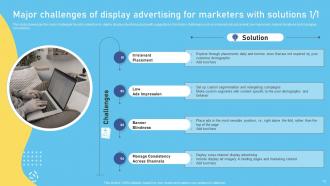
Slide 13: This slide showcases the major challenges faced by advertiser to deploy display advertising along with suggestions.
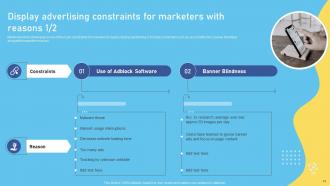
Slide 14: Mentioned slide showcases some of the major constraints for marketers to deploy display advertising.
Slide 15: This slide exhibit table of content- Recent Trends of online display advertising forms.
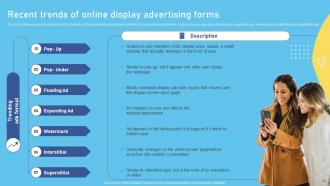
Slide 16: This slide showcases some of major trends in formats of display advertising in digital marketing.
Slide 17: This slide exhibit table of content- Format of display ads
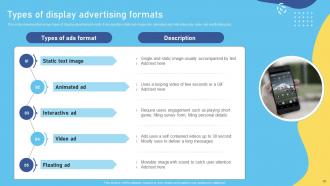
Slide 18: This slide showcase the various types of display advertising formats.
Slide 19: This slide showcases the size and location of major display advertising forms.
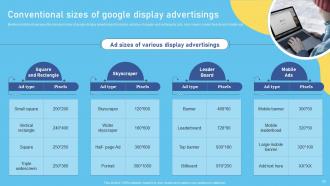
Slide 20: Mentioned slide showcases the standard sizes of google display advertisings.
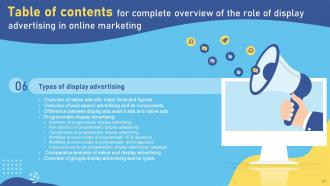
Slide 21: This slide exhibit table of content- Types of display advertising.
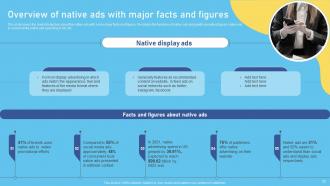
Slide 22: This slide covers the brief introduction about the native ads with some major facts and figures.
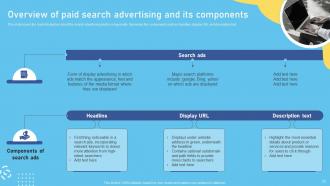
Slide 23: This slide covers the brief introduction about the search advertising and its components.
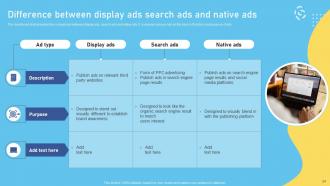
Slide 24: The mentioned slide provides the comparison between display ads, search ads and native ads.
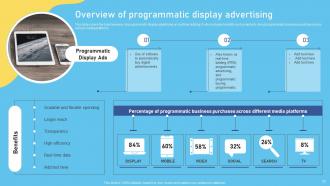
Slide 25: This slide covers the brief overview of programmatic display advertising or real time bidding.
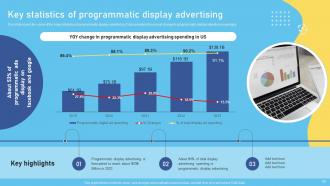
Slide 26: This slide covers the some of the major statistics of programmatic display advertising.
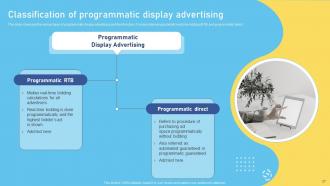
Slide 27: This slide showcase the various types of programmatic display advertising and their function.
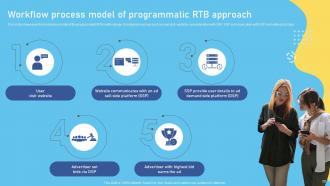
Slide 28: This slide showcases the functioning model of the programmatic RTB methodology.
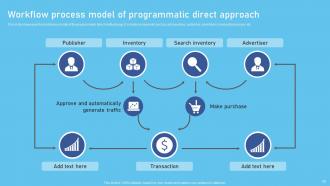
Slide 29: This slide showcases the functioning model of the programmatic direct methodology.
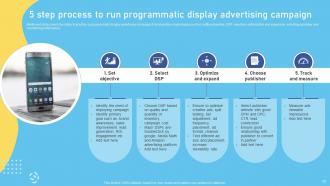
Slide 30: Mentioned slide covers the steps to practice a programmatic display advertising campaign.
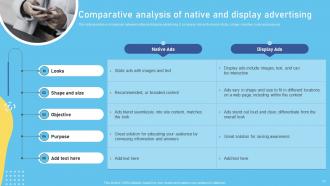
Slide 31: This slide provides a comparison between native and display advertising. It compares ads on the basis of size, shape, objective, looks and purpose.
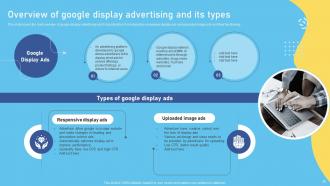
Slide 32: This slide covers the brief overview of google display advertising and it classification.
Slide 33: This slide exhibit table of content- Buying model of display advertising.
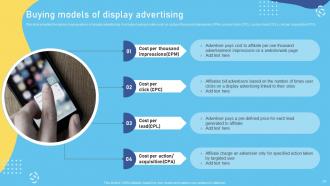
Slide 34: This slide provides the various buying options of display advertisings.
Slide 35: This slide exhibit table of content- Buying option for display advertising.
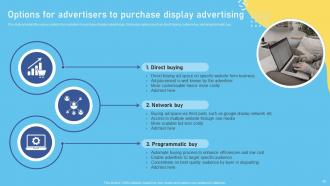
Slide 36: This slide provides the various options for marketers to purchase display advertisings.
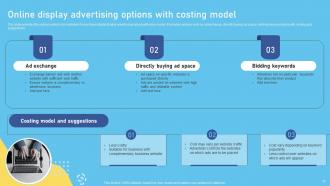
Slide 37: This slide provides the various options for marketers to purchase digital display advertisings along with price model.
Slide 38: This slide exhibit table of content- Bidding process model of display advertising.
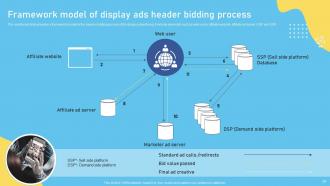
Slide 39: The mentioned slide provides a framework model for the header bidding process of the display advertising.
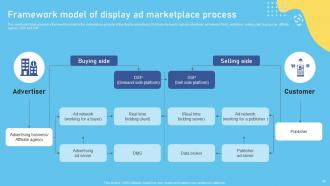
Slide 40: The mentioned slide provides a framework model for the marketplace process of the display advertising.
Slide 41: This slide exhibit table of content- Strategy.
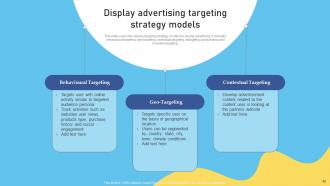
Slide 42: This slide covers the various targeting strategy models for display advertising.
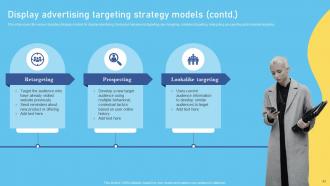
Slide 43: This slide covers the various targeting strategy models for display advertising.
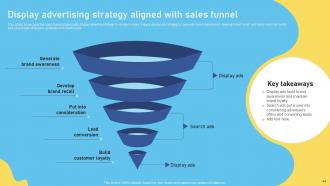
Slide 44: This slides showcases the sales funnel aligned with display adverting strategy to enhance sales.
Slide 45: This slide exhibit table of content- Implementation.
Slide 46: This slide provides the sequential plan of activities to implement display advertising campaign within a given timeframe.
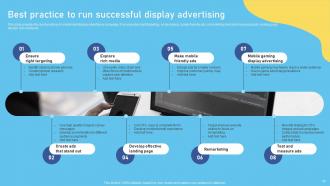
Slide 47: This slide provides the best practices to implement display advertising campaign.
Slide 48: This slide exhibit table of content- Dashboards.
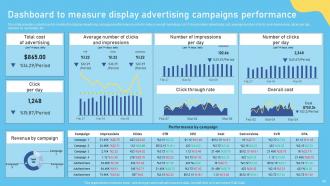
Slide 49: This slide provides a dashboard to monitor the display advertising campaign performance in order to reduce overall marketing cost.
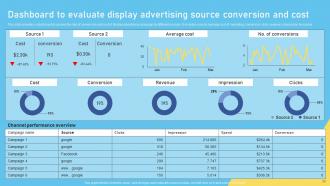
Slide 50: This slide provides a dashboard to assess the rate of conversion and cost of display advertising campaign by different sources.
Slide 51: This is the icons slide.
Slide 52: This slide presents title for additional slides.
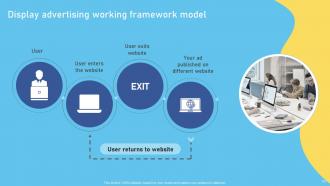
Slide 53: This slide showcase Display advertising working framework model.
Slide 54: This slide displays yearly bar graph for different products.
Slide 55: This slide showcase Arrow timeline.
Slide 56: This slide depicts 30-60-90 days plan for projects.
Slide 57: This slide exhibits ideas generated.
Slide 58: This slide presents your company's vision, mission and goals.
Slide 59: This slide showcase Quotes.
Slide 60: This slide shows details of team members like name, designation, etc.
Slide 61: This is thank you slide & contains contact details of company like office address, phone no., etc.
Complete Overview Of The Role Of Display Advertising In Online Marketing Complete Deck MKT CD with all 66 slides:
Use our Complete Overview Of The Role Of Display Advertising In Online Marketing Complete Deck MKT CD to effectively help you save your valuable time. They are readymade to fit into any presentation structure.
















FAQs for Complete Overview Of The Role Of Display Advertising In Online Marketing Complete
**INPUT**: What are the key components of an effective display advertising campaign? **OUTPUT**: Effective display advertising campaigns include compelling creative design, precise audience targeting, strategic ad placement, optimized landing pages, and comprehensive performance tracking. These components work together by enhancing brand visibility, driving qualified traffic, and maximizing conversion rates, with many organizations finding that strategic combinations of visual storytelling and data-driven targeting ultimately deliver stronger ROI and competitive market positioning. [Word count: 58 words]
Targeting options enhance display ad performance by enabling precise audience segmentation based on demographics, interests, behaviors, browsing history, and geographic location. These capabilities allow advertisers to deliver relevant messages to qualified prospects, significantly improving click-through rates, conversion rates, and return on ad spend while minimizing wasted impressions on uninterested audiences.
Key display advertising metrics include click-through rates, conversion rates, cost-per-acquisition, viewability scores, and return on ad spend. These measurements enable marketers to optimize campaign performance, allocate budgets strategically, and demonstrate ROI across channels, with many organizations finding that combining awareness metrics with conversion data delivers comprehensive insights for sustained competitive advantage.
A/B testing improves display ad effectiveness by comparing different creative elements, targeting parameters, and placement strategies to identify top-performing variations. Through systematic testing of headlines, visuals, call-to-action buttons, and audience segments, marketers can optimize click-through rates, conversion rates, and return on ad spend, with many brands finding that data-driven creative decisions significantly enhance campaign performance and reduce acquisition costs.
Retargeting enables businesses to re-engage previous website visitors through strategic ad placement, significantly improving conversion rates and maximizing marketing ROI. Through pixel tracking and audience segmentation, companies across retail, finance, and healthcare sectors can deliver personalized messaging that converts prospects into customers, ultimately reducing acquisition costs while enhancing customer lifetime value.
Programmatic advertising automates ad buying through real-time bidding and AI-driven targeting, while traditional display advertising relies on manual negotiations, fixed placements, and broader demographic targeting. Through automated platforms, advertisers achieve precise audience segmentation, dynamic pricing optimization, and instant campaign adjustments, ultimately delivering higher ROI and more efficient media spend than conventional approaches.
Video ads, interactive rich media, animated banners, responsive HTML5 creatives, and dynamic product ads represent the most effective display formats today. These formats enhance engagement through motion, personalization, and interactivity, with many retailers and e-commerce brands finding that video and dynamic ads deliver significantly higher click-through rates and conversions.
Mobile optimization is crucial for display advertising, as mobile devices now account for over 60% of digital ad impressions, with responsive design, fast loading times, and touch-friendly interfaces being essential. This optimization enables advertisers to reach consumers effectively across all touchpoints, significantly improving engagement rates and conversion performance while reducing bounce rates, ultimately delivering better ROI and competitive advantage in an increasingly mobile-first marketplace.
Common mistakes in display advertising include poor targeting, weak creative design, lack of frequency capping, inadequate landing page optimization, and insufficient performance tracking. Many businesses also neglect A/B testing their ad variations, fail to optimize for mobile experiences, and don't align their display campaigns with broader marketing strategies, ultimately missing opportunities for improved conversion rates and better return on advertising spend.
Businesses leverage data analytics for display ad targeting through demographic analysis, behavioral tracking, purchase history evaluation, and real-time engagement monitoring. These insights enable companies to create highly personalized campaigns, with retailers and financial services finding that data-driven targeting reduces acquisition costs while significantly improving conversion rates and customer engagement.
Visuals and design elements in display advertising deliver enhanced brand recognition, improved click-through rates, better audience engagement, and increased message retention. Through strategic color schemes, compelling imagery, and intuitive layouts, businesses across retail, technology, and financial services create memorable campaigns that capture attention in crowded digital spaces, ultimately driving higher conversion rates and stronger customer connections.
Advertisers ensure brand safety through content verification tools, contextual targeting technologies, publisher whitelisting, real-time monitoring systems, and brand suitability filters. These technologies streamline protection by scanning content context, blocking inappropriate placements, and providing transparency reports, with many organizations finding that strategic combinations of automated screening and human oversight ultimately deliver enhanced brand reputation while maintaining campaign reach.
Emerging display advertising trends for 2023 include programmatic automation, interactive rich media formats, contextual targeting, cross-device attribution, and AI-powered creative optimization. These technologies enhance campaign performance by delivering personalized experiences, improving targeting precision, and maximizing ROI across channels, with many retailers and financial services finding that integrated approaches ultimately drive higher engagement and competitive advantage.
User experience significantly impacts display ad effectiveness by influencing engagement rates, brand perception, and conversion outcomes through relevant targeting, non-intrusive placement, and mobile optimization. Well-designed display campaigns that prioritize seamless integration and fast loading times deliver higher click-through rates and customer satisfaction, with many retailers and financial services finding that user-centric approaches ultimately enhance both advertising ROI and brand loyalty.
Advertisers should be aware of data protection regulations like GDPR and CCPA, advertising standards authorities' guidelines, cookie consent requirements, sector-specific rules for finance and healthcare, and platform policies. These regulations ensure transparency, consumer privacy, and ethical advertising practices, with many organizations finding that compliance ultimately builds trust, enhances brand reputation, and delivers sustainable competitive advantage.
-
The website is jam-packed with fantastic and creative templates for a variety of business concepts. They are easy to use and customize.
-
Keep doing the good work guys. Surpass the needs and expectations always!!