

Complete Overview Of Training Course Feedback Survey Results Survey SS





Try Before you Buy Download Free Sample Product
 Impress Your
Audience
 100%
Editable
 Save Hours
of Time


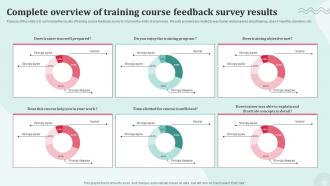
Purpose of this slide is to summarize the results of training course feedback survey to improve the skills of employees . Results provided are related to was trainer well prepared about training, does it meet the objectives, etc.
People who downloaded this PowerPoint presentation also viewed the following :
Complete Overview Of Training Course Feedback Survey Results Survey SS with all 7 slides:
Use our Complete Overview Of Training Course Feedback Survey Results Survey SS to effectively help you save your valuable time. They are readymade to fit into any presentation structure.






FAQs for Complete Overview Of Training Course Feedback Survey
Participants typically find interactive workshops, real-world case studies, hands-on practice sessions, personalized feedback, and actionable frameworks most valuable in training courses. These elements enhance learning retention by connecting theoretical concepts to practical applications, with many organizations finding that courses incorporating role-playing exercises, peer collaboration, and immediate skill implementation deliver significantly higher engagement and long-term knowledge retention.
Training course effectiveness in meeting stated objectives depends on measurable outcomes like skill acquisition, knowledge retention, behavioral changes, and performance improvements post-completion. Organizations typically assess this through pre/post evaluations, practical assessments, and follow-up surveys, with many finding that courses with clear learning pathways, interactive elements, and real-world applications deliver significantly higher objective achievement rates.
Training course presentation materials significantly enhance learning when they incorporate interactive elements, clear visual aids, relevant case studies, real-world scenarios, and multimedia components that cater to different learning styles. These materials streamline knowledge retention by reinforcing key concepts, facilitating hands-on practice, and enabling immediate application, with many organizations finding that engaging presentations ultimately deliver improved participant outcomes and higher training ROI.
Participants typically rate instructor delivery style and expertise based on clarity, engagement, subject knowledge, responsiveness to questions, and ability to facilitate learning effectively. Through comprehensive evaluations, organizations assess teaching methods, communication skills, and technical competency, with many finding that strong instructor ratings correlate with improved knowledge retention, higher participant satisfaction, and ultimately enhanced training program effectiveness.
Participants commonly suggest incorporating more interactive elements, real-world case studies, hands-on exercises, updated industry examples, and practical application opportunities into training content. These enhancements streamline learning by increasing engagement, improving knowledge retention, and enabling immediate skill application, with many organizations finding that interactive, practical training delivers significantly higher completion rates and better job performance outcomes.
Training courses deliver practical, actionable insights through hands-on exercises, real-world case studies, interactive workshops, and scenario-based learning modules that directly translate to workplace applications. These methodologies enable participants to immediately implement new skills, streamline existing processes, and enhance operational efficiency, with many organizations finding that employees demonstrate measurable performance improvements within weeks of completion.
The course effectively facilitated participant interaction through structured group discussions, collaborative exercises, breakout sessions, and peer-to-peer learning opportunities that encouraged knowledge sharing. These engagement methods enhanced the learning experience by building professional networks, fostering diverse perspectives, and creating dynamic environments where participants actively contributed, ultimately delivering stronger retention and practical application of course concepts.
The training course duration and pacing were well-calibrated to balance comprehensive content coverage with participant engagement, allowing adequate time for concept absorption, practical exercises, and interactive discussions. Many organizations find that this structured approach enhances knowledge retention, minimizes cognitive overload, and enables participants to immediately apply learned skills in their professional roles, ultimately delivering stronger training outcomes.
Interactive workshops, comprehensive course materials, hands-on simulations, expert-led discussions, and real-world case studies typically emerge as the most valuable training resources. These tools enhance learning by providing practical application opportunities, reinforcing theoretical concepts through experience, and enabling peer collaboration, with many organizations finding that multimodal approaches deliver significantly higher retention rates and improved skill implementation.
Training course preparation levels vary significantly among participants, with many organizations finding that pre-course readiness directly impacts learning outcomes, engagement rates, and skill retention. Effective preparation strategies include distributing prerequisite materials, conducting skills assessments, setting clear expectations, and providing foundational resources, ultimately enabling participants to maximize course value and accelerate their professional development in an increasingly competitive business environment.
Courses can better accommodate diverse learning styles by incorporating visual presentations, hands-on workshops, interactive discussions, audio recordings, and written materials throughout each module. This multimodal approach enables visual, auditory, and kinesthetic learners to engage effectively, with many training programs finding that varied delivery methods significantly enhance retention rates and participant satisfaction across different professional backgrounds.
Training participants typically report gaining enhanced communication abilities, practical problem-solving techniques, industry-specific technical competencies, leadership development skills, and improved analytical thinking capabilities. These skill acquisitions translate into measurable workplace improvements, with many organizations finding that employees demonstrate increased productivity, better collaboration, and more strategic decision-making abilities following comprehensive training programs.
The training environment significantly enhanced learning by providing comfortable seating, optimal lighting, minimal distractions, and accessible technology resources. Well-designed training spaces streamline knowledge retention, encourage active participation, and facilitate group collaboration, with many organizations finding that strategic investment in learning environments ultimately delivers improved training outcomes and higher participant engagement rates.
Participants typically show high recommendation rates when courses deliver practical skills, relevant content, and clear application pathways to their roles. Strong recommendations stem from interactive learning experiences, expert instruction, and tangible outcomes like improved performance or career advancement, with many finding that peer validation and networking opportunities significantly enhance perceived value and professional credibility.
Participants typically seek continued learning materials, implementation guides, refresher sessions, peer networks, and ongoing mentorship opportunities. These resources enhance knowledge retention by providing practical application support, addressing real-world challenges, and maintaining skill development momentum, with many organizations finding that comprehensive post-training support significantly improves training ROI and employee performance outcomes.
-
Editable templates with innovative design and color combination.
-
The service is fast, and I could access any presentation after buying the subscription. I don’t think I’ll ever have to worry about a presentation in my life.