

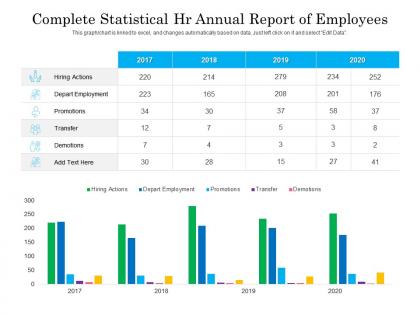
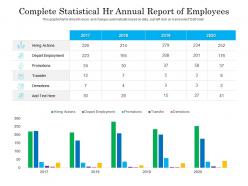
Complete statistical hr annual report of employees




Try Before you Buy Download Free Sample Product
 Impress Your
 Audience
 100%
100% Editable
 Save Hours
 of Time


Our Complete Statistical HR Annual Report Of Employees are topically designed to provide an attractive backdrop to any subject. Use them to look like a presentation pro.
People who downloaded this PowerPoint presentation also viewed the following :
Complete statistical hr annual report of employees with all 2 slides:
Use our Complete Statistical HR Annual Report Of Employees to effectively help you save your valuable time. They are readymade to fit into any presentation structure.
FAQs for Complete statistical hr annual
Start with the basics - turnover rates, time-to-hire, and engagement scores. Those three will tell you a lot. Performance metrics and training ROI come next, plus absenteeism patterns if that's an issue for you. Seriously though, resist the urge to track everything right away or you'll go insane looking at spreadsheets all day. Cost-per-hire is clutch for budget conversations with leadership. Internal mobility rates too. Pick maybe 5-7 that actually match your biggest headaches, nail those dashboards first, then add more later.
Look at your exit interview data first - that's where the gold is. HR analytics lets you catch patterns before people actually bounce. Track engagement scores, how good managers are, who's drowning in work, promotions, all that stuff. I've seen companies find crazy specific trends, like people who don't get promoted in 18 months being 3x more likely to quit. Pretty wild how predictable it gets. Once you spot the warning signs, you can actually do something about it. Better manager training, fix workload issues, make career paths clearer. Start connecting your performance data with why people leave and you'll see the real reasons they stick around.
Oh man, you're dealing with some seriously sensitive stuff - salaries, performance reviews, all that personal data. GDPR compliance is non-negotiable, obviously. Set up proper access controls and anonymize whatever you can. The legal nightmare potential here is real, trust me. Be upfront about what you're collecting and why. Regular audits are clutch. Only grab data you actually need for legit business reasons - don't go crazy collecting everything just because you can. Start with a privacy impact assessment before launching anything new. Solid data governance policies will save your butt later.
So basically you can look at your past hiring data and turnover rates to predict when you'll need people. Track seasonal patterns, which departments lose people most, retirement schedules - all that stuff. Honestly, most companies are terrible at this and just panic-hire. Feed the data into a predictive model and it'll tell you staffing gaps months out. Include external things too like industry trends. Start simple though - just map your current turnover first. That's your baseline. Way better than scrambling last minute when someone quits.
So Workday, BambooHR, and Tableau are the main ones everyone talks about. Budget's gonna be your biggest factor though - some of these get pricey fast. Look for automated reporting and predictive stuff, plus make sure it plays nice with whatever HRIS you're already using. Dashboard customization is clutch because generic reports are basically useless. Oh and don't mess around with privacy compliance - that'll bite you hard if you screw it up. Honestly, figure out your top 3 must-haves first, then just demo a few options.
So here's the thing - HR analytics actually shows you what's making people happy or miserable at work instead of just taking wild guesses. Look at your survey data and figure out which teams have higher satisfaction scores. You can break it down by department or how long people have been there, which is pretty useful honestly. Early burnout signs? Turnover risks? The data will flag those too. Rather than giving everyone the same random perks, focus your efforts where they'll actually work. Oh, and definitely compare your exit interviews with engagement scores - I bet you'll find some weird patterns that lead to easy fixes.
Honestly, the hardest part isn't even the tech stuff - it's convincing leadership who've always gone with their gut. Your data's gonna be a mess too. Payroll, recruiting, performance reviews - everything's in different systems and half of it's incomplete or just wrong. Most HR people aren't analytics-savvy yet, which creates this weird skills gap. Oh, and privacy issues are huge since you're dealing with employee info. Cultural shift is brutal. I'd say pick one simple use case first, get a quick win, then slowly expand from there. Way easier than trying to overhaul everything at once.
So here's what I'd do - start tracking diversity numbers across hiring, promotions, and retention. Really dig into your recruitment funnel data first. Are diverse candidates bailing at certain stages? That's usually where the problem is. Then look at pay gaps, promotion rates by demographic, employee engagement stuff. Honestly, the results might surprise you (and not in a good way). Once you have the data, actually DO something with it. Maybe your job descriptions are turning people off, or certain managers need bias training. Oh, and don't just run one report - set up dashboards so you're constantly monitoring this stuff.
So basically sentiment analysis tracks employee moods through surveys and emails - helps you catch problems before they blow up. I've seen it work really well for spotting burnout early. Companies use it to figure out which teams are struggling and what's pissing people off. You can analyze exit interviews, watch how internal communication changes after new policies, that sort of thing. Honestly though, the trick is actually doing something with the data instead of just hoarding it. Regular pulse checks are solid but only if you're gonna act on what you find, you know?
Honestly, social media is gold for finding where good candidates actually spend their time. LinkedIn's the obvious one, but don't sleep on Twitter, GitHub, or even Instagram - they'll show you what skills are trending and what people actually care about. Developers are basically glued to GitHub anyway. Look at hashtags, see who's engaging with what, figure out their networks. Then you can write job posts that don't suck and actually speak their language. I'd start with just one platform though - whichever one your dream hires use most - and test different approaches based on how they behave there.
Dude, HR analytics is a game changer. Instead of guessing who's gonna quit or who deserves that promotion, you actually have data backing your decisions. Pretty wild how much better you can predict flight risks and identify future stars early on. Most training programs are honestly garbage, but analytics shows you which ones actually work. You can build personalized development plans too - way better than those boring generic workshops everyone hates. My advice? Start simple with something like retention rates. Figure out what's making people leave and go from there.
Honestly, measuring HR analytics ROI is pretty straightforward - just compare what you spent on the program versus the money it saved you. Look at stuff like lower turnover costs, quicker hiring times, better productivity. The annoying part? Figuring out what your analytics actually caused vs. what would've happened anyway. Basic formula is (gains minus costs) divided by costs times 100. Don't try measuring everything at once though - that's a nightmare. Pick 2-3 metrics that clearly connect to business results. I'd start simple and add complexity later once you get the hang of it.
Honestly, you need both tech and business skills to nail HR analytics. Data literacy is huge - not saying you need to be a stats wizard, but get comfortable with metrics and reading dashboards. Excel is non-negotiable, and picking up SQL or Tableau will seriously make you stand out. Business sense matters just as much though. You've got to ask smart questions and tie insights back to actual strategy. Communication skills are clutch since you'll translate nerdy findings into stuff executives can act on. Oh, and master whatever HRIS you're using now - that's your foundation. Practice storytelling with numbers!
Honestly, HR analytics is a game-changer when everything's going sideways at work. It shows you what's actually happening with your team in real time - like who's about to quit or where you're missing key skills. Way better than just crossing your fingers and hoping things work out, you know? During big changes, you can quickly figure out if you need to hire, retrain people, or move them around. Track engagement too because sometimes leadership thinks everyone's doing great when they're actually falling apart. Oh, and pick maybe 3-5 metrics to watch weekly - don't go overboard or you'll drown in data.
Oh man, Google's Project Oxygen is like the gold standard here - they actually proved with data that good managers aren't just nice-to-haves (who knew?). Microsoft got smart about predicting which employees might quit by looking at engagement surveys. Netflix does their whole "keeper culture" thing with analytics backing their pay decisions. IBM used Watson to spot skills gaps and build custom learning for people. Honestly though, you don't need to go full tech giant mode. Just start with something basic like analyzing why people leave - even simple turnover data can tell you a ton about what's really going on.
-
Design layout is very impressive.
-
Editable templates with innovative design and color combination.
-
Easy to edit slides with easy to understand instructions.
-
Great designs, really helpful.
-
Awesomely designed templates, Easy to understand.