


Comprehensive devops adoption initiatives it powerpoint presentation slides




Try Before you Buy Download Free Sample Product
 Impress Your
 Audience
 100%
100% Editable
 Save Hours
 of Time


DevOps initiatives focus on implementing DevOps for application development in order to reduce overall IT costs, failures, and product delays. Here is a professionally designed template on comprehensive DevOps adoption initiatives that represents various trends associated with evaluating DevOps market scenarios and implementing DevOps. It includes different phases of the DevOps life cycle, main stages related to DevOps, and essential considerations for DevOps implementation. Discuss the crucial strategies for effective DevOps adoption and transformation associated with DevOps. Additionally, it highlights the roles and responsibilities of the DevOps team and the main activities involved in the DevOps process. Not only this, the template will guide you through the value proposition associated with DevOps, an environment reference model, user persona for a better understanding of the customer. This module uses slides on various metrics to measure the effectiveness of the DevOps system. Additionally, it can be of great use in assessing costs associated with DevOps adoption in terms of team training, DevOps management solutions, etc. It also covers slides on impact assessment of successful DevOps implementation and a dashboard to track activities. Download this insightful template now.
People who downloaded this PowerPoint presentation also viewed the following :
Content of this Powerpoint Presentation
Slide 1: This slide introduces Comprehensive DevOps Adoption Initiatives (IT). State Your Company Name and begin.
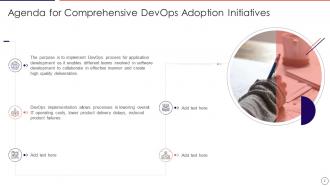
Slide 2: This slide shows Agenda for Comprehensive DevOps Adoption Initiatives.
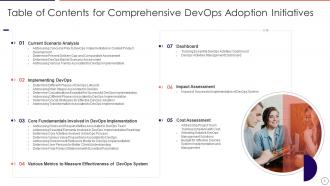
Slide 3: This slide presents Table of Contents for Comprehensive DevOps Adoption Initiatives.
Slide 4: This slide shows Table of Contents for Comprehensive DevOps Adoption Initiatives.
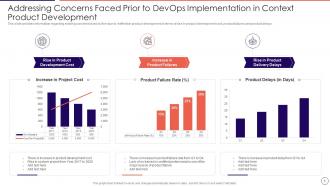
Slide 5: This slide displays Addressing Concerns Faced Prior to DevOps Implementation in Context Product Development.
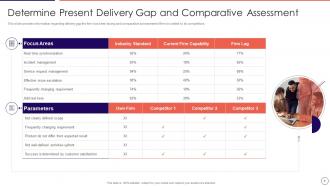
Slide 6: This slide represents Determine Present Delivery Gap and Comparative Assessment.
Slide 7: This slide shows Determine DevOps Market Scenario Assessment.
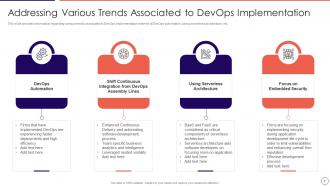
Slide 8: This slide presents Addressing Various Trends Associated to DevOps Implementation.
Slide 9: This slide shows Table of Contents for Comprehensive DevOps Adoption Initiatives.
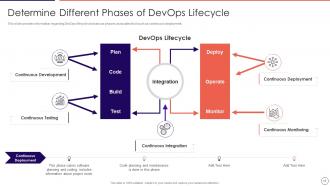
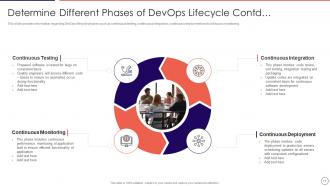
Slide 10: This slide displays DevOps lifecycle and various phases associated to it such as continuous deployment.
Slide 11: This slide represents DevOps implementation in terms of DevOps automation, using serverless architecture, etc.
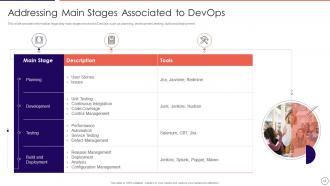
Slide 12: This slide shows main stages involved in DevOps such as planning, development, testing, build and deployment.
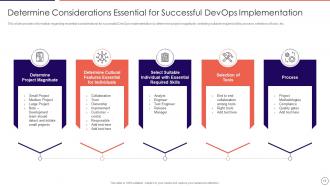
Slide 13: This slide presents Determine Considerations Essential for Successful DevOps Implementation.
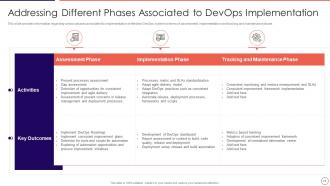
Slide 14: This slide shows Addressing Different Phases Associated to DevOps Implementation.
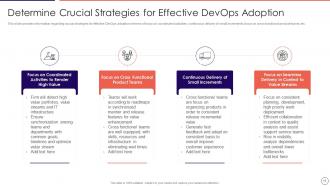
Slide 15: This slide displays Determine Crucial Strategies for Effective DevOps Adoption.
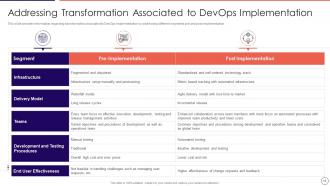
Slide 16: This slide represents Addressing Transformation Associated to DevOps Implementation.
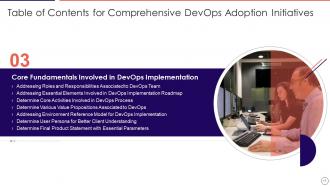
Slide 17: This slide shows Table of Contents for Comprehensive DevOps Adoption Initiatives.
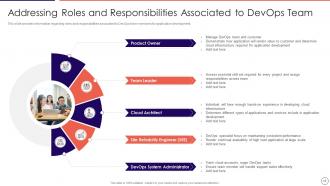
Slide 18: This slide presents roles and responsibilities associated to DevOps team members for application development.
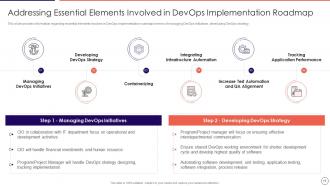
Slide 19: This slide shows Addressing Essential Elements Involved in DevOps Implementation Roadmap.
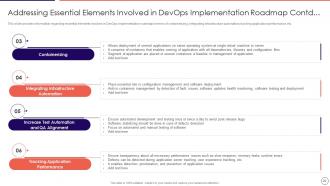
Slide 20: This slide displays essential elements involves in DevOps implementation roadmap in terms of containerizing, integrating infrastructure automation, tracking application performance, etc.
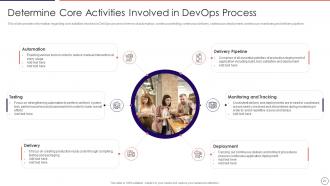
Slide 21: This slide represents Determine Core Activities Involved in DevOps Process.
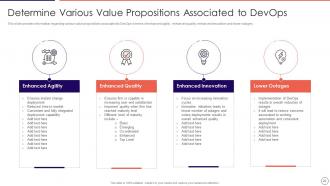
Slide 22: This slide shows Determine Various Value Propositions Associated to DevOps.
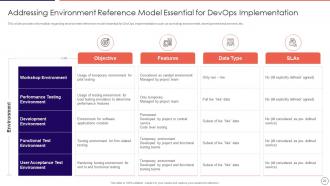
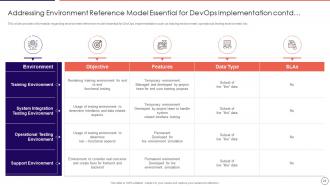
Slide 23: This slide presents Addressing Environment Reference Model Essential for DevOps Implementation.
Slide 24: This slide shows environment reference model essential for DevOps implementation.
Slide 25: This slide displays Determine User Persona for Better Client Understanding.
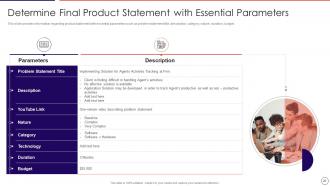
Slide 26: This slide represents Determine Final Product Statement with Essential Parameters.
Slide 27: This slide shows Table of Contents for Comprehensive DevOps Adoption Initiatives.
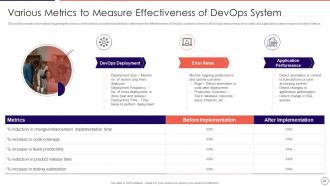
Slide 28: This slide presents Various Metrics to Measure Effectiveness of DevOps System.
Slide 29: This slide shows Table of Contents for Comprehensive DevOps Adoption Initiatives.
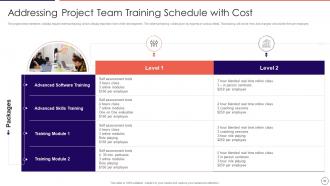
Slide 30: This slide displays Addressing Project Team Training Schedule with Cost.
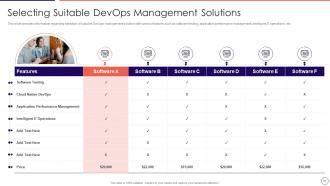
Slide 31: This slide represents Selecting Suitable DevOps Management Solutions.
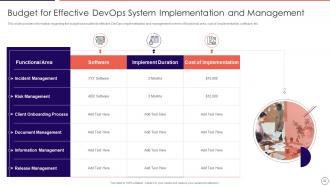
Slide 32: This slide shows Budget for Effective DevOps System Implementation and Management.
Slide 33: This slide presents Table of Contents for Comprehensive DevOps Adoption Initiatives.
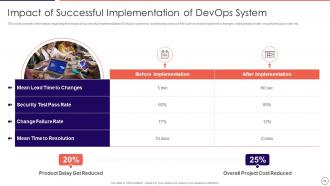
Slide 34: This slide shows Impact of Successful Implementation of DevOps System.
Slide 35: This slide displays Table of Contents for Comprehensive DevOps Adoption Initiatives.
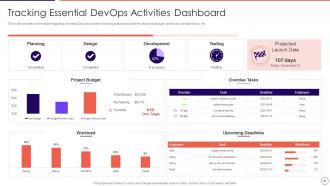
Slide 36: This slide represents essential DevOps activities tracking dashboard in terms of project budget, workload, overdue tasks, etc.
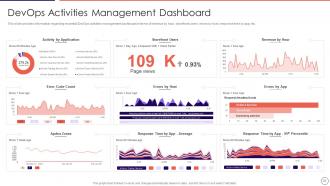
Slide 37: This slide shows DevOps Activities Management Dashboard.
Slide 38: This slide shows Icons for Comprehensive DevOps Adoption Initiatives.
Slide 39: This slide is titled as Additional Slides for moving forward.
Slide 40: This slide shows 30 60 90 Days Plan with text boxes.
Slide 41: This slide shows Weekly Timeline with Task Name.
Slide 42: This slide shows Roadmap For Process Flow.
Slide 43: This slide shows Post It Notes. Post your important notes here.
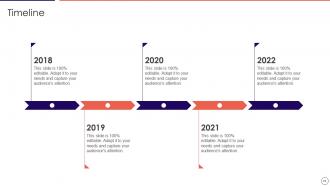
Slide 44: This is a Timeline slide. Show data related to time intervals here.
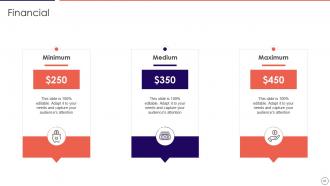
Slide 45: This is a Financial slide. Show your finance related stuff here.
Slide 46: This slide shows Venn diagram with text boxes.
Slide 47: This is a Thank You slide with address, contact numbers and email address.
Comprehensive devops adoption initiatives it powerpoint presentation slides with all 55 slides:
Use our Comprehensive DevOps Adoption Initiatives IT Powerpoint Presentation Slides to effectively help you save your valuable time. They are readymade to fit into any presentation structure.















FAQs for Comprehensive devops adoption initiatives it
Key benefits organizations achieve through DevOps adoption include faster deployment cycles, improved collaboration between development and operations teams, enhanced code quality, reduced time-to-market, and increased operational efficiency. These practices streamline software delivery by automating processes, minimizing manual errors, and enabling continuous integration, with many enterprises finding that DevOps ultimately delivers significant competitive advantage and improved customer experiences.
DevOps culture emphasizes collaboration, continuous integration, and shared responsibility across development and operations teams, contrasting traditional methodologies' siloed approaches with separate phases and handoffs. This cultural shift enables faster deployment cycles, improved communication, and enhanced product quality, with organizations like Netflix and Amazon leveraging DevOps practices to deliver seamless customer experiences and maintain competitive advantage.
Organizations face challenges including cultural resistance to collaboration, skills gaps in automation tools, legacy system integration complexities, security concerns with faster deployments, and inconsistent processes across teams. While these obstacles initially slow transformation, many companies find that addressing them systematically through training, gradual implementation, and cross-functional partnerships ultimately delivers enhanced operational efficiency and competitive advantage.
Implementing DevOps in legacy systems requires gradual modernization through containerization, automated testing frameworks, continuous integration pipelines, infrastructure as code, and cross-functional team restructuring. Organizations like banks and insurance companies successfully transition by starting with non-critical applications, establishing monitoring systems, and creating feedback loops, ultimately reducing deployment times while maintaining system stability and regulatory compliance.
Metrics and KPIs provide essential visibility into DevOps effectiveness by tracking deployment frequency, lead times, change failure rates, and mean time to recovery. These measurements enable organizations to identify bottlenecks, optimize workflows, and demonstrate tangible improvements in software delivery speed and reliability, with many teams finding that data-driven insights accelerate their transformation journey.
Essential DevOps tools include version control systems like Git, CI/CD platforms such as Jenkins and GitLab, containerization technologies like Docker and Kubernetes, infrastructure automation tools including Terraform and Ansible, and monitoring solutions like Prometheus and New Relic. These technologies streamline development workflows, enhance deployment reliability, and enable faster time-to-market, with many organizations finding significant improvements in operational efficiency.
Teams can foster DevOps collaboration by implementing cross-functional communication channels, establishing shared responsibility models, promoting knowledge sharing sessions, and creating unified metrics and goals. Through collaborative tools and continuous integration practices, organizations streamline workflows, reduce silos, and enhance transparency, with many technology companies finding that these cultural shifts ultimately deliver faster deployment cycles and improved operational efficiency.
Automation serves as DevOps' foundation, enabling continuous integration, automated testing, infrastructure provisioning, deployment pipelines, and monitoring across development lifecycles. Through strategic automation implementation, organizations streamline code releases, minimize manual errors, and accelerate delivery cycles, with many financial services and healthcare institutions finding that automated workflows reduce deployment time by 60-80% while enhancing operational reliability.
CI/CD serves as the automation backbone of DevOps frameworks, enabling seamless code integration, automated testing, and rapid deployment cycles that eliminate manual bottlenecks. These practices streamline development workflows by automatically building, testing, and deploying code changes, with organizations like Netflix and Amazon leveraging CI/CD to achieve faster time-to-market and enhanced operational efficiency.
Promoting DevOps across departments involves establishing cross-functional teams, implementing shared toolchains, creating unified communication channels, fostering collaborative culture through training, and aligning metrics across development and operations. These practices streamline workflows by breaking down silos, enhancing transparency, and accelerating deployment cycles, with many organizations finding that strategic cross-departmental integration ultimately delivers faster time-to-market and improved operational efficiency.
Organizations ensure DevOps practices align with security protocols by integrating security controls directly into CI/CD pipelines, implementing automated vulnerability scanning, conducting regular security assessments, and establishing clear governance frameworks. Through DevSecOps implementation, companies like financial services and healthcare providers streamline compliance requirements, reduce security vulnerabilities, and accelerate secure deployments, ultimately delivering faster time-to-market while maintaining robust protection.
Cloud computing significantly accelerates DevOps adoption by providing scalable infrastructure, automated deployment pipelines, and seamless integration capabilities that eliminate traditional hardware constraints. Through cloud platforms, organizations streamline development cycles, enhance collaboration between teams, and reduce deployment times from weeks to minutes, with companies in financial services and healthcare finding that cloud-native DevOps delivers faster innovation and improved operational efficiency.
DevOps enhances software quality and accelerates time to market by automating testing, enabling continuous integration, and streamlining deployment pipelines. Through automated quality checks and collaborative workflows, organizations minimize bugs, reduce manual errors, and deliver updates faster, with many financial services and e-commerce companies finding significantly improved customer experiences and competitive advantage.
Common DevOps misconceptions include believing it's only about tools, that it eliminates the need for operations teams, requires complete cultural overhaul overnight, or guarantees immediate results without process changes. These misunderstandings lead organizations to focus solely on automation tools rather than fostering collaboration, communication, and gradual cultural transformation, ultimately hindering successful implementation and sustainable outcomes.
Cultivating a growth mindset in DevOps requires encouraging continuous learning through cross-functional collaboration, implementing regular retrospectives, and celebrating failures as learning opportunities rather than setbacks. Through mentorship programs, skill-sharing sessions, and rotation between development and operations roles, teams develop adaptability and resilience, ultimately delivering faster innovation cycles and enhanced problem-solving capabilities across the organization.
-
Much better than the original! Thanks for the quick turnaround.
-
Editable templates with innovative design and color combination.
-
Content of slide is easy to understand and edit.
-
Much better than the original! Thanks for the quick turnaround.
-
The Designed Graphic are very professional and classic.