

Comprehensive Onboarding Program Aimed At Enhancing Employee Retention And Performance Complete Deck




Try Before you Buy Download Free Sample Product
 Impress Your
 Audience
 100%
100% Editable
 Save Hours
 of Time


The Employee Onboarding Plan is a comprehensive guide crafted to streamline the successful assimilation of new hires into an organization. Comprehensive Onboarding Program Aimed at Enhancing Employee Retention and Performance in PowerPoint is specifically designed to minimize employee turnover by enhancing engagement, productivity, retention, and overall satisfaction. This extensive Onboarding Process presentation is structured into distinct phases pre-boarding, initial onboarding, team-centric training and orientation, growth, mentoring, initial performance, and nurturing and employee development. The New Hire Integration Program presentation goes beyond and includes activities such as establishing pre-onboarding communication, personalizing pre-onboarding experiences, conducting employee orientation, implementing ongoing performance reviews and feedback, and creating career advancement programs for holistic professional and personal growth. Moreover, the Staff Integration Strategy deck incorporates the digitization of the employee onboarding plan through the integration of a learning management system. Finally, the Employee Orientation Plan template encompasses aspects like budget allocation and performance dashboard monitoring, specifically targeting attrition rate and employee experience assessment. Gain access to this robust template now for a powerful and effective onboarding strategy.
People who downloaded this PowerPoint presentation also viewed the following :
Content of this Powerpoint Presentation
Slide 1: The slide introduces Comprehensive Onboarding Program Aimed at Enhancing Employee Retention and Performance. Put your Company name and Begin.
Slide 2: The slide displays Agenda for presentation.
Slide 3: The slide contains Table of contents for presentation.
Slide 4: The slide continues Table of contents.
Slide 5: The slide shows another Table of contents which is to be discussed further.
Slide 6: This slide presents key onboarding challenges faced by the organization.
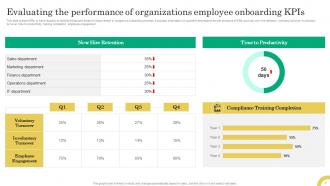
Slide 7: This slide represent KPIs to track regularly to identify trends and areas for improvement in company's onboarding process.
Slide 8: This slide shows a survey analysis of employees who resigned within the first six months of their employment.
Slide 9: This slide examines the need for optimizing company's onboarding process.
Slide 10: The slide displays another Table of contents.
Slide 11: This slide sets objective and goals for onboarding plan.
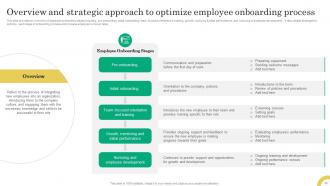
Slide 12: This slide renders an overview of employee onboarding stages.
Slide 13: This slide presents expected outcome of effective onboarding program.
Slide 14: The slide highlights Table of contents further.
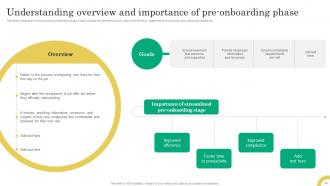
Slide 15: This slide represents an overview of pre-onboarding phase.
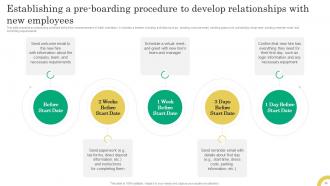
Slide 16: This slide depicts an onboarding schedule before the commencement of initial orientation.
Slide 17: This slide shows an initial communication plan for guiding the new hire through the pre-onboarding process.
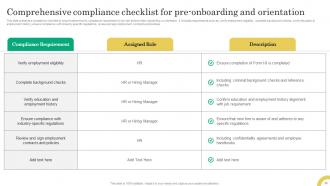
Slide 18: This slide displays a compliance checklist to ensure adherence to compliance requirement to be met before initial onboarding.
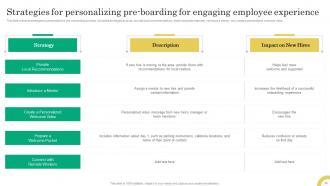
Slide 19: This slide represents strategies to personalize the pre-onboarding process.
Slide 20: The slide depicts Table of contents for presentation.
Slide 21: This slide presents an overview of initial onboarding stage.
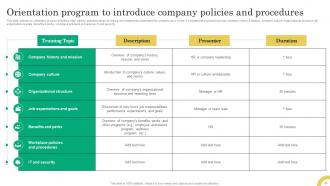
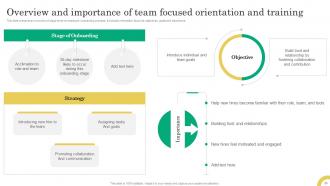
Slide 22: This slide outlines an overview to introducing employees to company culture and processes.
Slide 23: This slide outlines an orientation program including initial training sessions aimed at helping new employees.
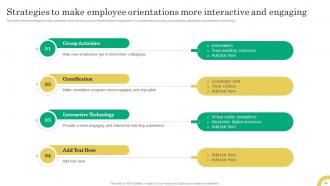
Slide 24: This slide presents strategies to make orientation more interactive and increase employee engagement.
Slide 25: This slide represents the activities to be conducted to improve orientation program.
Slide 26: This slide highlights an overview why introduction to key stakeholders is important.
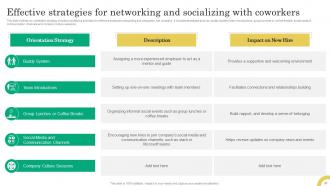
Slide 27: This slide outlines an orientation strategy including socializing activities.
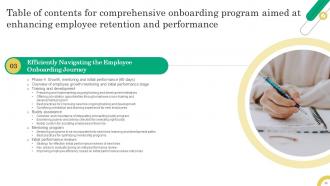
Slide 28: The slide renders Table of contents further.
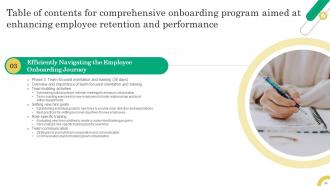
Slide 29: This slide describes an overview of stage three on employee onboarding process.
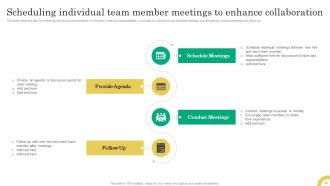
Slide 30: This slide presents a plan for effectively introducing team members to their team, roles and responsibilities.
Slide 31: This slide exhibits various team building activities to build relationship and trust.
Slide 32: This slide discusses the four types of goals that can be used to provide new employees.
Slide 33: This slide presents best practices for establishing individual goals for new hires.
Slide 34: This slide outlines a strategy to assess new hires' skills.
Slide 35: This slide outlines a personalized role-specific training plan for new hires.
Slide 36: This slide presents strategies for promoting open communication and feedback between the new hire and their teammates.
Slide 37: This slide outlines a communication plan for fostering team collaboration and communication.
Slide 38: The slide highlights Table of contents which is to be discussed further.
Slide 39: This slide presents an overview of fourth phase of employee onboarding.
Slide 40: This slide outlines steps to prepare for ongoing training and development.
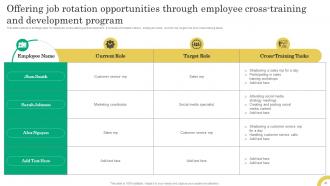
Slide 41: This slide illustrates a strategic plan for employee cross-training and development.
Slide 42: This slide presents best practices for improving new hire ongoing training and development.
Slide 43: This slide shows the key onboarding gamification examples for optimizing the learning experience for new hires.
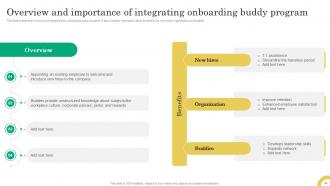
Slide 44: This slide describes an overview of integrating an onboarding buddy program.
Slide 45: This slide represents a criteria checklist for selecting right buddy for effective onboarding.
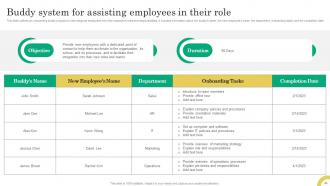
Slide 46: This slide outlines an onboarding buddy program to help integrate employees into their respective roles and responsibilities.
Slide 47: This slide presents various types of mentorship programs to incorporate in learning and growth development.
Slide 48: This slide presents best practices for optimizing the mentorship programs.
Slide 49: This slide outlines a strategy to provide effective initial performance reviews of new hires.
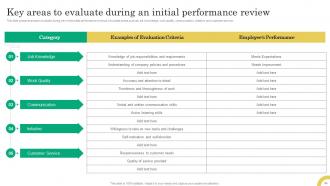
Slide 50: This slide presents areas to evaluate during new hires initial performance reviews.
Slide 51: This slide shows a strategy for improving employee performance.
Slide 52: The slide shows Table of contents for presentation further.
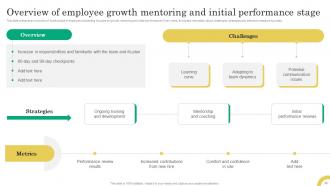
Slide 53: The slide renders Overview of nurturing and employee development stage.
Slide 54: This slide presents a framework for establishing a culture of continuous learning and employee growth.
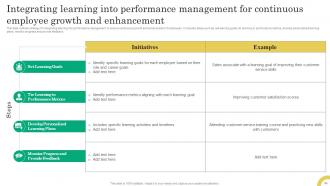
Slide 55: This slide outlines strategy for integrating learning into performance management.
Slide 56: This slide represent an overview on the need of reward and recognition program.
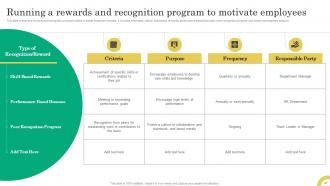
Slide 57: This slide presents a rewards and recognition program outline to boost employee morales.
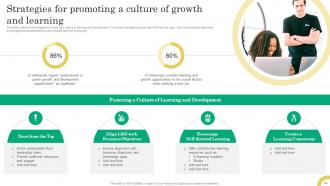
Slide 58: This slide outlines the strategies for fostering a culture of learning and development.
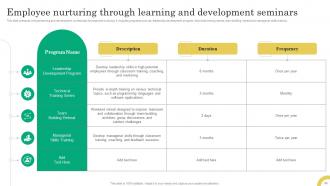
Slide 59: This slide shows various learning and development workshops for employee nurturing.
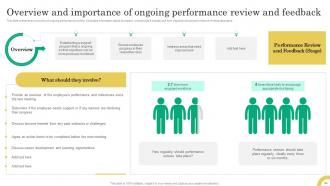
Slide 60: This slide represents an overview of ongoing performance review.
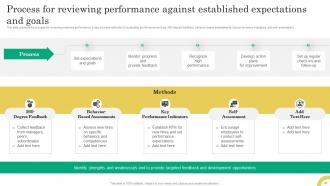
Slide 61: This slide presents the process for reviewing employee performance.
Slide 62: This slide renders a 30,60 and 90-day performance review plan for analyzing new hires performance areas.
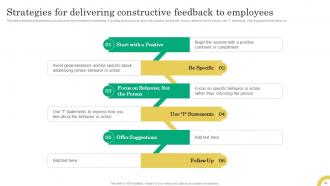
Slide 63: This slide presents the techniques to provide constructive feedback to employees.
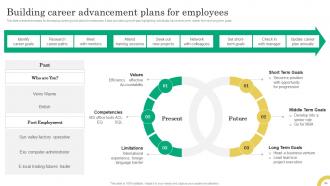
Slide 64: This slide shows the steps for developing career growth plans for employees.
Slide 65: The slide describes Title of contents which is to be discussed further.
Slide 66: This slide highlights an overview of digitalizing the employee onboarding system.
Slide 67: This slide presents various solutions and systems for digitizing the employee onboarding experience.
Slide 68: This slide exhibits a comparative analysis of various learning management systems.
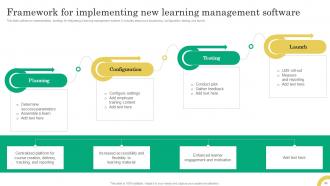
Slide 69: This slide outlines an implementation strategy for integrating a learning management system.
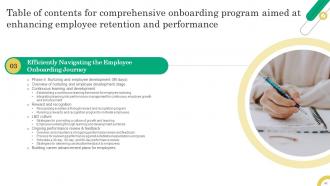
Slide 70: The slide displays another Table of contents for presentation.
Slide 71: This slide defines the roles & responsibilities for streamlined employee onboarding process.
Slide 72: This slide presents a pie chart showcasing the budget for each phase of employee onboarding.
Slide 73: This slide provides a checklist for employee onboarding.
Slide 74: The slide shows again Table of contents for presentation.
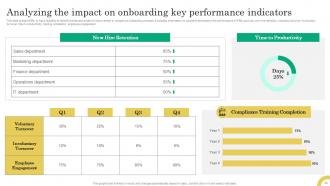
Slide 75: This slide present KPIs to track regularly to identify trends and areas for improvement in company's onboarding process.
Slide 76: This slide showcases a before vs after analysis of successful implementation of employee onboarding plan.
Slide 77: The slide describes Table of contents which is to be discussed further.
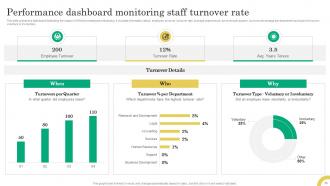
Slide 78: This slide represents a dashboard illustrating the impact of effective employee onboarding.
Slide 79: This slide depicts a dashboard tracking employee experience KPIs.
Slide 80: This slide shows all the icons included in the presentation.
Slide 81: This slide is titled as Additional Slides for moving forward.
Slide 82: This is Our Mission slide with related imagery and text.
Slide 83: This is About Us slide to show company specifications etc.
Slide 84: This is a Timeline slide. Show data related to time intervals here.
Slide 85: This slide provides Clustered Column chart with two products comparison.
Slide 86: This is a Thank You slide with address, contact numbers and email address.
Comprehensive Onboarding Program Aimed At Enhancing Employee Retention And Performance Complete Deck with all 94 slides:
Use our Comprehensive Onboarding Program Aimed At Enhancing Employee Retention And Performance Complete Deck to effectively help you save your valuable time. They are readymade to fit into any presentation structure.











































FAQs for Comprehensive Onboarding Program Aimed At Enhancing Employee Retention And
Effective onboarding presentations include clear company culture communication, role-specific expectations, process workflows, technology training modules, and relationship-building opportunities with key stakeholders. These elements streamline new employee integration by reducing confusion, accelerating productivity, and enhancing retention rates, with many organizations finding that structured presentations ultimately deliver faster time-to-contribution and improved employee satisfaction.
Presentation templates enhance onboarding by standardizing information delivery, ensuring consistent messaging across departments, and creating visually engaging content that improves retention. These templates streamline HR processes, reduce preparation time, and enable managers to focus on personalized interactions, with many organizations finding that structured visual onboarding accelerates employee integration and reduces time-to-productivity significantly.
Storytelling transforms onboarding presentations by creating emotional connections, making complex information memorable, and helping new hires understand company culture and values through relatable narratives. Through compelling stories about customer successes, team achievements, and organizational growth, companies enhance engagement, accelerate cultural integration, and ultimately deliver more impactful onboarding experiences that boost retention.
Visuals in onboarding presentations enhance information retention by simplifying complex processes, creating memorable associations, and appealing to visual learning preferences. Through infographics, flowcharts, and interactive diagrams, organizations streamline knowledge transfer while reducing cognitive overload, with many HR departments finding that visual-rich onboarding increases employee comprehension rates and accelerates time-to-productivity across departments.
Common onboarding presentation pitfalls include information overload, generic content lacking role-specific relevance, poor visual design, lengthy sessions without engagement breaks, and missing clear action items. Organizations across industries find that avoiding these mistakes through structured, interactive presentations with bite-sized modules, personalized content, and visual storytelling significantly enhances new hire retention and accelerates productivity timelines.
Cultural differences significantly impact onboarding through varying communication styles, learning preferences, hierarchy expectations, feedback comfort levels, and relationship-building approaches across regions. Multinational companies increasingly customize their programs by incorporating local mentorship models, culturally-sensitive training materials, and flexible timelines, with many organizations finding that tailored onboarding enhances employee engagement and reduces early turnover rates.
Key metrics include time-to-productivity, employee retention rates, training completion scores, role competency assessments, and new hire satisfaction surveys. These measurements enable organizations to streamline their onboarding processes by identifying knowledge gaps, reducing turnover costs, and accelerating integration, with many companies finding that effective tracking ultimately delivers faster employee engagement and improved long-term performance outcomes.
Companies leverage new hire feedback by conducting structured surveys, exit interviews, and focus groups to identify presentation gaps, content clarity issues, and engagement opportunities. This input enables organizations to streamline materials, enhance interactive elements, and personalize experiences, with many finding that iterative improvements based on employee insights ultimately deliver faster integration and higher retention rates.
PowerPoint, Canva, Prezi, Articulate Storyline, and Adobe Creative Suite offer robust features for creating interactive onboarding presentations. These platforms enable organizations to design visually compelling content with multimedia elements, interactive assessments, and personalized learning paths, ultimately delivering more engaging employee experiences and faster time-to-productivity across departments.
Departments can tailor onboarding presentations by customizing content focus, incorporating role-specific workflows, adapting communication styles, and highlighting relevant tools and processes. Sales teams emphasize CRM systems and customer interaction protocols, while IT departments focus on security frameworks and technical infrastructure, with many organizations finding that department-specific approaches reduce training time and accelerate employee productivity.
Onboarding timing significantly impacts engagement and retention, with employees who experience structured programs within their first 90 days showing 58% higher likelihood of remaining after three years. Well-timed onboarding enhances productivity, accelerates role integration, and builds stronger organizational connections, while delayed or rushed processes often result in confusion, reduced confidence, and ultimately higher turnover rates across industries.
Interactive elements in onboarding presentations enhance engagement by incorporating polls, quizzes, clickable scenarios, and real-time feedback mechanisms that transform passive viewing into active participation. These features enable HR teams to gauge comprehension, customize content delivery, and create memorable experiences, with many organizations finding that interactive onboarding reduces time-to-productivity and increases new hire retention rates significantly.
Best practices for presenting company culture during onboarding include storytelling sessions with leadership, interactive workshops showcasing core values, mentorship pairings with cultural ambassadors, immersive office tours highlighting traditions, and structured feedback sessions. These approaches enhance new hire engagement by creating emotional connections, accelerating cultural integration, and building stronger team relationships, with many organizations finding that comprehensive cultural immersion significantly improves retention rates.
Onboarding templates can be customized by adjusting communication frequency, incorporating virtual collaboration tools, emphasizing digital resource accessibility for remote teams, while prioritizing hands-on demonstrations and face-to-face mentoring for in-person training. Remote templates focus on structured check-ins and self-paced modules, whereas in-person versions leverage immediate feedback and collaborative workspace interactions, ultimately delivering tailored experiences that optimize engagement across different work environments.
Digital onboarding trends include interactive virtual reality experiences, AI-powered personalized learning paths, gamified progress tracking, mobile-first design approaches, and real-time collaboration tools. These technologies streamline employee integration by delivering immersive experiences, adaptive content delivery, and seamless remote accessibility, with many organizations finding that strategic digital transformation ultimately enhances engagement and accelerates time-to-productivity.
-
“As you have innovative ideas and they are all customizable, this saves a huge chunk of your time to prepare well-read presentations.”
-
Great combination of visuals and information. Glad I purchased your subscription.