

Comprehensive Tutorial About Natural Language Processing NLP Powerpoint Presentation Slides AI CD V




Try Before you Buy Download Free Sample Product
 Impress Your
 Audience
 100%
100% Editable
 Save Hours
 of Time


Explore the realm of Natural Language Processing NLP in Artificial Intelligence with our dedicated PowerPoint Presentation titled, Comprehensive Tutorial About Natural Language Processing NLP. NLP is the field of artificial intelligence that empowers machines to comprehend and generate human language. The template includes a Tokenization deck that delves into various facets of NLP, encompassing its historical evolution, key concepts, applications, training of NLP models, and future advancements. Moreover, our Text Summarization PowerPoint PPT unveils subsegments of NLP, such as Natural Language Understanding NLU and Natural Language Generation NLG. It explores associated technologies like deep learning, machine learning, NLP libraries, programming languages, and more. Lastly, the template underscores the practical application of NLP, emphasizing its role in customer feedback management and its widespread use across various sectors such as marketing, finance, legal, healthcare, education, government, and beyond. Dont miss the opportunity to access this powerful template that demystifies NLP and its applications in the realm of Artificial Intelligence. Elevate your understanding and harness the potential of NLP now.
People who downloaded this PowerPoint presentation also viewed the following :
Content of this Powerpoint Presentation
Slide 1: This slide introduces Comprehensive Tutorial About Natural Language Processing (NLP). Commence by stating Your Company Name.
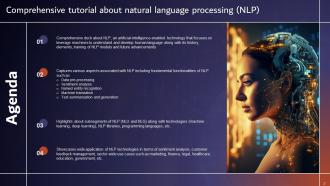
Slide 2: This slide depicts the Agenda of the presentation.
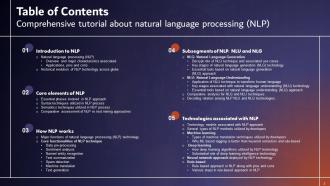
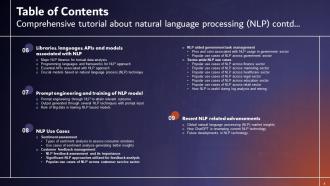
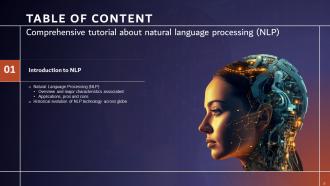
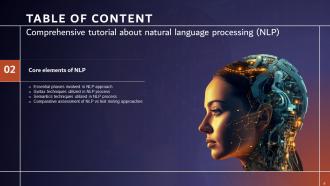
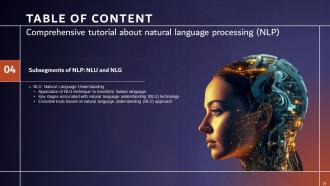
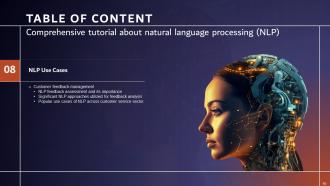
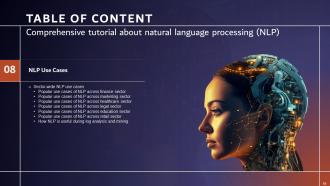
Slide 3: This slide includes the Table of contents.
Slide 4: This slide further includes the Table of contents.
Slide 5: This slide highlights the Title for the Topics to be discussed further.
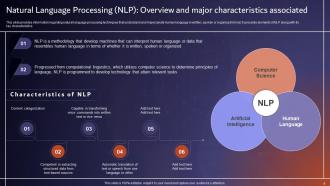
Slide 6: This slide provides information regarding natural language processing techniques.
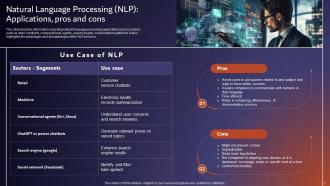
Slide 7: This slide states the natural language processing applications.
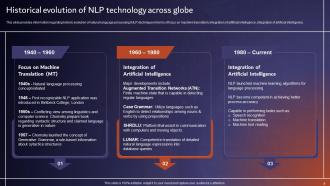
Slide 8: This slide reveals the Historical evolution of NLP technology across globe.
Slide 9: This slide indicates the Heading for the Contents to be covered further.
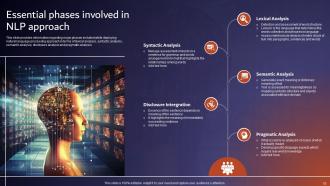
Slide 10: This slide showcases the Essential phases involved in NLP approach.
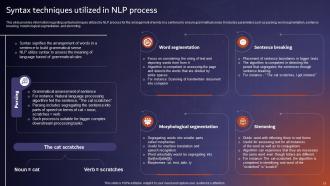
Slide 11: This slide highlights the Syntax techniques utilized in NLP process.
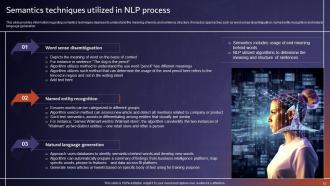
Slide 12: This slide reveals the Semantics techniques utilized in NLP process.
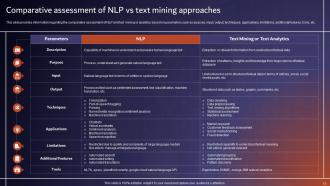
Slide 13: This slide shows the Comparative assessment of NLP vs text mining approaches.
Slide 14: This slide includes the Title for the Ideas to be discussed next.
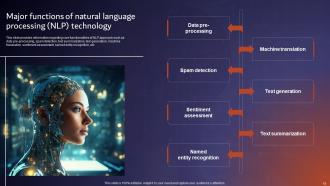
Slide 15: This slide exhibits the Major functions of natural language processing.
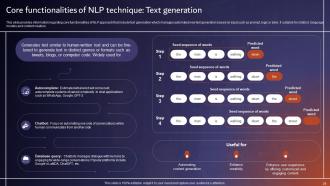
Slide 16: This slide shows the Core functionalities of NLP technique.
Slide 17: This slide continues the Core functionalities of NLP technique.
Slide 18: This slide continues the Core functionalities of NLP technique.
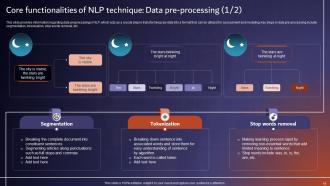
Slide 19: This slide highlights the Core functionalities of NLP technique.
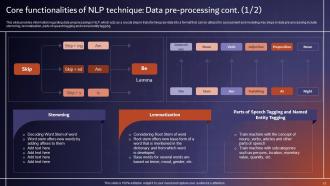
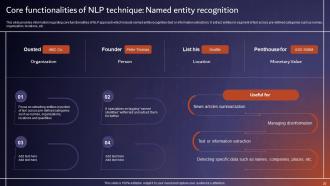
Slide 20: This slide portrays the Core functionalities of NLP technique.
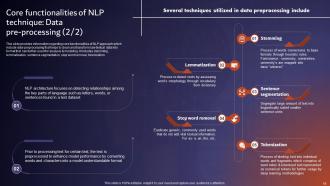
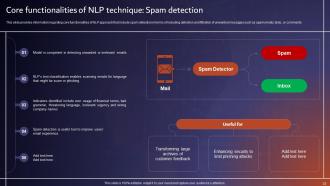
Slide 21: This slide exhibits the core functionalities of NLP approach.
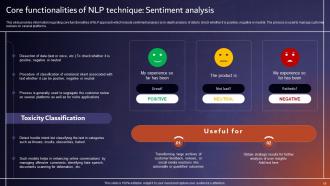
Slide 22: This slide displays the Core functionalities of NLP technique.
Slide 23: This slide provides information regarding core functionalities of NLP approach.
Slide 24: This slide exhibits the Core functionalities of NLP technique.
Slide 25: This slide contains the Heading for the Ideas to be covered further.
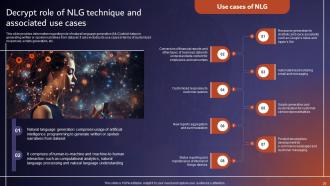
Slide 26: This slide showcases the Decrypt role of NLG technique and associated use cases.
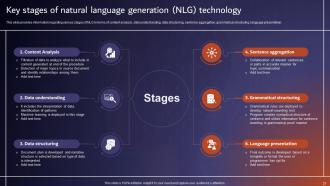
Slide 27: This slide highlights the Key stages of natural language generation (NLG) technology.
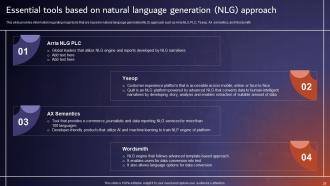
Slide 28: This slide displays the Essential tools based on natural language generation (NLG) approach.
Slide 29: This slide contains the Title for the Contents to be discussed next.
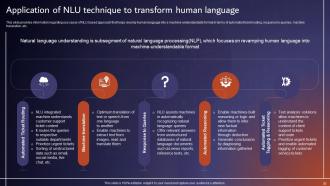
Slide 30: This slide presents the Application of NLU technique to transform human language.
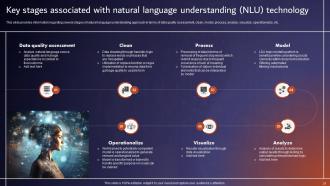
Slide 31: This slide states the Key stages associated with natural language understanding (NLU) technology.
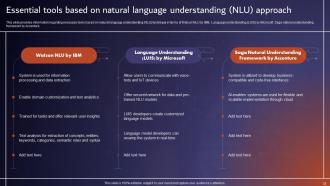
Slide 32: This slide depicts the Essential tools based on natural language understanding (NLU) approach.
Slide 33: This slide indicates the Heading for the Topics to be covered in the upcoming template.
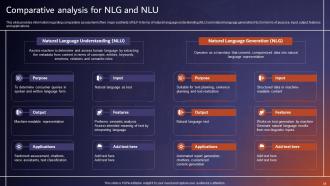
Slide 34: This slide reveals the Comparative analysis for NLG and NLU.
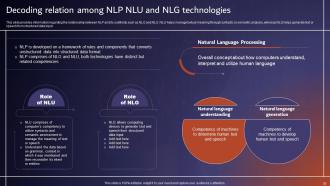
Slide 35: This slide talks about Decoding relation among NLP NLU and NLG technologies.
Slide 36: This slide exhibits the Title for the Topics to be discussed next.
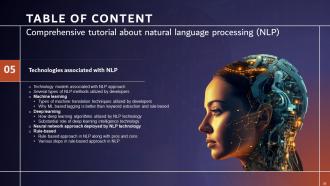
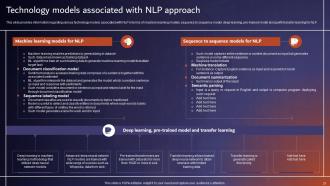
Slide 37: This slide provides information regarding various technology models associated with NLP.
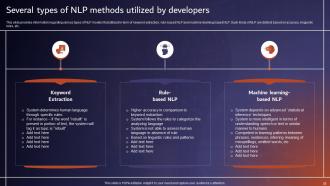
Slide 38: This slide depicts the Several types of NLP methods utilized by developers.
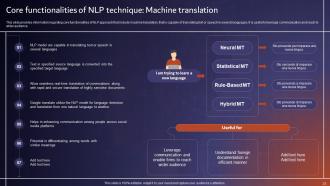
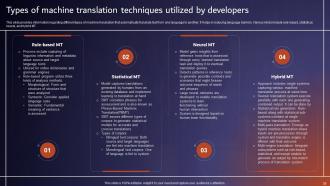
Slide 39: This slide provides information regarding different types of machine translation that automatically translate text from one language to another.
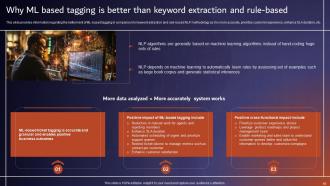
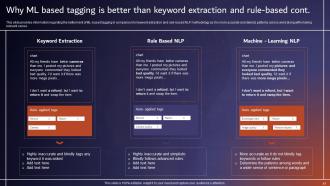
Slide 40: This slide shows the betterment of ML-based tagging in comparison to keyword extraction and rule-based NLP methodology.
Slide 41: This slide continues the comparison and betterment of ML tagging over keyword extraction.
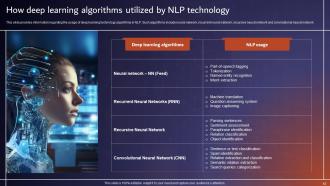
Slide 42: This slide provides information regarding the usage of deep learning technology algorithms in NLP.
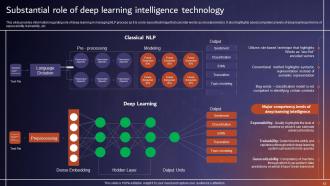
Slide 43: This slide highlights the Substantial role of deep learning intelligence technology.
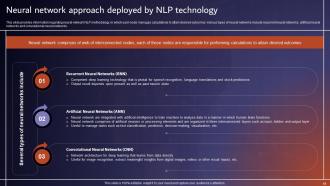
Slide 44: This slide contains the Neural network approach deployed by NLP technology.
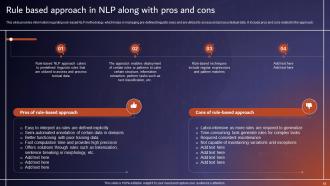
Slide 45: This slide talks about the Rule based approach in NLP along with pros and cons.
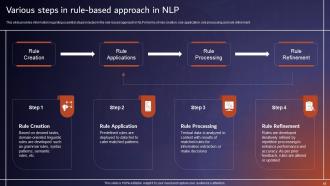
Slide 46: This slide states the Various steps in rule-based approach.
Slide 47: This slide indicates the Heading for the Contents to be covered further.
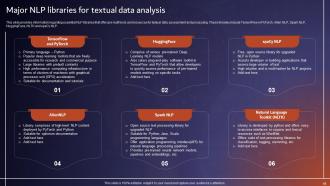
Slide 48: This slide exhibits the Major NLP libraries for textual data analysis.
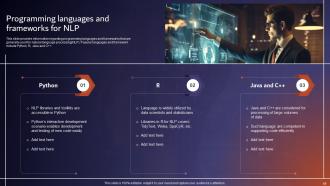
Slide 49: This slide deals with Programming languages and frameworks for NLP.
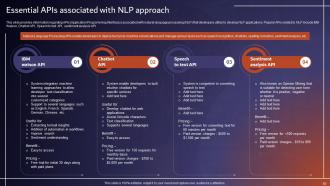
Slide 50: This slide highlights the Essential APIs associated with NLP approach.
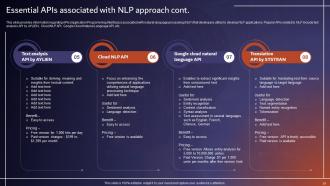
Slide 51: This slide continues the Essential APIs associated with NLP approach.
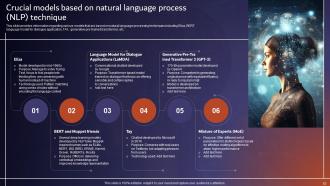
Slide 52: This slide shows the Crucial models based on natural language process (NLP) technique.
Slide 53: This slide portrays the Title for the Ideas to be discussed next.
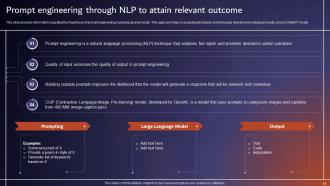
Slide 54: This slide talks about Prompt engineering through NLP to attain relevant outcome.
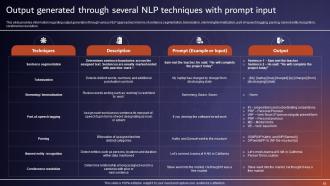
Slide 55: This slide provides information regarding output generation through various NLP approaches.
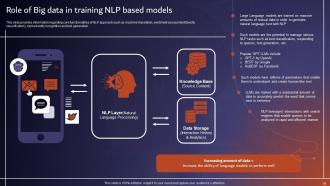
Slide 56: This slide shows the Role of Big data in training NLP based models.
Slide 57: This slide includes the Heading for the Ideas to be covered in the upcoming template.
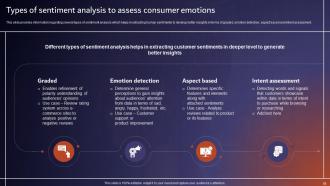
Slide 58: This slide states the Types of sentiment analysis to assess consumer emotions.
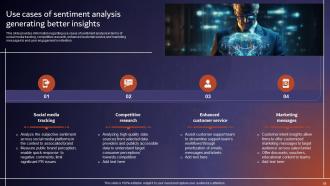
Slide 59: This slide represents the Use cases of sentiment analysis generating.
Slide 60: This slide includes the Title for the Contents to be discussed next.
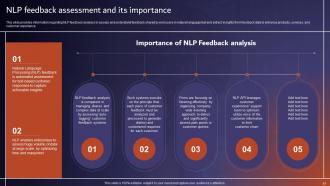
Slide 61: This slide provides information regarding NLP feedback analysis.
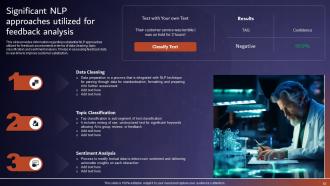
Slide 62: This slide presents the Significant NLP approaches utilized for feedback analysis.
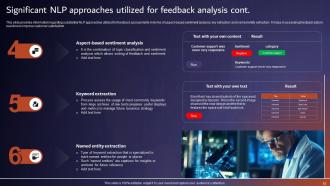
Slide 63: This slide continues the Significant NLP approaches utilized for feedback analysis.
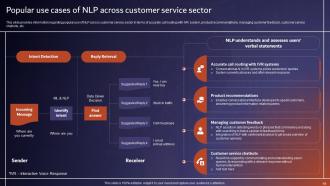
Slide 64: This slide reveals the Popular use cases of NLP across customer service sector.
Slide 65: This slide exhibits the Heading for the Topics to be coveerd further.
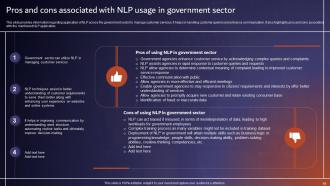
Slide 66: This slide highlights the Pros and cons associated with NLP usage in government sector.
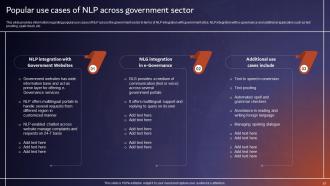
Slide 67: This slide provides information regarding popular use cases of NLP across the government sector.
Slide 68: This slide includes the Title for the Topics to be discussed next.
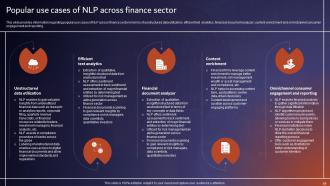
Slide 69: This slide talks about the Popular use cases of NLP across finance sector.
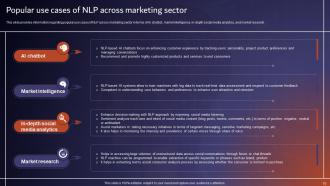
Slide 70: This slide deals with Popular use cases of NLP across marketing sector.
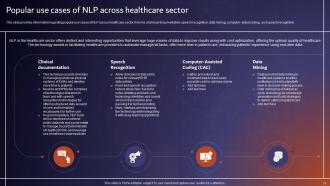
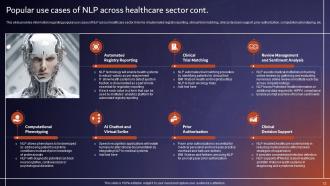
Slide 71: This slide shows the Popular use cases of NLP across healthcare sector.
Slide 72: This slide continues the Popular use cases of NLP across healthcare sector.
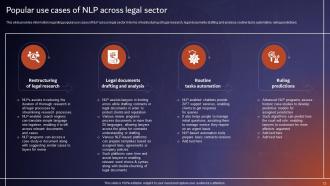
Slide 73: This slide provides information regarding popular use cases of NLP across legal sector.
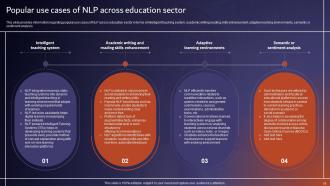
Slide 74: This slide indicates the Popular use cases of NLP across education sector.
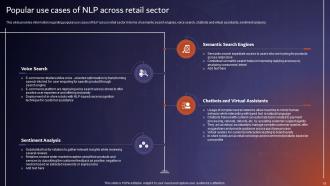
Slide 75: This slide reveals the Popular use cases of NLP across.
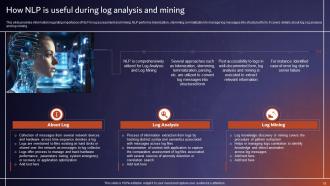
Slide 76: This slide provides information regarding importance of NLP in log assessment and mining.
Slide 77: This slide states the Heading for the Contents to be covered further.
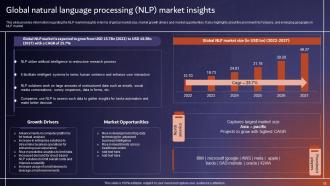
Slide 78: This slide portrays the Global natural language processing (NLP) market insights.
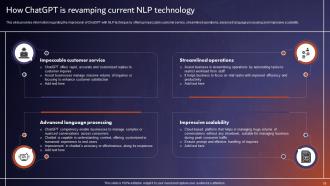
Slide 79: This slide provides information regarding the improvision of chatgpt with NLP technique.
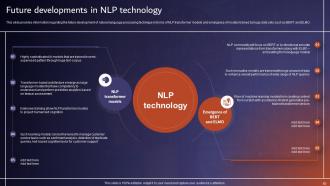
Slide 80: This slide talks about the Future developments in NLP technology.
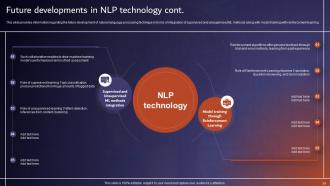
Slide 81: This slide continues the Future developments in NLP technology.
Slide 82: This is the Icons slide containing all the Icons used in the plan.
Slide 83: This slide is used for depicting some Additional information.
Slide 84: This is the About us slide. State your company-related information here.
Slide 85: This is Meet our team slide. State your team-related ifnormation here.
Slide 86: This slide incorporates the organization's mission, vision, and goals.
Slide 87: This is the Puzzle slide with related imagery.
Slide 88: This slide showcases the company's Roadmap.
Slide 89: This is the 30 60 90 Days plan slide for effective planning.
Slide 90: This is the Thank you slide for acknowledgement.
Comprehensive Tutorial About Natural Language Processing NLP Powerpoint Presentation Slides AI CD V with all 98 slides:
Use our Comprehensive Tutorial About Natural Language Processing NLP Powerpoint Presentation Slides AI CD V to effectively help you save your valuable time. They are readymade to fit into any presentation structure.








FAQs for Comprehensive Tutorial About Natural Language Processing NLP Powerpoint Presentation Slides
Natural language processing encompasses the broad computational handling of human language, including text analysis, translation, and speech recognition, while natural language understanding focuses specifically on comprehending meaning, context, and intent behind language. NLP handles surface-level tasks like tokenization and parsing, whereas NLU delivers deeper semantic analysis, enabling chatbots, virtual assistants, and automated customer service systems to provide more contextually relevant responses.
Tokenization significantly impacts NLP model performance by determining how text is segmented into processable units, affecting accuracy, computational efficiency, and semantic understanding. Effective tokenization strategies, particularly subword approaches like BPE or WordPiece, enable models to handle unknown words, reduce vocabulary size, and capture morphological patterns, ultimately delivering improved language comprehension and faster processing across diverse applications.
Semantic analysis enables conversational AI systems to understand context, intent, and meaning beyond literal words, interpreting nuances, relationships, and implied concepts within conversations. Through advanced language models, these systems deliver more accurate responses, maintain contextual awareness across multi-turn dialogues, and provide personalized interactions, with many customer service and virtual assistant applications finding significantly improved user satisfaction and engagement rates.
Effective sentiment analysis implementation requires robust data preprocessing, advanced machine learning models like BERT or transformer networks, and real-time processing capabilities for high-volume social feeds. Companies integrate these systems with comprehensive monitoring dashboards, enabling marketing teams to track brand perception, identify emerging issues, and respond proactively to customer feedback, ultimately enhancing reputation management and competitive positioning.
Common NER challenges include ambiguity resolution, handling out-of-vocabulary terms, managing domain-specific entities, addressing multilingual variations, and dealing with nested entity structures. These complexities present both technical and operational hurdles, with many organizations finding that robust training data, contextual modeling, and domain adaptation strategies significantly enhance accuracy while streamlining automated information extraction processes.
Transformer models revolutionize NLP by processing entire sequences simultaneously rather than sequentially, enabling parallel computation, capturing long-range dependencies more effectively, and delivering superior contextual understanding through attention mechanisms. These architectures streamline translation services, enhance chatbot interactions, and accelerate document analysis across industries like finance and healthcare, ultimately providing faster, more accurate language processing with significantly reduced computational time.
NLP applications handle ambiguous language through contextual analysis, semantic disambiguation, machine learning models, syntactic parsing, and probabilistic reasoning. These techniques work by analyzing surrounding text, leveraging large datasets for pattern recognition, and applying statistical methods, with many organizations in finance and healthcare finding that combining multiple approaches delivers more accurate interpretations and enhanced user experiences.
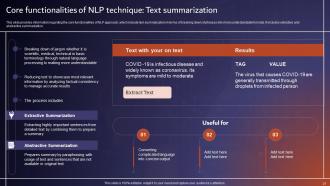
NLP enables automated summarization through extractive techniques that identify key sentences, abstractive methods that generate new summary text, and hybrid approaches combining both strategies. Financial institutions use these systems to summarize research reports and regulatory documents, while news organizations streamline content curation, ultimately delivering faster information processing and enhanced decision-making capabilities.
Ethical considerations in NLP deployment include data privacy protection, algorithmic bias mitigation, transparency in automated decisions, consent for data usage, and fairness across diverse user groups. While these challenges require careful attention, organizations in healthcare, finance, and customer service increasingly find that proactive ethical frameworks enhance user trust, ensure regulatory compliance, and ultimately deliver sustainable competitive advantage.
Different languages present varying challenges for NLP models through distinct grammatical structures, syntax patterns, morphological complexity, and semantic frameworks, requiring language-specific training approaches and data preprocessing techniques. These structural differences significantly impact model accuracy and processing efficiency, with many organizations finding that multilingual models need extensive fine-tuning for languages like Arabic, Chinese, or Finnish to deliver comparable performance and competitive advantage across global markets.
NLP applications in healthcare include clinical documentation automation, medical coding, patient risk assessment, diagnostic support, and electronic health record analysis. These technologies streamline patient-data processing by extracting insights from unstructured notes, automating administrative tasks, and enabling predictive analytics, with many hospitals finding that NLP significantly reduces documentation time while improving care coordination and clinical decision-making.
NLP revolutionizes customer service by enabling automated chatbots, sentiment analysis, real-time language translation, intelligent ticket routing, and voice-to-text transcription systems. Through these technologies, organizations streamline response times, personalize customer interactions, and reduce operational costs, with many financial services and retail companies finding that NLP-powered support delivers 24/7 availability while enhancing overall customer satisfaction.
Machine learning significantly enhances NLP accuracy by enabling algorithms to learn from vast datasets, recognize complex patterns, and adapt to linguistic nuances through training. These advanced models streamline language understanding across industries like banking for fraud detection and healthcare for patient record analysis, ultimately delivering more precise automated services and improved customer experiences.
Businesses utilize NLP for competitive analysis by analyzing competitor websites, social media content, customer reviews, and press releases to extract insights about pricing strategies, product launches, and market positioning. Through sentiment analysis and trend detection, companies can monitor brand perception, identify market gaps, and anticipate competitor moves, ultimately enabling faster strategic responses and enhanced competitive advantage.
Future NLP trends include multimodal AI integration, conversational AI advancement, low-code NLP platforms, enhanced language understanding, and domain-specific model specialization. These developments streamline content creation, automate customer interactions, and enable real-time translation across industries, with organizations in healthcare, finance, and retail finding that specialized models deliver faster processing, improved accuracy, and competitive advantage.
-
Great product, helpful indeed!
-
They saved me a lot of time because they had exactly what I was looking for. Couldn’t be happier!