

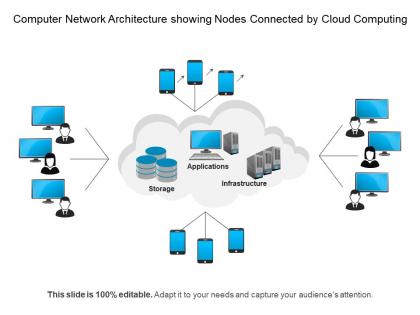
Computer network architecture showing nodes connected by cloud computing




Try Before you Buy Download Free Sample Product
 Impress Your
 Audience
 100%
100% Editable
 Save Hours
 of Time


Create equanimity with our Computer Network Architecture Showing Nodes Connected By Cloud Computing. They will have a calming effect.
People who downloaded this PowerPoint presentation also viewed the following :
Computer network architecture showing nodes connected by cloud computing with all 5 slides:
Deliver instructive advice with our Computer Network Architecture Showing Nodes Connected By Cloud Computing. Convey information that improves conditions.




FAQs for Computer network architecture showing nodes connected
So you're basically dealing with VMs, containers, storage (object, block, file - the usual suspects), plus networking stuff like load balancers and firewalls. Management layers tie it all together. CDNs are clutch if you've got global users, trust me on that one. You'll also need identity management, monitoring tools, and API gateways for services to talk to each other. Everything connects through virtual networks and subnets - honestly, it's like digital plumbing sometimes. Here's what I'd do: map your data flow first, then build your network topology around that. Saves you from wanting to throw your laptop out the window later.
So basically, cloud stuff lives in someone else's data centers instead of your own servers. Traditional IT means you're stuck buying and fixing all that hardware yourself - and trust me, servers love breaking at the worst times. Cloud lets you scale up instantly when you need more power, plus you only pay for what you actually use instead of dropping huge money upfront on equipment. Way more flexible than waiting around for IT to order new servers. I'd probably start by figuring out which of your systems would benefit most from that kind of flexibility first.
So virtualization is what makes cloud computing work - it takes one physical server and splits it into like 50 virtual ones. Pretty neat trick, honestly. Cloud providers use this to share hardware across tons of users without everyone needing their own dedicated machine. Makes everything way more flexible since you can spin resources up or down super fast. Plus it's cheaper because you're not wasting unused server capacity. When you're building stuff in the cloud, definitely use virtualization tools - they'll help you allocate resources better and keep costs down. Game changer for infrastructure, no joke.
Look, the deployment model you pick basically dictates your whole network strategy. Public cloud means you're dealing with internet connections and shared stuff - so you'll need solid bandwidth optimization plus extra security layers since you can't control what's underneath. Private gives you total control, but damn, you're literally building a data center from the ground up. Hybrid's actually the tricky one though. You need rock-solid connections between environments - VPNs, direct links, matching security policies across everything. Oh, and map out your data flows first before you do anything else.
First thing - encrypt everything, both when it's moving around and just sitting there. Set up network segmentation so different parts of your system can't all talk to each other. MFA is non-negotiable for access control. I can't tell you how many companies I've seen with zero visibility into their network traffic - it's wild. Configure your firewalls properly, use VPNs for anything sensitive, and whatever compliance stuff your industry needs. Your cloud provider does some security work but definitely not everything. Oh, and run a security audit first so you know what you're actually working with.
Honestly, start with auto-scaling groups and load balancers right away - don't wait until you're drowning in traffic. Horizontal scaling is your friend here, way better than just buying beefier servers. Microservices are clutch for this (though they can be a pain to set up initially). Containerization with Kubernetes will handle the dynamic stuff pretty well. Oh, and monitoring is huge - you'll want to catch issues before they wreck your day. Set your scaling triggers based on CPU, memory, or whatever metrics actually make sense for your app.
So microservices are when you chop up your app into tiny independent pieces - like one handles logins, another does payments, etc. Your cloud network gets way more complicated though because now all these services need to constantly chat with each other. Honestly, it can be a total headache at first. You'll need better load balancers and API gateways to manage everything talking back and forth. Oh, and service discovery becomes crucial - services need to find each other somehow. My advice? Map out which services depend on what before you jump into all the networking stuff. Trust me on that one.
So CDNs are basically like a bunch of servers spread around the world that cache your stuff. You upload to your cloud storage, then the CDN grabs copies and puts them on edge servers everywhere. When someone visits your site, they get served from whichever server is closest to them instead of your main one. Honestly, it's pretty cool how much faster everything loads. Takes a ton of pressure off your origin servers too. AWS and Azure both have their own CDN services - I'd probably just use whichever one matches your cloud provider since they're designed to work together.
Honestly, security headaches are probably gonna be your biggest pain point. Legacy systems fight cloud infrastructure like crazy - I swear some of these old setups are just stubborn. Data migration gets messy fast, and don't even get me started on compliance rules that change depending on your industry. Network performance can tank during the switch too. Oh, and the pricing models? Totally different beast from what you're used to on-premise. Training your team takes time you probably don't have. My advice? Test it out with something non-critical first so you can screw up safely.
Think of cloud networking like having backup plans for your backup plans. You spread your stuff across different regions, so when one data center crashes (and they do), everything just switches over automatically. No more panicking about fried servers or hardware nightmares. Recovery happens crazy fast since you've got copies already running elsewhere. Honestly, the hardest part is remembering to set up those automatic failover rules beforehand - trust me, you don't want to be figuring that out at 2am during an actual crisis. Way easier to do it now when you're thinking clearly.
Dude, API management is like having a bouncer for your cloud services. It does all the grunt work - authentication, rate limiting, routing traffic where it needs to go. Without it, your microservices turn into complete chaos (learned this the hard way). You can actually monitor what's happening instead of guessing why something broke. Plus you get proper versioning and security baked in. Honestly, just set it up from day one. I've spent way too many late nights tracking down connection problems that could've been avoided. Your future self will thank you.
So multitenancy means you gotta build rock-solid isolation everywhere in your network. VLANs, VPCs, network segmentation - the whole nine yards. Security gets super tricky because if one tenant gets hacked, it can't bleed over to the others (total disaster if that happens). You need separate routing tables and solid access controls. Oh, and bandwidth allocation is crucial - can't have one heavy user crushing everyone else's speeds. Honestly, the best approach? Design it like you're hosting completely different companies, even though they're all running on the same physical gear underneath.
Dude, cloud networking is crazy right now. Edge computing is huge - basically moving stuff closer to users so things don't lag. Everyone's doing multi-cloud setups too because getting stuck with one vendor sucks. Zero-trust security is replacing the old "trust everything inside the firewall" approach, which honestly makes way more sense. Container networking is everywhere since microservices are taking over (though the complexity can be a nightmare). Oh, and service mesh is big too. I'd say mess around with edge for anything that needs to be fast, and definitely look into zero-trust. Your security team will thank you later.
So edge computing is basically putting mini data centers way closer to where your data actually gets created, instead of everything living in those massive centralized cloud regions. You're still using the same networking stuff, just processing locally first before sending results back to your main cloud setup. Honestly, it's pretty genius - cuts down latency like crazy and saves you a ton on bandwidth costs. The tricky part? Your network design has to handle this hybrid thing smoothly. Those edge nodes need solid connections back to central cloud for syncing everything up.
Design for failure from day one - trust me on this. Microservices get complicated fast, so grab something like Istio for traffic management and set up proper load balancing. Auto-scaling isn't optional either. Security's where zero-trust comes in handy; segment everything and encrypt communication between services. Monitoring becomes your best friend because things break in weird ways with distributed systems. CNI plugins work well for container networking. Map out those service dependencies early and throw health checks everywhere. Oh, and keep services loosely coupled but well-connected - sounds contradictory but you'll get what I mean once you start building.
-
It saves your time and decrease your efforts in half.
-
Great product with effective design. Helped a lot in our corporate presentations. Easy to edit and stunning visuals.