

Conducting Cyber Security Gap Analysis Of Organization Preventing Data Breaches Through Cyber Security




Try Before you Buy Download Free Sample Product
 Impress Your
Audience
 100%
Editable
 Save Hours
of Time


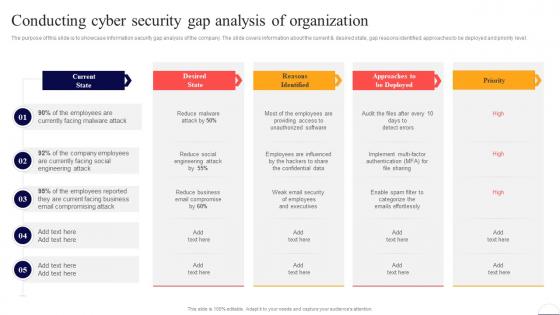
The purpose of this slide is to showcase information security gap analysis of the company. The slide covers information about the current and desired state, gap reasons identified, approaches to be deployed and priority level.
People who downloaded this PowerPoint presentation also viewed the following :
Conducting Cyber Security Gap Analysis Of Organization Preventing Data Breaches Through Cyber Security with all 7 slides:
Use our Conducting Cyber Security Gap Analysis Of Organization Preventing Data Breaches Through Cyber Security to effectively help you save your valuable time. They are readymade to fit into any presentation structure.







FAQs for Conducting Cyber Security Gap Analysis Of Organization Preventing Data Breaches
A comprehensive cyber security gap analysis includes current security posture assessment, threat landscape evaluation, regulatory compliance review, risk prioritization matrix, and remediation roadmap development. These components work together by identifying vulnerabilities, mapping threats to business assets, and establishing strategic priorities, with many organizations finding that this systematic approach delivers enhanced security resilience and optimized resource allocation.
Organizations can identify their current cybersecurity posture through comprehensive risk assessments, vulnerability scanning, penetration testing, compliance audits, and security maturity evaluations. These strategic approaches enable businesses to map existing defenses, uncover critical gaps, and benchmark against industry standards, with many financial institutions and healthcare organizations finding that regular posture assessments ultimately deliver enhanced threat resilience and regulatory compliance.
Key metrics for assessing cyber security vulnerabilities include mean time to detection, vulnerability exposure window, patch deployment rates, security control effectiveness scores, and incident response times. These measurements enable organizations to quantify risk exposure, prioritize remediation efforts, and track security posture improvements, with many financial institutions and healthcare providers finding that systematic vulnerability metrics significantly enhance their defensive capabilities.
Gap analysis enables organizations to prioritize cybersecurity investments by identifying specific vulnerabilities, assessing risk levels, and mapping current security capabilities against industry standards and regulatory requirements. This strategic approach helps businesses allocate resources efficiently, focusing on high-impact areas like network security, data protection, and incident response, ultimately delivering maximum security enhancement while optimizing budget allocation.
Industry standards and compliance requirements serve as critical benchmarks in cyber security gap analysis, providing frameworks like ISO 27001, NIST, SOC 2, and regulatory mandates such as GDPR or HIPAA. These standards enable organizations to systematically identify vulnerabilities, prioritize remediation efforts, and ensure comprehensive coverage across all security domains, while ultimately delivering regulatory compliance, reduced risk exposure, and enhanced stakeholder confidence in an increasingly complex threat landscape.
Organizations should approach framework definition by first assessing current security policies, infrastructure capabilities, compliance requirements, and threat landscape exposure against industry standards like NIST or ISO 27001. This strategic evaluation enables companies to identify specific vulnerabilities, prioritize resource allocation, and establish measurable security objectives, with many enterprises finding that comprehensive framework mapping ultimately delivers enhanced operational resilience and competitive advantage.
Common tools include vulnerability scanners like Nessus and OpenVAS, compliance frameworks such as NIST and ISO 27001, penetration testing suites, and risk assessment platforms like Qualys and Rapid7. These methodologies work together by identifying vulnerabilities, benchmarking against standards, and prioritizing remediation efforts, with many organizations finding that combining automated scanning with manual assessments delivers comprehensive security insights.
Gap analysis assists in aligning cybersecurity measures with business objectives by identifying discrepancies between current security capabilities and strategic business requirements, enabling organizations to prioritize investments that protect critical assets while supporting growth initiatives. Through systematic assessment, companies can streamline security frameworks to match operational needs, regulatory demands, and risk tolerance levels, ultimately delivering enhanced protection without hindering business agility or competitive advantage.
Common pitfalls include inadequate stakeholder involvement, focusing solely on technical controls while ignoring processes and people, using outdated threat intelligence, and failing to prioritize findings by business risk. Organizations often rush the assessment phase or rely on generic frameworks without customizing to their specific industry requirements, ultimately delivering incomplete analysis that misses critical vulnerabilities and reduces the strategic value of their security investments.
Organizations effectively communicate gap analysis findings through comprehensive executive summaries, detailed technical reports for IT teams, and visual dashboards highlighting priority vulnerabilities and remediation timelines. Many financial institutions and healthcare organizations find that presenting findings through risk-based categories, clear cost-benefit analyses for proposed solutions, and regular progress updates enables stakeholder buy-in while ensuring strategic cybersecurity investments align with business objectives.
Training programs following a cyber security gap analysis should include phishing simulation exercises, incident response drills, data protection protocols, access management procedures, and compliance requirements training. These programs address identified vulnerabilities by enhancing employee awareness, reducing human error risks, and strengthening security culture, with many organizations finding that targeted training significantly improves their overall security posture.
Emerging technologies like artificial intelligence, machine learning algorithms, automated threat detection systems, behavioral analytics, and cloud-based security platforms significantly enhance gap analysis accuracy by identifying vulnerabilities faster, predicting potential attack vectors, and providing real-time risk assessments. These technologies enable organizations to streamline remediation processes, minimize manual oversight errors, and ultimately deliver more comprehensive security postures with enhanced operational efficiency.
Gap analysis enables businesses to identify weaknesses in current incident response protocols, recovery timeframes, and communication channels by comparing existing capabilities against industry standards and regulatory requirements. Through systematic evaluation, organizations can strengthen detection mechanisms, streamline recovery procedures, and enhance coordination between IT teams and stakeholders, ultimately reducing downtime costs and improving business continuity during security incidents.
A one-time gap analysis provides a comprehensive snapshot of current cybersecurity posture against established standards, identifying immediate vulnerabilities, compliance deficiencies, policy gaps, and infrastructure weaknesses. Ongoing assessments deliver continuous monitoring and adaptive protection, with many organizations finding that regular evaluations enable faster threat response, sustained compliance, and proactive security enhancement in an increasingly dynamic threat landscape.
Organizations ensure gap analysis relevance by implementing continuous monitoring systems, conducting quarterly threat landscape reviews, and integrating real-time threat intelligence feeds into their assessment frameworks. Through adaptive methodologies and regular stakeholder consultations, companies in banking, healthcare, and retail maintain current security postures, ultimately delivering proactive defense strategies and sustained competitive advantage in an increasingly dynamic threat environment.
-
The ease of modifying templates is just superb! Also, the vast collection offers plenty of options to choose from.
-
I want to thank SlideTeam for the work that they do, especially their customer service.