


Conducting Project Viability Study To Ensure Profitability Project Management Dashboard





Try Before you Buy Download Free Sample Product
 Impress Your
Audience
 100%
Editable
 Save Hours
of Time


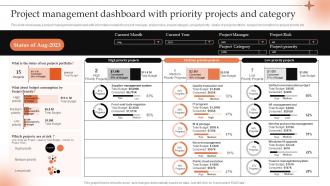
This slide showcases a project management dashboard with information related to project manager, project risks, project category, project priority, status of project portfolio, budget consumption by project priority etc.
People who downloaded this PowerPoint presentation also viewed the following :
Conducting Project Viability Study To Ensure Profitability Project Management Dashboard with all 7 slides:
Use our Conducting Project Viability Study To Ensure Profitability Project Management Dashboard to effectively help you save your valuable time. They are readymade to fit into any presentation structure.






FAQs for Conducting Project Viability Study To Ensure Profitability
Key indicators of project viability include financial feasibility, market demand assessment, technical capability evaluation, resource availability analysis, and risk-benefit ratios. These indicators enable organizations to streamline decision-making by evaluating potential ROI, operational requirements, and strategic alignment, with many companies finding that comprehensive viability studies ultimately deliver better resource allocation and enhanced competitive positioning.
Market research influences project viability by validating demand assumptions, identifying target customer segments, and revealing competitive landscapes that directly impact revenue projections. Through comprehensive market analysis, organizations can adjust product features, pricing strategies, and go-to-market approaches before significant investment, with many companies finding that thorough research reduces project failure rates while enhancing strategic positioning.
Risk assessment forms the foundation of project viability studies by identifying potential threats, evaluating their likelihood and impact, quantifying financial exposure, and developing mitigation strategies. Through comprehensive risk analysis, organizations can make informed investment decisions, secure appropriate funding, and build contingency plans, with many financial institutions and stakeholders requiring detailed risk profiles before approving project funding or partnerships.
Financial projections for viable projects require comprehensive market research, realistic revenue assumptions, detailed cost analysis, and sensitivity testing across multiple scenarios. Through robust financial modeling, organizations can forecast cash flows, assess profitability timelines, and identify potential risks, with many finding that conservative estimates and regular projection updates ultimately deliver more accurate results and enhanced investor confidence.
Project viability study timelines depend on project complexity, scope of analysis required, data availability, stakeholder involvement levels, and regulatory requirements. While simple studies may take weeks, complex infrastructure or technology projects often require months, with many organizations finding that thorough upfront analysis ultimately accelerates implementation and reduces costly revisions later.
Stakeholder interviews contribute to assessing project viability by revealing critical insights into resource availability, potential risks, organizational readiness, and market conditions that quantitative data often misses. Through these conversations, project managers identify implementation barriers, gauge support levels, and uncover operational constraints, while stakeholders provide context on feasibility challenges, ultimately enabling more accurate viability assessments and strategic decision-making.
Essential post-launch success metrics include financial performance indicators, customer satisfaction scores, operational efficiency measures, market penetration rates, and return on investment calculations. These metrics enable organizations to assess project outcomes comprehensively, with many companies finding that tracking both quantitative results and qualitative feedback ultimately delivers deeper insights into long-term viability and competitive positioning.
Regulatory challenges can be anticipated through comprehensive legal research, stakeholder consultation, industry trend analysis, and engagement with regulatory bodies early in the planning process. By examining similar projects in comparable jurisdictions, conducting thorough compliance assessments, and building relationships with regulatory experts, organizations can identify potential hurdles and develop mitigation strategies, ultimately reducing project delays and ensuring smoother approval processes.
Feasibility analysis is crucial for determining project viability because it systematically evaluates technical, financial, operational, and market factors before resource commitment, minimizing investment risks and identifying potential obstacles early. Through comprehensive assessment, organizations can make informed decisions about project continuation, resource allocation, and strategic modifications, with many companies finding that thorough feasibility studies ultimately enhance project success rates and deliver stronger competitive advantages.
A project viability study should assess competition through market share analysis, competitive positioning evaluation, pricing strategy comparison, and differentiation opportunity identification. This comprehensive approach enables organizations to understand competitive landscapes, identify market gaps, and develop strategic advantages, with many businesses finding that thorough competitive analysis ultimately delivers better market positioning and sustainable competitive differentiation.
Project viability studies utilize financial modeling tools like NPV and IRR calculations, market research methodologies, risk assessment frameworks, SWOT analysis, and feasibility software platforms. These comprehensive approaches enable organizations to evaluate technical feasibility, market demand, and financial projections systematically, with many businesses finding that combining quantitative metrics with qualitative assessments delivers more accurate investment decisions.
Project teams can gather customer feedback through surveys, focus groups, interviews, beta testing programs, and social media monitoring to assess viability comprehensively. These methods enable teams to validate market demand, identify potential pain points, and refine product features, with many organizations finding that early customer insights significantly reduce development risks and enhance market acceptance rates.
Common pitfalls include inadequate market research, overly optimistic financial projections, insufficient risk assessment, ignoring stakeholder concerns, and underestimating implementation timelines. These oversights can derail projects in sectors like healthcare technology rollouts or retail expansion initiatives, with many organizations finding that comprehensive due diligence and realistic scenario planning ultimately deliver more accurate feasibility assessments and successful project outcomes.
Technology integration significantly enhances project feasibility by streamlining operations, reducing manual processes, and enabling real-time data analysis and decision-making. Modern businesses leverage automation, cloud platforms, and analytics tools to minimize costs, accelerate timelines, and improve resource allocation, with many organizations finding that strategic technology adoption ultimately delivers competitive advantage and measurable ROI improvements.
Environmental sustainability significantly impacts project viability through regulatory compliance requirements, stakeholder expectations, cost considerations, and long-term operational efficiency. Projects incorporating sustainable practices often experience enhanced market positioning, reduced resource costs, and improved risk management, with many organizations finding that environmentally conscious initiatives ultimately deliver competitive advantages and stronger financial performance in increasingly sustainability-focused markets.
-
I faced no difficulty while searching for the slide I wanted. Honestly, the website’s interface is easy to use and can be navigated easily!
-
Easy to use and customize templates. Helped me give a last minute presentation.