

Conservation Of Mechanical Energy Ppt PPT Template ACP





Try Before you Buy Download Free Sample Product
 Impress Your
Audience
 100%
Editable
 Save Hours
of Time


Elevate your presentations with our Conservation of Mechanical Energy PowerPoint Template. This professionally designed deck features engaging visuals and clear layouts, perfect for illustrating key concepts in physics. Ideal for educators and students alike, it simplifies complex ideas, ensuring impactful communication of mechanical energy principles.
People who downloaded this PowerPoint presentation also viewed the following :
Conservation Of Mechanical Energy Ppt PPT Template ACP with all 41 slides:
Use our Conservation Of Mechanical Energy Ppt PPT Template ACP to effectively help you save your valuable time. They are readymade to fit into any presentation structure.

















FAQs for Conservation Of Mechanical Energy Ppt
The principle of conservation of mechanical energy states that in isolated systems without non-conservative forces, the total mechanical energy remains constant, with kinetic and potential energy transforming into each other while maintaining constant sum. This fundamental physics law enables engineers and scientists to predict motion in pendulums, roller coasters, and satellite trajectories, ultimately delivering precise calculations for mechanical systems and structural designs across aerospace, automotive, and renewable energy industries.
Potential energy transforms into kinetic energy through gravitational or elastic forces that accelerate objects, converting stored energy into motion. In mechanical systems like pendulums, roller coasters, and springs, this transformation enables predictable energy transfer, with many engineering applications finding that understanding these conversions optimizes system efficiency and performance outcomes.
Mechanical energy is conserved in isolated systems where only conservative forces like gravity, elastic forces, and electrostatic forces act, with no friction or air resistance present. These systems include pendulums in vacuum, springs oscillating without damping, and planetary orbital mechanics, where energy seamlessly transfers between kinetic and potential forms while maintaining total mechanical energy constant throughout motion.
Conservative forces like gravity and elastic forces allow complete energy conversion between kinetic and potential forms, preserving total mechanical energy throughout motion. Non-conservative forces such as friction and air resistance dissipate mechanical energy as heat, reducing the system's total mechanical energy, with many physics applications finding that understanding this distinction enables accurate predictions of energy conservation in mechanical systems.
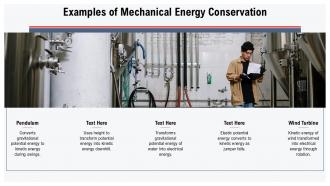
In a pendulum, mechanical energy continuously converts between kinetic energy at the bottom of the swing and potential energy at the highest points, with total mechanical energy remaining constant throughout the motion. This principle enables precise timekeeping in grandfather clocks, regulates mechanical systems in manufacturing equipment, and enhances energy-efficient designs across automotive and aerospace industries, ultimately delivering consistent performance and operational reliability.
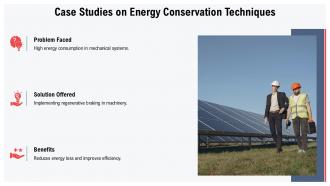
Friction acts as a non-conservative force that converts mechanical energy into thermal energy, causing the total mechanical energy of a system to decrease over time. While this presents challenges for ideal energy conservation, it enables practical applications like braking systems in automotive engineering and controlled energy dissipation in manufacturing processes, ultimately delivering safety mechanisms and operational control across industries.
Graphical representations enhance understanding of mechanical energy conservation by visualizing kinetic energy, potential energy, and total energy relationships across motion phases, position changes, and time intervals. Through energy-position graphs and energy-time plots, students and engineers can analyze system behaviors, identify conservation principles, and predict mechanical outcomes more effectively, ultimately delivering clearer comprehension and enhanced problem-solving capabilities.
Practical examples include pendulum clocks, roller coasters, bouncing balls, wind-up toys, and playground swings, where kinetic and potential energy continuously interchange. These systems demonstrate energy transformation principles that engineers leverage in designing efficient machinery, renewable energy systems, and transportation solutions, ultimately delivering cost-effective technologies and enhanced performance across manufacturing, automotive, and energy sectors.
During conservation, kinetic and potential energy continuously transform into each other while maintaining constant total mechanical energy, with potential energy converting to kinetic as objects fall or accelerate, and kinetic converting back to potential during upward motion or compression. This dynamic interplay enables systems across industries, from hydroelectric plants to manufacturing equipment, to optimize energy efficiency, reduce operational costs, and enhance performance through strategic energy management and recovery mechanisms.
Mechanical energy conservation in closed systems with external forces depends on whether those forces are conservative or non-conservative in nature. While conservative forces like gravity and elastic forces allow mechanical energy to remain constant through energy transformation, non-conservative forces such as friction and air resistance convert mechanical energy to heat, ultimately reducing the system's total mechanical energy and preventing true conservation.
Conservation of mechanical energy operates as a specialized case within the broader first law of thermodynamics, which states that total energy in an isolated system remains constant. While mechanical energy conservation applies specifically to kinetic and potential energy transformations in systems without friction or heat transfer, the first law encompasses all energy forms including thermal, chemical, and electromagnetic. This relationship demonstrates how fundamental energy principles scale from mechanical systems to comprehensive thermodynamic processes, ultimately enabling engineers and physicists to predict system behaviors across applications.
Common misconceptions about mechanical energy conservation include believing it applies universally regardless of friction, assuming total energy disappears rather than transforms, and expecting perfect conservation in real-world scenarios. Many students struggle with understanding that while mechanical energy decreases due to air resistance or surface friction, total energy remains constant through transformation into heat, sound, or other forms, ultimately demonstrating energy's fundamental principle of conservation across all physical systems.
Mechanical energy conservation guides engineers in designing efficient systems by minimizing energy losses, optimizing component placement, and predicting performance outcomes across various applications. Through strategic engineering approaches, industries like automotive, aerospace, and renewable energy enhance operational efficiency, reduce material costs, and deliver superior product performance, ultimately gaining competitive advantage in increasingly sustainability-focused markets.
Effective experiments include pendulum swings, roller coaster models, bouncing balls, mass-and-spring systems, and inclined plane demonstrations. These hands-on approaches enhance student understanding by visualizing energy transformations between kinetic and potential states, while educational institutions find that interactive experiments significantly improve comprehension rates and long-term retention of fundamental physics principles.
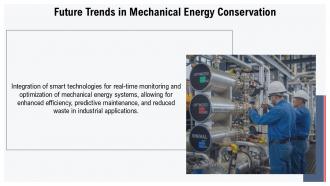
Technological advancements leverage mechanical energy principles through wind turbines converting kinetic energy, hydroelectric systems harnessing gravitational potential energy, and wave generators capturing oscillatory motion. These technologies streamline energy conversion by maximizing rotational efficiency, minimizing friction losses, and optimizing energy storage systems, ultimately delivering cost-effective renewable solutions and competitive advantages for utilities across global markets.
-
The templates you provide are great! They have saved me tons of time and made my presentations come alive. Thank you for this awesome product. Keep up the good work!
-
Requested a complete pitch deck. Delivered immediately and with high quality well researched content.