

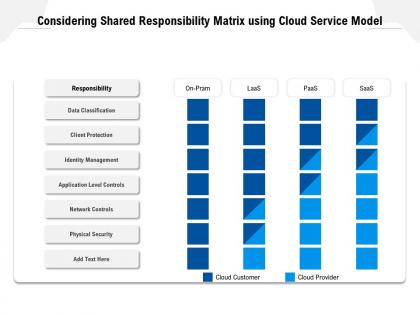
Considering shared responsibility matrix using cloud service model




Try Before you Buy Download Free Sample Product
 Impress Your
 Audience
 100%
100% Editable
 Save Hours
 of Time


Our Considering Shared Responsibility Matrix Using Cloud Service Model are topically designed to provide an attractive backdrop to any subject. Use them to look like a presentation pro.
People who downloaded this PowerPoint presentation also viewed the following :
Considering shared responsibility matrix using cloud service model with all 2 slides:
Use our Considering Shared Responsibility Matrix Using Cloud Service Model to effectively help you save your valuable time. They are readymade to fit into any presentation structure.

FAQs for Considering shared responsibility matrix using
A Shared Responsibility Matrix defines who is responsible, accountable, consulted, and informed for each project task, creating clear role delineation across team members and stakeholders. This framework streamlines decision-making by eliminating role confusion, accelerating project timelines, and enhancing accountability, with many organizations finding that structured responsibility mapping significantly reduces project delays and improves cross-functional collaboration.
A Shared Responsibility Matrix improves communication by clearly defining roles, accountability levels, and decision-making authority for each team member across project tasks. This transparency eliminates confusion, reduces overlapping responsibilities, and establishes clear communication channels, with many organizations finding that structured role clarity enhances collaboration, minimizes conflicts, and ultimately delivers faster project completion and improved team efficiency.
An effective Shared Responsibility Matrix includes clearly defined roles, specific task assignments, accountability measures, communication protocols, and escalation procedures. These components streamline project management by eliminating confusion, enhancing collaboration, and establishing transparent ownership structures, with many organizations finding that well-structured matrices significantly reduce delays, improve cross-functional coordination, and ultimately deliver faster project completion and better stakeholder alignment.
A Shared Responsibility Matrix proves most beneficial in complex multi-stakeholder projects, cloud migrations, vendor partnerships, cross-functional initiatives, and organizational restructuring scenarios. These frameworks streamline accountability by clearly defining roles, minimizing overlap, and reducing confusion, with many organizations finding that structured responsibility allocation accelerates project delivery while preventing costly miscommunications and resource conflicts.
Roles and responsibilities are determined by identifying all stakeholders involved in the project or process, analyzing their specific functions, decision-making authority, and accountability levels. This involves mapping each team member's expertise, resource control, and deliverable ownership, while considering organizational hierarchy, cross-functional dependencies, and communication requirements, ultimately ensuring comprehensive coverage and clear accountability across all critical activities.
Common pitfalls include unclear role definitions, overlapping responsibilities without clear ownership, insufficient stakeholder input during creation, and failing to regularly update the matrix as projects evolve. Many organizations find that vague accountability boundaries, inadequate communication channels, and lack of escalation procedures ultimately undermine project efficiency, with successful teams avoiding these issues through detailed documentation and regular matrix reviews.
A Shared Responsibility Matrix supports risk management by clearly defining accountability for risk identification, assessment, and mitigation across team members, eliminating confusion and ensuring comprehensive coverage. This structured approach enables project teams to proactively address vulnerabilities, streamline communication during crisis situations, and maintain consistent oversight, ultimately reducing project delays and cost overruns while enhancing stakeholder confidence.
Tools for designing Shared Responsibility Matrices include Microsoft Visio, Lucidchart, SmartDraw, Miro, and specialized project management platforms like Monday.com or Asana. These solutions streamline matrix creation by offering templates, real-time collaboration features, and integration capabilities, with many organizations finding that cloud-based platforms enhance team coordination and ultimately deliver clearer accountability frameworks.
Organizations customize Shared Responsibility Matrices by adapting responsibility categories, stakeholder roles, and accountability levels to match specific project requirements, complexity, and team structures. Financial services projects might emphasize compliance oversight while manufacturing initiatives focus on quality control and safety protocols, with many organizations finding that tailored matrices improve clarity and reduce project delays significantly.
Best practices for updating a Shared Responsibility Matrix include conducting regular review sessions with stakeholders, documenting scope changes immediately, maintaining version control with clear change logs, and establishing formal approval processes for modifications. These practices streamline accountability by ensuring transparent communication, preventing role confusion, and adapting to evolving project requirements, with many organizations finding that quarterly reviews and automated notification systems ultimately deliver enhanced project coordination and reduced operational risks.
A Shared Responsibility Matrix enhances accountability by clearly defining roles, ownership boundaries, and decision-making authority for each team member across specific tasks and deliverables. This transparency eliminates confusion, reduces overlap, and ensures nothing falls through cracks, with many organizations finding that structured responsibility mapping significantly improves project outcomes and team performance.
A Shared Responsibility Matrix enhances cross-functional team coordination by clearly defining each team member's role across project phases, deliverables, and decision points. This framework streamlines collaboration between departments like IT, marketing, and operations by establishing accountability boundaries, reducing role confusion, and ensuring seamless handoffs, ultimately delivering faster project completion and improved team efficiency.
Effectiveness metrics include compliance rates, incident response times, security audit scores, stakeholder satisfaction levels, and risk mitigation success rates. These measurements enable organizations to assess accountability clarity, operational efficiency, and collaborative outcomes across cloud environments, with many enterprises finding that regular metric evaluation enhances both security posture and strategic alignment between teams.
A Shared Responsibility Matrix aligns with Agile methodologies by promoting transparency, collaborative accountability, and iterative clarity across cross-functional teams. Through sprint planning and daily standups, teams continuously refine responsibility boundaries, enhance communication between developers, testers, and product owners, while ensuring deliverables remain focused and dependencies are managed, ultimately accelerating development cycles.
Healthcare systems like Kaiser Permanente and financial institutions including JPMorgan Chase have successfully implemented Shared Responsibility Matrices to clarify cloud security roles between internal teams and providers like AWS. These frameworks streamline compliance management, enhance incident response coordination, and minimize security gaps, with many organizations finding that clear accountability boundaries ultimately deliver faster threat resolution and reduced operational risk in increasingly complex multi-cloud environments.
No Reviews