


Construction Costing Proposal Powerpoint Presentation Slides




Try Before you Buy Download Free Sample Product
 Impress Your
 Audience
 100%
100% Editable
 Save Hours
 of Time


To build a production facility, every important aspect and element needs to be taken into account. It not only requires efficient manual work, but it also demands detailed planning, professionalism, guaranteed safety, and infallible blueprint of the structure. Therefore, it is necessary to ensure an experienced and well-qualified project manager for the management and development of the infrastructure. This Construction Costing Proposal PowerPoint Presentation Slides helps you give a detailed account of all the construction services that your company offers to the clients. Mention the hurdles in assembling an infrastructure and offer solutions to your clients like the value proposition of building, appropriate structure design, and experienced architects by taking the aid of this construction industry PPT template. Eliminate the concerns of your customers by highlighting the construction phases in a well-organized manner with the help of this architecture industry PPT slide. Mention the key deliverables like efficient site survey, project blueprint, material specifications, site testing, procurement, regulation, and governance to the clients with the assistance of this content-specific PPT proposal layout. Outline the work schedule and cost estimate for the whole plan of action by taking the assistance of our building sector PPT slideshow. These proposal slides will assist you in formulating the list of tasks such as pre-construction, foundation, framing, exterior furnishes, electrical works to ensure their successful execution. Introduce your company's team responsible for all the hard work by employing our design services PPT slideshow. Gain the trust of your clients by utilizing this building services PPT graphic to exhibit your company's mission, vision, awards, achievements, and core values. You can easily display the client testimonials and case studies of your past projects through our construction management PPT presentation. Download this expertly designed PPT visual and showcase your terms and conditions for signing the work contract with your company.
People who downloaded this PowerPoint presentation also viewed the following :
Content of this Powerpoint Presentation
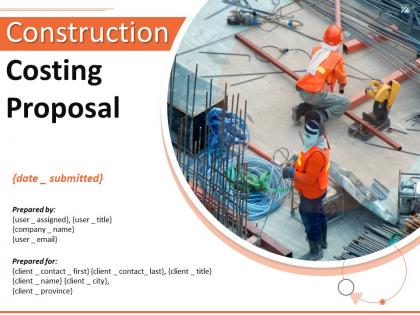
Slide 1: This slide introduces Construction Costing Proposal. State Client Details and User details and begin.
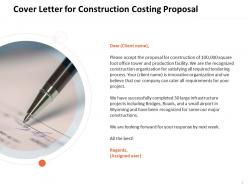
Slide 2: This slide displays Cover Letter for Construction Costing Proposal.
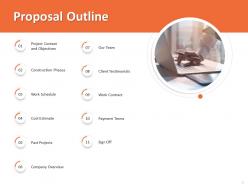
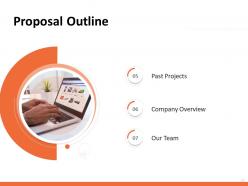
Slide 3: This slide showcases Proposal Outline.
Slide 4: This slide depicts Proposal Outline with- Project Context and Objectives and Construction Phases.
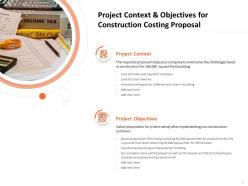
Slide 5: This slide showcases Project Context & Objectives for Construction Costing Proposal. The required proposal helps your company to overcome the challenges faced in construction for 100,000 square foot building
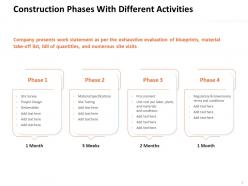
Slide 6: This slide showcases Construction Phases With Different Activities. Company presents work statement as per the exhaustive evaluation of blueprints, material take-off list, bill of quantities, and numerous site visits
Slide 7: This slide showcases Proposal Outline with- Work Schedule Cost Estimate
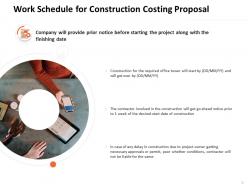
Slide 8: This slide showcases Work Schedule for Construction Costing Proposal.
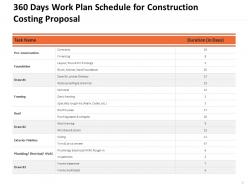
Slide 9: This slide showcases 360 Days Work Plan Schedule.
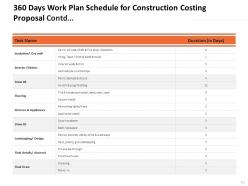
Slide 10: This slide is continued with 360 Days Work Plan Schedule.
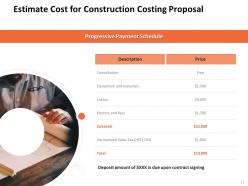
Slide 11: This slide depicts Estimate Cost for Construction Costing Proposal.
Slide 12: This slide showcases Proposal Outline with- Company Overview, Our Team, Past Projects.
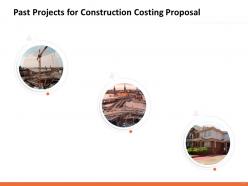
Slide 13: This slide represents Past Projects for Construction Costing Proposal.
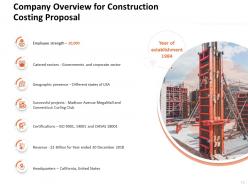
Slide 14: This slide showcases Company Overview for Construction
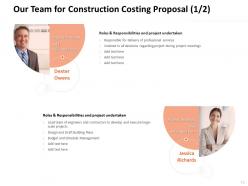
Slide 15: This is Our Team slide with Names and Designations.
Slide 16: This is also Our Team slide with Names and Designations.
Slide 17: This slide shows Proposal Outline with- Client Testimonials, Work Contract.
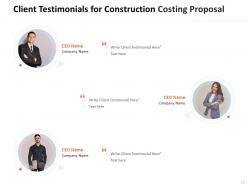
Slide 18: This slide shows Client Testimonials for Construction Costing Proposal.
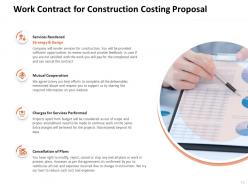
Slide 19: This slide shows Work Contract for Construction Costing Proposal
Slide 20: This slide is continued with Work Contract .
Slide 21: This slide shows Proposal Outline contaning- Payment Terms, Sign Off.
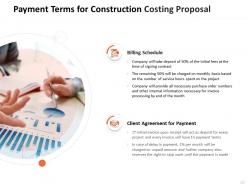
Slide 22: This slide showcases Payment Terms for Construction Costing Proposal.
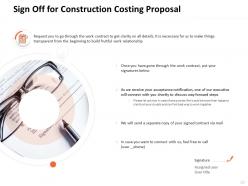
Slide 23: This is Sign Off slide for Construction Costing Proposal
Slide 24: This is Contact Us slide with Address, Contact Number and Email address.
Slide 25: This is Icons Slide for Construction Costing Proposal.
Slide 26: This slide is Additional Slides for moving forward.
Slide 27: This is About Us slide to showcase Company specifications.
Slide 28: This slide displays Our Mission Vision Goal.
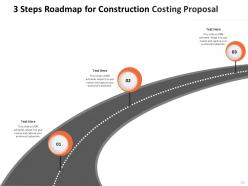
Slide 29: This slide shows 3 Steps Roadmap for Construction Costing Proposal.
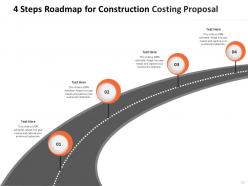
Slide 30: This slide showcases 4 Steps Roadmap for Construction Costing Proposal.
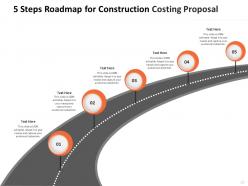
Slide 31: This slide shows 5 Steps Roadmap for Construction Costing Proposal
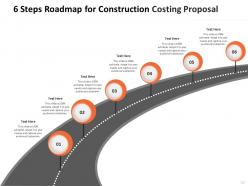
Slide 32: This slide showcases 6 Steps Roadmap for Construction Costing Proposal
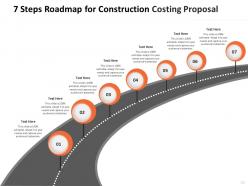
Slide 33: This slide depicts 7 Steps Roadmap for Construction Costing Proposal.
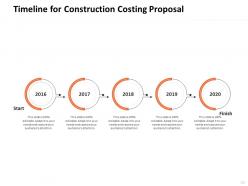
Slide 34: This slide shows Timeline process.
Slide 35: This is 30 60 90 Day Plan slide.
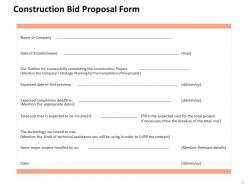
Slide 36: This slide represents Construction Bid Proposal Form.
Construction Costing Proposal Powerpoint Presentation Slides with all 36 slides:
Use our Construction Costing Proposal Powerpoint Presentation Slides to effectively help you save your valuable time. They are readymade to fit into any presentation structure.



FAQs for Construction Costing Proposal
So construction proposals usually break down into labor, materials, equipment, and overhead - that's the main stuff. They'll also throw in subcontractor fees, permits, insurance, plus a contingency buffer (like 5-10% because something always breaks or goes wrong, trust me). Most decent proposals spell out exactly what work they're doing and when, plus how you'll pay them. The good contractors also list what's NOT included - super important so they can't hit you with surprise charges later. Oh, and don't just look at the bottom line when comparing bids. Contractors get creative with how they structure things to look cheaper.
Dude, labor's gonna be your biggest expense - like 30-40% of everything. Base wages are just the start though. You've got benefits, insurance, overtime, union stuff if that applies. What really screws people over is how crazy different rates are by location. SF electrician versus some guy in bumfuck Texas? Totally different ballgame. Oh and don't forget trade specialty matters too. I'd say get fresh quotes from your subs and pad it a bit for wage bumps, especially if your project's dragging on for months.
Dude, material procurement can totally make or break your costing - I've watched so many proposals crash because people just guessed at prices instead of getting actual supplier quotes. Current market rates are all over the place right now, so you really need real numbers. Don't forget about lead times either, those affect your whole timeline. Storage costs, delivery schedules, potential waste - it all adds up fast. Oh and always pad your material costs by like 5-10% because prices shift constantly. Trust me, better to overestimate than scramble later when steel costs spike or whatever.
Honestly, tech makes cost estimation way more accurate since it cuts out those annoying calculation mistakes we all make. AI software can dig through old project data and predict material costs better than Excel ever could. BIM models are pretty sweet - they'll count everything in your 3D design automatically, so you're not sitting there tallying up rebar like some medieval accountant. Plus you get live market pricing, which is clutch when steel prices are bouncing around like crazy. Just pick something that plays nice with whatever system you're already using, or you'll hate your life trying to make it work.
Labor costs always get you - seriously, pad those numbers. And don't even get me started on permits, they're a nightmare but you gotta factor them in. Be super specific about materials or clients will assume you meant the bargain basement stuff, then act shocked when you clarify. Weather delays? Yeah, those happen. Material deliveries are late half the time too. I learned this the hard way on my last project - always build in contingency money because something WILL go wrong. Document everything you're assuming in your proposal. Trust me on this one.
Ugh, scope changes are the worst - they totally blow up your original budget. You're not just paying for extra materials and labor either. There's all the coordination mess, potential delays, and sometimes you gotta rip out work that's already done. The timing matters too - changes later in the project cost way more because everything's already in motion. I learned this the hard way on my first big job. Always pad your estimates with at least 10-20% contingency, and document every single change with proper change orders. Trust me, it'll save your ass when clients start questioning costs later.
So there's basically four ways to tackle this. You've got analogous estimating - just comparing to similar projects you've done before. Parametric uses statistical models, which sounds fancy but it's pretty straightforward. Bottom-up is where you break down every single cost line by line (takes forever but it's super accurate). Then there's three-point estimating with your best/worst/likely scenarios. If I had to pick? Bottom-up wins for accuracy hands down, but man does it eat up time. Early on I'd probably just use analogous or parametric to get rough numbers, then get detailed later when you know more about what you're actually dealing with.
Dude, location absolutely murders your budget - we're talking 20-40% swings easy. Labor in rural spots might run you $30/hour, but cities? You're looking at $60+ no problem. Shipping materials gets expensive quick, especially the heavy stuff. Then weather screws you over too - harsh winters or hurricane zones mean crazy building codes and you can only work certain months. Permitting fees are honestly the worst part sometimes, depending where you are. I learned this the hard way on a job in Denver. Always multiply your costs when you're working somewhere new.
Contingency fees are like your construction emergency fund for when stuff goes wrong - and trust me, it will. Most projects budget around 5-15% of total costs for this. Hit a water line nobody knew about? That's contingency money. Weather delays your concrete pour for two weeks? Yep, contingency again. Material costs suddenly spike because of some supply chain mess? You get the idea. I learned this the hard way on my first big project when we found old foundation issues nobody expected. Base your percentage on how complicated and risky the job is. Better to have it and not need it than scrambling for extra cash mid-project.
So here's what I do - calculate overhead as 10-20% of your direct costs, depending on project size and how complex things get. Break it into actual categories: office rent, insurance, equipment, admin staff, PM time. Honestly, nothing bugs me more than contractors who just throw a random number at the wall. Don't bury it in your labor rates either. Make overhead its own line item so they know what they're paying for. That way when they inevitably ask questions (and they will), you can actually explain each piece instead of scrambling.
Put the total cost and timeline right at the top - don't make them hunt for it. Then break down each line item so they know where their money's going. Charts help a ton, especially when you're dealing with people who aren't super technical. I always add a contingency buffer because something will definitely go sideways. Oh, and be upfront about your assumptions - like what could change the price later. Don't just email them the proposal either. Walk through it together if you can. Finish with when you need an answer back.
Look, historical data is basically your reality check for cost predictions - shows you what actually went down vs. what you hoped would happen. You'll start noticing patterns in budget overruns and figure out which project types always seem to go sideways. Track the reasons too, not just final numbers - weather screwups, material costs going crazy, scope creep, all that fun stuff. Honestly, even a messy spreadsheet beats flying blind. The whole thing becomes like having a crystal ball, except it's built on real numbers instead of crossing your fingers and hoping for the best.
Basically you question every single design decision and hunt for cheaper alternatives that work just as well. Do you actually need that pricey imported stone? Local stuff might look identical for way less. Get your whole crew involved early - architects, engineers, contractors can all suggest money-saving swaps before you're stuck with expensive specs. Hit the big-ticket items first like structural and mechanical systems since that's where real savings live. Oh, and start these value engineering sessions during design development, not when you're already out to bid. That timing makes all the difference.
Dude, permits and regulations can seriously mess with your budget - we're talking 10-30% extra depending on how complicated your project is. The fees alone add up, then you've got inspection costs on top. Building codes might force you into expensive materials too, which honestly sucks but whatever. Each city does things differently, so what works in one place might not fly somewhere else. I'd hit up your local building department ASAP to get real numbers on permits and timelines. Oh, and definitely pad your budget for surprises because something always comes up that nobody saw coming.
Honestly, weekly budget check-ins are a lifesaver - they'll catch problems before they spiral. Get everything in writing upfront, especially your specs. Any changes, even tiny ones? Written approval only. I learned this the hard way on a kitchen reno that went sideways fast. Your project manager should be doing weekly reviews religiously, not just when things go wrong. Oh, and budget for 10-15% contingency because something always comes up. Way better to track costs weekly than get hit with a nasty surprise later. Set up those reviews now and actually stick to them.
-
Great quality slides in rapid time.