

Construction employee safety training proposal powerpoint presentation slides




Try Before you Buy Download Free Sample Product
 Impress Your
 Audience
 100%
100% Editable
 Save Hours
 of Time


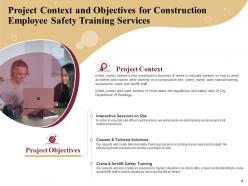
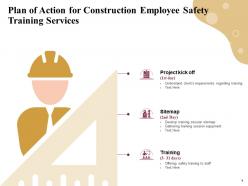
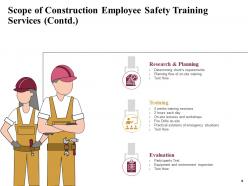
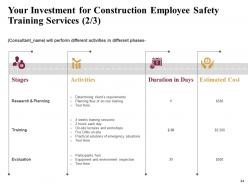
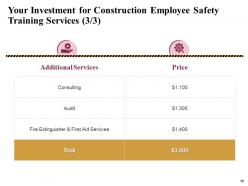
Our Construction Employee Safety Training Proposal Powerpoint Presentation Slides are explicit and effective. They combine clarity and concise expression.Construction work is a precarious job that requires a massive workforce to construct buildings, roads, houses, and tree forts. Over the past few years, many mishappenings have occurred at construction sites. These include falls, being caught between objects, electrocutions, and being struck by objects. With the increase in occupational fatalities, it is important to train the construction workforce regarding their health and safety. Employ our innovatively-designed Construction Employee Safety Training Proposal PowerPoint Presentation Slides and pitch your safety training services to create awareness among construction workers. With the help of our worker's training PowerPoint proposal templates, emphasize the significance of safety standards composed for the protection of the construction workforce. Take the assistance of our ready-to-use PPT theme to showcase how this training can help your customers build a safe culture within the organization. Discuss the benefits of providing employee training like the reduction of workplace injuries, identification of risks and hazards involved in construction boundaries, and implementation of an effective safety management system effectively through this staff training PowerPoint slideshow. Explain project goals confidently such as, interactive sessions on-site, custom, tailored solutions, crane, and forklift safety training. Precisely exhibit your plan of action and describe the scope of construction training services like research, planning, training, and evaluation by adopting our hazard prevention session PPT graphic. Give clarity on the project completion time step by step using our time frame slide. Share additional offerings that your company renders and cost details that they have to pay upon accepting your proposal. Develop a better engagement and communication with your clients by providing company history, mission, vision, core values, achievements, and awards. Download our topic-specific site workforce training PowerPoint layout that is bound to make an impact on your audience.
People who downloaded this PowerPoint presentation also viewed the following :
Content of this Powerpoint Presentation
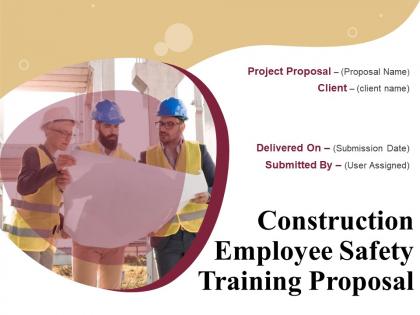
Slide 1: This slide introduces Construction Employee Safety Training Proposal. State Proposal name, Client name, Submission date, User assigned.
Slide 2: This slide displays Cover Letter for Construction Employee Safety Training.
Slide 3: This slide displays Table of Content of the presentation.
Slide 4: This slide depicts Table of Content of Presentation.
Slide 5: This slide describes Project Context & Objectives for Construction Employee Safety Training.
Slide 6: This slide shows Table of content.
Slide 7: This slide describes Plan of Action.
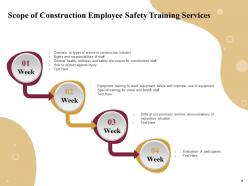
Slide 8: This slide is continued with Scope of Construction Employee Safety Training.
Slide 9: This slide provides Overview to types of issues in construction industry.
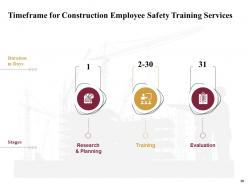
Slide 10: This slide showcases Timeframe for Construction Employee Safety Training.
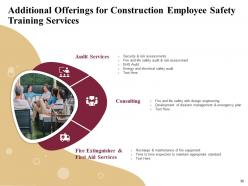
Slide 11: This slide shows Additional Service Offerings.
Slide 12: This slide shows Table of content.
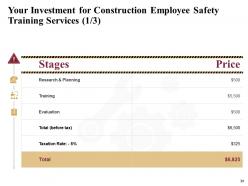
Slide 13: This slide depicts Investment details.
Slide 14: This slide showcases Investment details.
Slide 15: This slide showcases Investment details.
Slide 16: This slide depicts Table of Content.
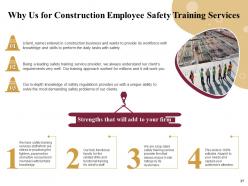
Slide 17: This slide shows reasons for choosing us. Depicts Strengths that will add to your firm
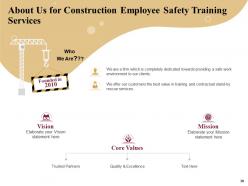
Slide 18: This is About Us slide with Vision, Mission and Goal of Company.
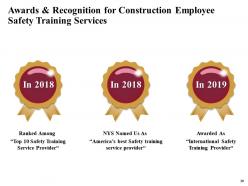
Slide 19: This slide displays Awards & Recognition.
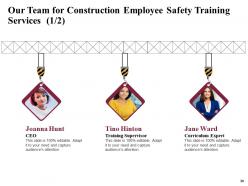
Slide 20: This is Our Team slide with Names and Designations.
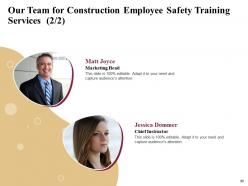
Slide 21: This is Our Team slide.
Slide 22: This slide shows Table of content.
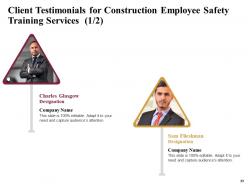
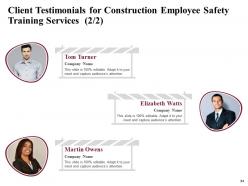
Slide 23: This slide displays Client Testimonials.
Slide 24: This slide shows Client Testimonials.
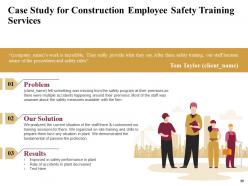
Slide 25: This slide showcases Case Study for Construction Employee Safety Training.
Slide 26: This slide shows Table of Content.
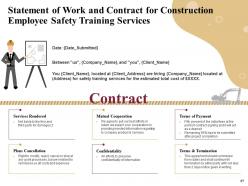
Slide 27: This slide showcases Statement of Work & Contract for Construction Employee Safety Training.
Slide 28: This slide shows Table of content.
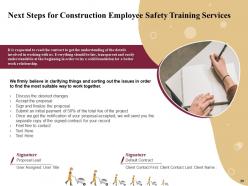
Slide 29: This slide showcases Next Steps for Construction Employee Safety Training.
Slide 30: This is Contact Us slide with Email Address, Address and Contact number.
Slide 31: This is Icons Slide for Construction Employee Safety Training.
Slide 32: This is Additional Slides for moving forward.
Slide 33: This is About Us slide to showcase Company specfications.
Slide 34: This is Our Mission slide with Mission, Vision and Goals.
Slide 35: This slide showcases Timeline process.
Slide 36: This slide showcases Roadmap process.
Slide 37: This is 30 60 90 Days Plan slide.
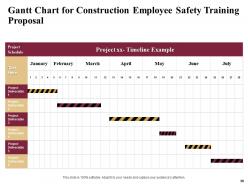
Slide 38: This slide represents Gantt Chart for Workers Training Proposal Template.
Construction employee safety training proposal powerpoint presentation slides with all 38 slides:
Use our Construction Employee Safety Training Proposal Powerpoint Presentation Slides to effectively help you save your valuable time. They are readymade to fit into any presentation structure.


FAQs for Construction employee safety training proposal
Effective construction safety training programs include hazard identification protocols, personal protective equipment usage, emergency response procedures, equipment operation safety, and regulatory compliance standards. These components work together by reducing workplace accidents, ensuring OSHA adherence, and building safety-conscious culture, with many construction companies finding that comprehensive training ultimately delivers lower insurance costs, improved productivity, and enhanced worker confidence on job sites.
VR technology enhances construction safety training by creating immersive simulations, enabling risk-free practice scenarios, and providing realistic hazard exposure without actual danger. Through virtual environments, construction workers experience fall protection protocols, equipment operation procedures, and emergency responses, while trainers track performance metrics and identify skill gaps, ultimately delivering more effective safety outcomes than traditional classroom methods.
Construction safety training legal requirements include OSHA's 10-hour and 30-hour programs, hazard communication standards, fall protection certification, equipment operation training, and site-specific safety orientations. These comprehensive requirements streamline compliance by establishing clear protocols, reducing liability exposure, and ensuring consistent safety practices across projects, with many construction firms finding that proactive training programs ultimately deliver lower insurance costs and enhanced competitive positioning.
Cultural factors significantly impact construction safety training effectiveness by influencing communication styles, hierarchical respect patterns, risk perception differences, and learning preferences across diverse workforce populations. Organizations with culturally adaptive training programs, incorporating multilingual materials, culturally relevant examples, and respect for different authority structures, ultimately achieve higher safety compliance rates and reduced workplace incidents across international construction teams.
Hands-on training delivers superior retention and practical application compared to classroom instruction, enabling workers to practice safety procedures, operate equipment properly, and respond to real hazards in controlled environments. While classroom learning provides essential theoretical foundations, field-based training develops muscle memory, situational awareness, and emergency response skills that significantly reduce workplace accidents and enhance overall site safety.
Organizations measure construction safety training success through incident reduction rates, safety audit scores, employee knowledge assessments, compliance metrics, and behavioral observation data. These measurement approaches enable construction companies, engineering firms, and project managers to track improved safety performance, reduced insurance costs, and enhanced regulatory compliance, while identifying training gaps and ultimately delivering stronger safety cultures and competitive advantages in project bidding.
Common construction safety hazards include falls from heights, electrical hazards, equipment accidents, struck-by incidents, and caught-in hazards like trenching collapses. Effective training programs address these through hands-on simulations, site-specific protocols, and regular safety assessments, with many construction companies finding that comprehensive programs significantly reduce workplace injuries while enhancing operational efficiency and regulatory compliance.
Construction safety training should be updated annually at minimum, with immediate updates following regulatory changes, incident investigations, or new technology implementations. Many construction companies find that quarterly refreshers combined with project-specific briefings enhance compliance effectiveness, reduce workplace accidents, and ultimately deliver lower insurance costs while maintaining competitive advantage in increasingly safety-conscious markets.
**INPUT**: What strategies can be employed to engage workers during safety training sessions? **OUTPUT**: Effective engagement strategies include interactive simulations, hands-on demonstrations, real incident case studies, peer-to-peer learning sessions, and gamified safety challenges. These approaches enhance retention by connecting theoretical knowledge to practical applications, with many construction companies finding that workers respond better to scenario-based training and visual storytelling, ultimately delivering improved safety compliance and reduced workplace incidents. [Word count: 58 words]
Novice workers gain foundational knowledge of hazard identification, proper equipment usage, and basic safety protocols, while seasoned professionals benefit from advanced risk assessment techniques, leadership skills, and updates on new regulations. Construction companies find that targeted training approaches enhance overall site safety, with newcomers developing essential protective habits and experienced workers refining their expertise to mentor others, ultimately reducing workplace incidents.
Emerging technologies supporting construction safety training include virtual reality simulations, augmented reality overlays, mobile learning platforms, IoT wearable sensors, and AI-powered analytics systems. These technologies enhance training effectiveness by delivering immersive experiences, providing real-time hazard detection, and enabling personalized learning paths, with many construction companies finding that workers retain safety protocols significantly better through interactive, technology-driven approaches.
Safety training can be tailored for specialized construction roles through role-specific modules covering electrical hazard identification, excavation cave-in prevention, equipment-specific protocols, and targeted risk assessments. Construction companies increasingly customize training programs by incorporating hands-on simulations, trade-specific OSHA standards, and specialized equipment handling, with electrical contractors and excavation teams finding that targeted approaches significantly reduce workplace incidents while enhancing operational efficiency.
Interactive tools in construction safety training deliver enhanced engagement, improved knowledge retention, realistic scenario simulation, immediate feedback capabilities, and standardized learning experiences across teams. These technologies streamline safety protocols by enabling hands-on practice without real-world risks, accelerating competency development, and reducing workplace incidents, with many construction companies finding that interactive training ultimately delivers faster certification processes and stronger safety cultures.
Effective communication enhances construction safety by establishing clear protocols, ensuring consistent hazard reporting, and creating shared understanding of safety procedures across all team levels. Through structured training programs, construction teams develop standardized communication methods for equipment operations, emergency responses, and daily safety briefings, ultimately reducing workplace accidents and enabling faster incident resolution.
Effective construction safety training methodologies include immersive VR simulations, hands-on equipment demonstrations, peer-to-peer mentoring programs, regular safety audits, and scenario-based learning modules. These approaches enhance worker awareness by combining practical experience with real-world applications, ultimately delivering significant accident reduction and improved safety compliance across construction projects.
-
Presentation Design is very nice, good work with the content as well.
-
Illustrative design with editable content. Exceptional value for money. Highly pleased with the product.