

Construction management strategies for maximizing resource efficiency powerpoint presentation slides





Try Before you Buy Download Free Sample Product
 Impress Your
Audience
 100%
Editable
 Save Hours
of Time


Resource management ensures managers have real time visibility into people and other resources on demand to have greater control over delivery. Here is a professionally designed construction management strategy for maximizing efficiency template to analyze various tools used in the company. The purpose of this is to study practices and procedures for increasing labor productivity. Firms can identify multiple reasons for project failures and the need for an effective management system. You can display the need for efficient construction, significant reasons for the poor design, consequences, current planning and scheduling, productivity status, efficiency indicators, and more. The template showcases the key statistics on a global scale with variant strategies to execute. Organizations can present essential components of a resource management plan, fundamental principles, stages involved, budget, costing, scheduling strategies, etc. One can develop the procurement routes, ways to improve labor productivity, and challenges and solutions in construction management. The proposal exhibits the benefits of an automated system and best practices for high-quality management. Learn ways to address the environmental impact of construction and tools for implementation in the future. Get access to the market’s best template on construction management strategies for maximizing efficiency and download it now. Talk to our experts and ask your queries.
People who downloaded this PowerPoint presentation also viewed the following :
Content of this Powerpoint Presentation
Slide 1: This slide displays the title i.e. 'Construction Management Strategies for Maximizing Resource Efficiency' and your Company Name.
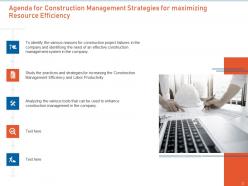
Slide 2: This slide presents the agenda of the project.
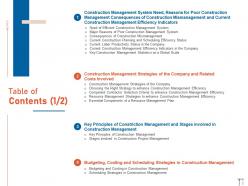
Slide 3: This slide showcases the table of contents for the project.
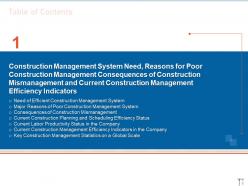
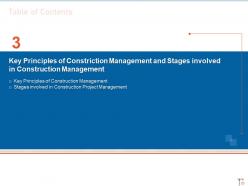
Slide 4: This slide showcases the table of contents for the project.
Slide 5: This slide displays the title for need for construction management system.
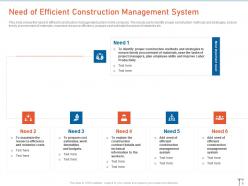
Slide 6: This slide shows the need of efficient construction management system in the company. The needs are to identify proper construction methods and strategies, ensure timely procurement of materials, maximize resource efficiency, prepare cost estimated and work timetables etc.
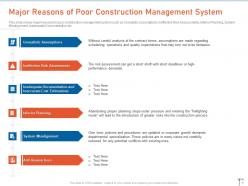
Slide 7: This slide shows major reasons for poor construction management system such as Unrealistic Assumptions, Ineffective Risk Assessments, Inferior Planning, System Misalignment, Inadequate Documentation etc.
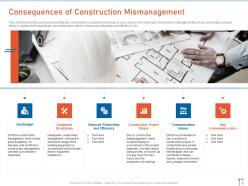
Slide 8: This slide shows the consequences that any construction company must incur in case of poor and improper construction management such as overbudget, project delay’s, equipment breakdown, etc.
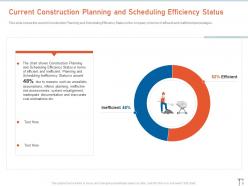
Slide 9: This slide shows the current Construction Planning and Scheduling Efficiency Status in the company in terms of efficient and inefficient percentages.
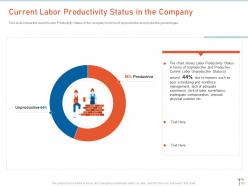
Slide 10: This slide shows the current Labor Productivity Status in the company in terms of unproductive and productive percentages.
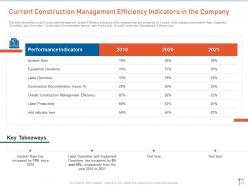
Slide 11: This slide shows the current Construction Management System Efficiency Indicators of the company that are compared for 3 years.
Slide 12: This slide shows the some of the general Construction Management Statistics on a Global Scale such as increase in value of construction projects worldwide, increase in construction industry fatality rate, etc.
Slide 13: This slide displays the title for construction management strategies.
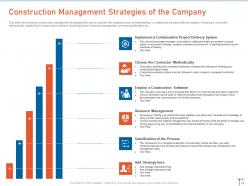
Slide 14: This slide shows some construction management strategies that can be used by the company such as implementing a collaborative project delivery system, choosing a contractor methodically, etc.
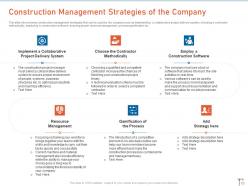
Slide 15: This slide shows some construction management strategies that can be used by the company such as implementing a collaborative project delivery system, choosing a contractor methodically, etc.
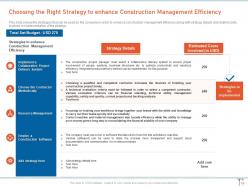
Slide 16: This slide shows the strategies that can be used by the company in order to enhance construction management efficiency along with strategy details and related costs involved in implementation of the strategy.
Slide 17: This slide shows the strategic evaluation criteria for selecting a competent contractor in order to increase the overall Construction Management Efficiency
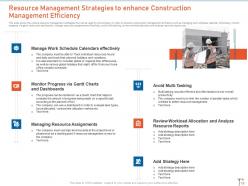
Slide 18: This slide shows the various resource management strategies that can be used by the company in order to enhance construction management efficiency such as managing work schedule calendar effectively, etc.
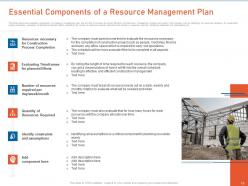
Slide 19: This slide shows some essential components of a resource management plan that will help to increase the overall efficiency of construction management process and system in the company such as identifying the resources necessary for construction project completion, etc.
Slide 20: This slide displays the title for key principles of construction management.
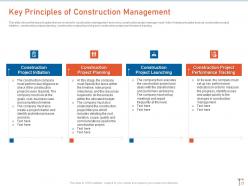
Slide 21: This slide shows the key principles that are involved in construction management and every construction project manager must follow theses principles such as construction project initiation, etc.
Slide 22: This slide shows the various stage that are involved in construction project management of the company such as design, Pre-Construction, Procurement, Construction, Commissioning, etc. in each stage.
Slide 23: This slide presents the title for budgeting, costing and scheduling strategies.
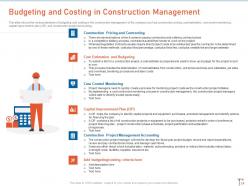
Slide 24: This slide shows the various elements of budgeting and costing in the construction management of the company such as construction pricing, cost estimation, cost control monitoring, etc.
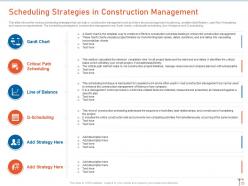
Slide 25: This slide shows the various scheduling strategies that can help in construction management and provide a structured approach to planning, problem identification, cash flow forecasting and resource requirements.
Slide 26: This slide exhibits the title for construction management procurement routes.
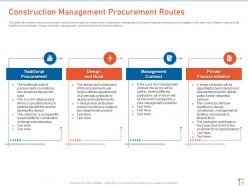
Slide 27: This slide shows the various procurement routes that are used to enhance the construction management process efficiency and acquire the supplies in the most cost-effective way.
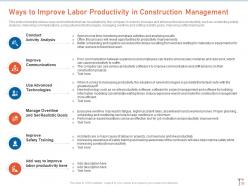
Slide 28: This slide shows the various ways and methods that can be adopted by the company in order to increase and enhance the labor productivity such as conducting activity analysis, etc.
Slide 29: This slide displays the title for challenges and solutions in construction management.
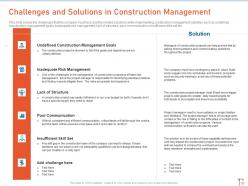
Slide 30: This slide shows the challenges that the company must face and the related solutions while implementing construction management activities such as inadequate risk management, lack of structure, etc.
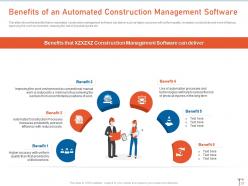
Slide 31: This slide shows the benefits that an automated construction management software can deliver such as higher accuracy with uniform quality, increase in productivity and work efficiency, etc.
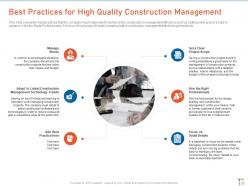
Slide 32: This slide shows the best practices that the company must implement to enhance the construction management efficiency such as setting clear project scope in advance, Hire the Right Professionals, etc.
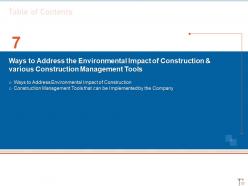
Slide 33: This slide displays the title for ways to address the environmental impact.
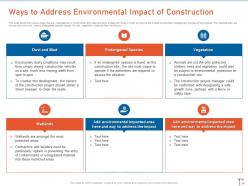
Slide 34: This slide shows the various areas that are impacted due to construction activities and ways to deal with those in order to improve the overall construction management process effectiveness.
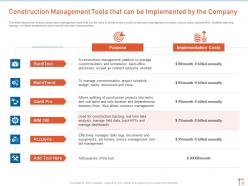
Slide 35: This slide shows the various construction management tools that can be used to enhance the overall construction management process, reduce costs, etc.
Slide 36: This slide displays the title for future construction management efficiency.
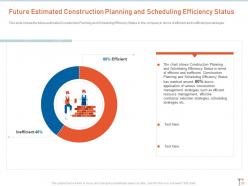
Slide 37: This slide shows the future estimated Construction Planning and Scheduling Efficiency Status in the company in terms of efficient and inefficient percentages.
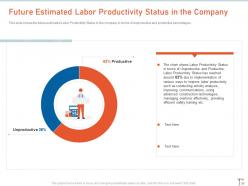
Slide 38: This slide shows the future estimated Labor Productivity Status in the company in terms of unproductive and productive percentages.
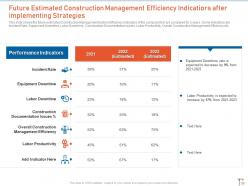
Slide 39: This slide shows the future estimated Construction Management System Efficiency Indicators of the company that are compared for 3 years.
Slide 40: This slide presents the title for dashboards.
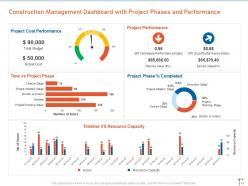
Slide 41: This slide exhibits the dashboard with project phases and performance.
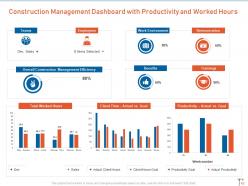
Slide 42: This slide showcases the dashboard with productivity and worked hours.
Slide 43: This is the icons slide for the project.
Slide 44: This slide presents the title for additional slides.
Slide 45: This slide demonstrates the vision, mission and goal of the company.
Slide 46: This slide presents the roadmap of the project.
Slide 47: This slide presents about the company, it's target audience and value for clients.
Slide 48: This slide exhibits the 30-60-90 days plan for the project.
Slide 49: This slide presents the details of team members responsible for project.
Slide 50: This slide displays the venn diagram.
Slide 51: This slide displays the posts for past experiences of the clients.
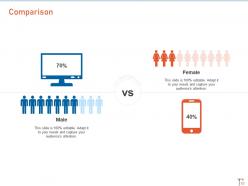
Slide 52: This slide showcases the comparison of products.
Slide 53: This slide displays the goals of the company.
Slide 54: This is the thank you slide and contains contact details of the company like address, phone no., etc. "
Construction management strategies for maximizing resource efficiency powerpoint presentation slides with all 54 slides:
Use our Construction Management Strategies For Maximizing Resource Efficiency Powerpoint Presentation Slides to effectively help you save your valuable time. They are readymade to fit into any presentation structure.








FAQs for Construction management strategies for maximizing resource efficiency
Construction management phases include initiation and planning, design and procurement, execution and monitoring, and project closeout and handover. These phases influence success by establishing clear project scope and budgets, coordinating resources and timelines, maintaining quality control and safety standards, and ensuring proper documentation, with many construction firms finding that systematic phase management reduces delays and cost overruns significantly.
Building Information Modeling (BIM) enhances construction collaboration by creating centralized digital platforms where architects, engineers, contractors, and project managers share real-time project data, identify potential conflicts before construction begins, and coordinate schedules seamlessly. Through BIM integration, construction teams reduce costly rework by up to 30%, accelerate project timelines, and improve communication across all stakeholders, ultimately delivering more efficient project outcomes.
Risk management in construction involves identifying potential hazards like weather delays, cost overruns, safety incidents, regulatory changes, and supply chain disruptions before they impact project timelines and budgets. Effective strategies include comprehensive insurance coverage, detailed contingency planning, regular safety audits, diversified supplier networks, and proactive stakeholder communication, with many construction firms finding that these approaches significantly reduce project costs while enhancing delivery reliability.
Effective communication improves construction efficiency by ensuring clear project specifications, coordinating schedules across multiple trades, and enabling rapid problem resolution. Through digital communication platforms and regular stakeholder meetings, construction teams minimize costly delays, reduce rework from misunderstood requirements, and maintain seamless workflow coordination, ultimately delivering projects on time and within budget.
Best practices for resource allocation in construction management include workforce scheduling optimization, equipment utilization tracking, material procurement planning, budget distribution analysis, and progress milestone monitoring. These strategies streamline project efficiency by minimizing downtime, reducing waste, and maximizing productivity across all phases, with many construction firms finding that systematic resource allocation ultimately delivers faster project completion and significantly improved profit margins.
Sustainable construction practices integrate into project management through green material procurement, waste reduction protocols, energy-efficient design planning, environmental impact assessments, and lifecycle cost analysis. These strategies streamline operations by minimizing resource waste, reducing long-term operational costs, and ensuring regulatory compliance, with many construction firms finding that sustainable approaches ultimately deliver competitive advantages and enhanced client satisfaction.
Change management significantly impacts construction timelines and budgets by controlling scope creep, streamlining approval processes, and maintaining stakeholder alignment throughout project phases. Effective change protocols enable construction teams to assess cost implications quickly, adjust resource allocation strategically, and communicate timeline impacts transparently, ultimately delivering projects within budget while minimizing delays and disputes.
Critical factors include technical expertise, financial stability, safety records, project timeline capabilities, and quality certifications. Through thorough vetting processes, construction managers can streamline project delivery, minimize cost overruns, and enhance overall construction quality, with many firms finding that strategic subcontractor partnerships ultimately deliver competitive advantages and improved client satisfaction.
Construction managers can effectively monitor progress through digital project management platforms, regular milestone checkpoints, mobile reporting apps, drone surveillance, and scheduled team briefings. These methods enable real-time tracking while maintaining workflow continuity, with many construction firms finding that strategic monitoring actually enhances productivity by identifying bottlenecks early and optimizing resource allocation.
Construction project performance metrics include schedule adherence, budget variance, quality indicators, safety incidents, and stakeholder satisfaction scores. These measurements enable project managers to identify bottlenecks, control costs, and maintain standards, with many construction firms finding that comprehensive tracking ultimately delivers improved profitability and client retention.
Construction management strategies address labor shortages through workforce development programs, strategic partnerships with trade schools, enhanced recruitment initiatives, and technology integration for efficiency gains. These approaches streamline project delivery by automating routine tasks, improving worker productivity, and creating appealing career pathways, with many construction firms finding that comprehensive workforce planning ultimately delivers competitive advantage and project success.
Cost estimation challenges in construction management include material price volatility, labor cost fluctuations, regulatory changes, project scope modifications, and unforeseen site conditions. These obstacles can be addressed through advanced software tools, historical data analysis, and contingency planning, with many construction firms finding that strategic combinations of predictive analytics and experienced project managers ultimately deliver more accurate budgets and enhanced profitability.
Regulatory compliance significantly shapes construction management strategies by requiring specialized planning protocols, comprehensive documentation systems, and proactive risk assessment frameworks. Through strategic compliance integration, construction managers streamline permitting processes, minimize project delays, and reduce costly violations, while ensuring worker safety and environmental standards, ultimately delivering competitive advantage in an increasingly regulated industry.
Innovative project scheduling tools include AI-powered platforms, 4D BIM modeling, cloud-based collaboration software, automated resource optimization systems, and real-time progress tracking applications. These technologies streamline construction workflows by predicting delays, optimizing resource allocation, and enhancing team coordination, with many construction firms finding that integrated scheduling platforms ultimately deliver faster project completion and reduced costs.
Effective stakeholder engagement requires regular communication, structured feedback loops, transparent progress reporting, and proactive conflict resolution strategies throughout project phases. Through digital collaboration platforms and scheduled touchpoints, construction managers enable better coordination between clients, contractors, and regulatory bodies, while maintaining clear expectations and timelines, ultimately delivering smoother project execution and stronger stakeholder relationships.
-
Awesomely designed templates, Easy to understand.
-
Commendable slides with attractive designs. Extremely pleased with the fact that they are easy to modify. Great work!
-
Awesome presentation, really professional and easy to edit.
-
I discovered this website through a google search, the services matched my needs perfectly and the pricing was very reasonable. I was thrilled with the product and the customer service. I will definitely use their slides again for my presentations and recommend them to other colleagues.
-
Understandable and informative presentation.