


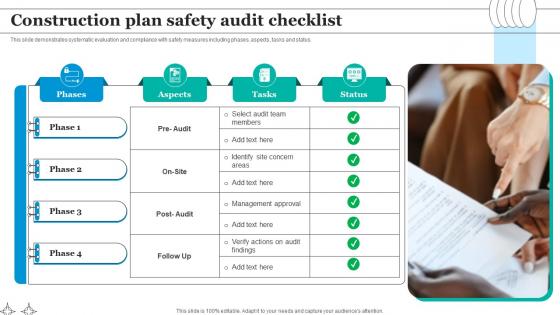
Construction Plan Safety Audit Checklist




Try Before you Buy Download Free Sample Product
 Impress Your
Audience
 100%
Editable
 Save Hours
of Time


This slide demonstrates systematic evaluation and compliance with safety measures including phases, aspects, tasks and status.
People who downloaded this PowerPoint presentation also viewed the following :
Construction Plan Safety Audit Checklist with all 9 slides:
Use our Construction Plan Safety Audit Checklist to effectively help you save your valuable time. They are readymade to fit into any presentation structure.









FAQs for Construction Plan
Essential components of a construction safety audit checklist include personal protective equipment compliance, hazard identification protocols, equipment inspection records, emergency response procedures, and training documentation verification. These comprehensive elements work together by ensuring regulatory adherence, minimizing workplace incidents, and maintaining operational continuity, with many construction firms finding that systematic audits ultimately deliver reduced liability costs and enhanced project efficiency.
Construction safety audits should be conducted weekly for active sites, with daily inspections for high-risk activities like excavation or steel work, and comprehensive monthly reviews covering all safety protocols. This strategic combination enables early hazard identification, ensures regulatory compliance, and minimizes workplace incidents, with many construction companies finding that frequent auditing ultimately delivers reduced insurance costs and enhanced project timelines.
Construction safety audit checklists should include OSHA regulations, local building codes, environmental compliance standards, equipment safety protocols, and industry-specific guidelines like ANSI standards. These comprehensive frameworks streamline regulatory compliance by standardizing inspections, minimizing workplace incidents, and ensuring consistent safety practices, with many construction firms finding that systematic audits ultimately deliver reduced liability costs and enhanced operational efficiency.
Technology enhances construction safety audits by automating data collection, enabling real-time monitoring, and providing predictive analytics for risk assessment. Through IoT sensors, drones, and mobile applications, construction companies streamline inspection processes, identify hazards faster, and maintain comprehensive digital records, ultimately delivering improved compliance, reduced incidents, and enhanced worker safety across project sites.
The most common safety hazards identified in construction audits include falls from heights, electrical hazards, struck-by incidents from equipment or materials, caught-in accidents involving machinery, and hazardous material exposure. These risks significantly impact project timelines and costs, with many construction firms finding that proactive hazard identification through comprehensive audits ultimately delivers reduced insurance premiums, improved worker safety, and enhanced operational efficiency.
Safety items are prioritized by risk level, regulatory requirements, frequency of incidents, and potential severity of consequences. Construction teams typically address fall protection, electrical hazards, and equipment safety first, while many organizations find that incorporating historical accident data and site-specific conditions delivers more targeted safety improvements and enhanced regulatory compliance.
Employee training serves as a foundational element in construction safety audits, ensuring workers understand hazard identification, proper equipment usage, emergency procedures, and regulatory compliance requirements. Comprehensive training programs enable auditors to verify workforce competency across safety protocols, with construction companies finding that well-trained teams significantly reduce workplace incidents, streamline audit processes, and ultimately deliver enhanced operational safety and regulatory adherence.
Construction companies can effectively track audit findings through digital management systems, standardized reporting protocols, assigned responsibility matrices, and regular follow-up schedules. These tracking mechanisms enable systematic resolution by prioritizing critical safety issues, establishing clear timelines for corrective actions, and maintaining comprehensive documentation, with many construction firms finding that structured follow-up processes significantly reduce repeat violations and enhance overall site safety performance.
**INPUT**: What are the best practices for documenting safety audits in construction? **OUTPUT**: Best practices for documenting construction safety audits include standardized checklists, photographic evidence, real-time digital reporting, detailed corrective action plans, and comprehensive follow-up tracking. These documentation methods enhance accountability by streamlining compliance verification, minimizing legal risks, and ensuring consistent safety standards, with many construction firms finding that digital platforms ultimately deliver faster incident resolution and improved project outcomes. [Word count: 60 words]
Weather conditions significantly impact construction audits by requiring evaluation of precipitation effects, wind hazard assessments, temperature-related safety protocols, visibility considerations, and equipment stability measures. These environmental factors influence worker protection requirements, material handling procedures, and operational timing decisions, with many construction companies finding that comprehensive weather-responsive safety protocols ultimately reduce incidents while maintaining project momentum in challenging conditions.
Worker engagement methods include safety committees with employee representatives, peer-to-peer auditing programs, anonymous reporting systems, toolbox talks, and safety suggestion programs. These approaches enhance audit effectiveness by leveraging frontline insights, building ownership through participation, and encouraging proactive hazard identification, with many construction companies finding that worker-led initiatives significantly improve compliance rates and overall site safety culture.
Construction audit checklists can be customized by incorporating project-specific variables like site conditions, equipment types, regulatory requirements, workforce size, and unique hazards. Many construction firms find that tailoring checklists to specific sectors, whether residential developments, industrial facilities, or infrastructure projects, enhances safety compliance while streamlining inspection processes, ultimately delivering better risk management and regulatory adherence.
Follow-up actions after safety audits are crucial for transforming findings into tangible workplace improvements, ensuring identified hazards are properly addressed, and maintaining regulatory compliance. These actions enable construction companies to track corrective measure implementation, verify safety protocol effectiveness, and demonstrate continuous improvement commitment, ultimately reducing accident rates and creating safer work environments while protecting against liability exposure.
Subcontractors can be integrated through pre-qualification safety assessments, mandatory safety orientation programs, joint safety meetings, shared incident reporting systems, and coordinated emergency response protocols. This collaborative approach ensures consistent safety standards across all project phases, with construction companies finding that integrated subcontractor participation reduces workplace incidents, enhances regulatory compliance, and ultimately delivers more efficient project timelines.
Key indicators of a successful construction safety culture include consistent safety protocol adherence, proactive hazard reporting, regular training participation, low incident rates, and strong leadership commitment to safety initiatives. These indicators manifest through daily safety briefings, open communication channels, and comprehensive documentation practices, with many construction companies finding that such cultures ultimately deliver reduced insurance costs, improved worker retention, and enhanced project efficiency.
-
I really liked their customized design services. I got my desired template made by their expert team. Thank You!
-
I'm happy to discover your PowerPoint presentations and templates. They met my expectations precisely. Very innovative!