


Construction Project Guidelines Playbook Powerpoint Presentation Slides





Try Before you Buy Download Free Sample Product
 Impress Your
Audience
 100%
Editable
 Save Hours
of Time


Construction Project Guidelines Playbook is considered a guideline to deliver construction projects faster. The objective of the playbook is to develop facilities within a predefined schedule and timeframe and enable workforce wellbeing through improved safety initiatives. Construction Playbook covers construction projects portfolio to manage construction projects pipeline and project schedule. The bidding and contracts management is captured along the playbook. The playbook covers a project overview, including project charter, supply chain management through procurement process checklist, procurement plan, and supplier rating assessment scorecard. The project schedule management includes work breakdown structure and weekly construction schedule tracking. Risk management consists of a risk mitigation plan and project risk management reporting. Moreover, the playbook covers information regarding workforce safety, including construction material safety data sheets, workplace injury or incident summary reports, accident reporting summaries, and workforce assistance programs. It caters to details about critical people involved in the construction project management team, RACI matrix, and weekly construction employee work timesheet. The cost of the construction project is managed through budget tracking and suitable construction management software solution usage. The dashboards are catered to track essential construction activities, project portfolio, and ongoing progress. Download it now.
People who downloaded this PowerPoint presentation also viewed the following :
Content of this Powerpoint Presentation
Slide 1: This slide introduces Construction Project Guidelines Playbook. State your company name and begin.
Slide 2: This slide states Agenda of the presentation.
Slide 3: This slide presents Table of Content for the presentation.
Slide 4: This is another slide continuing Table of Content for the presentation.
Slide 5: This slide highlights title for topics that are to be covered next in the template.
Slide 6: This slide shows Different Construction Projects Pipeline Management.
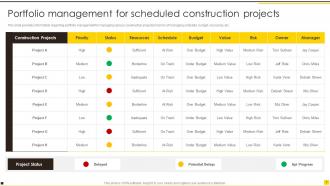
Slide 7: This slide presents Portfolio Management for Scheduled Construction Projects.
Slide 8: This slide highlights title for topics that are to be covered next in the template.
Slide 9: This slide provides information regarding flat slab construction method as modern method of construction.
Slide 10: This slide showcases Modular Building/ 3D Volumetric Construction Method.
Slide 11: This slide shows Twin Wall Technology Construction Method.
Slide 12: This slide presents Insulated Concrete Framework Construction Method.
Slide 13: This slide displays Hybrid or Semi- Volumetric Construction Method.
Slide 14: This slide represents 3D printed construction method as modern method of construction.
Slide 15: This slide showcases timber frames construction method as modern method of construction.
Slide 16: This slide highlights title for topics that are to be covered next in the template.
Slide 17: This slide shows Managing Bidding Process Across Construction Project.
Slide 18: This slide presents Several Kinds of Construction Management Contracts.
Slide 19: This slide highlights title for topics that are to be covered next in the template.
Slide 20: This slide displays Project Charter for Construction Schedule Overview.
Slide 21: This slide highlights title for topics that are to be covered next in the template.
Slide 22: This slide represents Procurement Process Checklist for Construction Project Manager.
Slide 23: This is another slide continuing Procurement Process Checklist for Construction Project Manager.
Slide 24: This slide showcases Procurement Plan for Project Requirements Management.
Slide 25: This slide shows Supplier Rating Assessment Scorecard.
Slide 26: This slide highlights title for topics that are to be covered next in the template.
Slide 27: This slide presents Work Breakdown Structure for Construction Project Tasks Management.
Slide 28: This slide displays Construction Project Schedule Management to Track Progress.
Slide 29: This slide represents Weekly Construction Project Schedule Tracking.
Slide 30: This slide highlights title for topics that are to be covered next in the template.
Slide 31: This slide showcases Risk Mitigation Plan to Manage Key Construction Project Concerns.
Slide 32: This slide shows Construction Project Risk Management Reporting.
Slide 33: This slide highlights title for topics that are to be covered next in the template.
Slide 34: This slide presents Essential Guidelines to Ensure Worker’s Safety.
Slide 35: This is another slide continuing Essential Guidelines to Ensure Worker’s Safety.
Slide 36: This slide provides information regarding construction material safety data sheet.
Slide 37: This slide displays Workplace Injury or Incident Summary Report.
Slide 38: This slide represents Accident Reporting Summary for Construction Site.
Slide 39: This slide showcases Workforce Assistance Program for Worker’s Wellbeing.
Slide 40: This slide highlights title for topics that are to be covered next in the template.
Slide 41: This slide shows Reporting Structure of Construction Firm Personnel.
Slide 42: This slide presents Key People Involved in Construction Project Management Team.
Slide 43: This slide displays RACI Matrix for Essential Construction Activities Assigned.
Slide 44: This slide represents Weekly Construction Employee Work Timesheet.
Slide 45: This slide highlights title for topics that are to be covered next in the template.
Slide 46: This slide showcases Construction Budget Tracking to Manage Overall Costs.
Slide 47: This slide shows Selecting Suitable Construction Management Software Solution.
Slide 48: This slide highlights title for topics that are to be covered next in the template.
Slide 49: This slide presents Essential Construction Activities Management Dashboard.
Slide 50: This slide displays Construction Project Portfolio Management Dashboard.
Slide 51: This slide represents Ongoing Construction Project Progress Tracking Dashboard.
Slide 52: This slide contains all the icons used in this presentation.
Slide 53: This slide is titled as Additional Slides for moving forward.
Slide 54: This slide displays Column chart with two products comparison.
Slide 55: This slide depicts Venn diagram with text boxes.
Slide 56: This slide shows SWOT describing- Strength, Weakness, Opportunity, and Threat.
Slide 57: This is Our Mission slide with related imagery and text.
Slide 58: This slide contains Puzzle with related icons and text.
Slide 59: This is a Timeline slide. Show data related to time intervals here.
Slide 60: This is a Thank You slide with address, contact numbers and email address.
Construction Project Guidelines Playbook Powerpoint Presentation Slides with all 65 slides:
Use our Construction Project Guidelines Playbook Powerpoint Presentation Slides to effectively help you save your valuable time. They are readymade to fit into any presentation structure.









FAQs for Construction Project Guidelines Playbook
**INPUT**: What are the key phases of a construction project lifecycle? **OUTPUT**: Construction project lifecycles include pre-planning, design development, procurement, construction execution, and project closeout, with each phase requiring specific deliverables and stakeholder coordination. These phases streamline resource allocation, risk management, and quality control, with many construction firms finding that structured lifecycle management reduces costs by 15-20% while enhancing delivery timelines and client satisfaction. [Word count: 54 words]
Project managers can effectively estimate construction costs through detailed material takeoffs, labor rate analysis, equipment cost calculations, and comprehensive market research for current pricing. These methodologies enable accurate budgeting by incorporating historical data, vendor quotes, and contingency planning, with many construction firms finding that systematic estimation processes reduce cost overruns and enhance project profitability.
Common construction risks include budget overruns, schedule delays, safety incidents, regulatory compliance issues, and resource availability challenges. These risks can significantly impact project outcomes through inadequate planning, weather disruptions, and supply chain interruptions, with many construction firms finding that proactive risk management strategies ultimately deliver better cost control and enhanced project success rates.
Technology streamlines construction project management by automating scheduling, enhancing real-time communication, and providing data-driven insights for resource allocation. Through project management software, IoT sensors, and mobile platforms, construction companies deliver faster project completion, reduce material waste, and improve safety compliance, with many firms finding that digital integration ultimately provides significant competitive advantage in an increasingly complex industry landscape.
Safety protocol serves as the foundational framework within construction project guidelines, establishing mandatory procedures for hazard identification, equipment usage, emergency response, and worker training requirements. These protocols streamline project execution by reducing accident-related delays, minimizing liability costs, and ensuring regulatory compliance, ultimately delivering enhanced operational efficiency and competitive advantage for construction firms.
Stakeholders should be engaged through regular communication meetings, progress reports, milestone reviews, and collaborative decision-making processes at each project phase. Construction teams increasingly use digital platforms and scheduled touchpoints to keep clients, contractors, and regulatory bodies informed, while establishing clear feedback channels ensures transparency, minimizes delays, and ultimately delivers projects that meet all stakeholder expectations.
Construction projects must address building codes, zoning regulations, environmental compliance, safety standards, and permit requirements across federal, state, and local jurisdictions. These legal frameworks ensure structural integrity, worker protection, and community safety, with many developers finding that early legal consultation streamlines approvals, minimizes costly delays, and ultimately delivers faster project completion.
Sustainable practices can be integrated into construction guidelines through energy-efficient building standards, waste reduction protocols, sustainable material specifications, water conservation requirements, and environmental impact assessments. These frameworks enable construction companies to minimize resource consumption, reduce operational costs, and enhance project outcomes, with many organizations finding that sustainable guidelines ultimately deliver competitive advantages and improved client satisfaction.
Effective construction scheduling methods include Critical Path Method (CPM), Gantt charts, Last Planner System, and resource-based scheduling techniques. These approaches streamline project coordination by identifying dependencies, optimizing resource allocation, and enabling real-time adjustments, with many contractors finding that integrated scheduling ultimately delivers faster completion times and reduced costs.
Change orders significantly impact project timelines and budgets by introducing scope modifications, resource reallocations, and workflow disruptions that often extend completion dates and increase costs. These modifications can delay construction schedules through permit revisions, material procurement adjustments, and labor redeployment, with many contractors finding that proactive change management processes help minimize budget overruns and timeline extensions.
BIM delivers enhanced collaboration, improved project visualization, cost reduction, schedule optimization, and clash detection capabilities throughout construction projects. These technologies streamline workflows by enabling real-time coordination between architects, engineers, and contractors, while minimizing errors and rework, ultimately delivering faster project completion and significant cost savings for construction firms.
Communication within construction project teams can be optimized through regular progress meetings, centralized digital platforms, clear reporting protocols, standardized documentation processes, and direct channels between field and office staff. These approaches streamline coordination by reducing miscommunication, accelerating decision-making, and ensuring real-time updates, with many construction firms finding that enhanced communication ultimately delivers faster project completion and improved safety outcomes.
Dispute resolution strategies include early intervention protocols, mediation services, arbitration clauses, collaborative project delivery methods, and clear communication frameworks. These approaches streamline conflict resolution by establishing predetermined processes, reducing legal costs, and maintaining project timelines, with many construction firms finding that proactive dispute management ultimately delivers better stakeholder relationships and improved project outcomes.
Quality control measures safeguard construction project outcomes by establishing systematic inspection protocols, implementing material testing standards, and maintaining continuous monitoring throughout each phase. These approaches streamline project delivery by minimizing defects, reducing costly rework, and ensuring compliance with safety regulations, with many construction firms finding that rigorous quality frameworks ultimately enhance client satisfaction while delivering projects on time and within budget.
Subcontractor management significantly impacts project timelines, quality control, budget adherence, communication flow, and regulatory compliance across construction initiatives. Effective oversight streamlines coordination between multiple trades, minimizes cost overruns, and ensures consistent quality standards, with many construction firms finding that strategic subcontractor partnerships ultimately deliver faster project completion and enhanced competitive advantage.
-
Informative design.
-
“I've always gotten excellent slides from them and the customer service is up to the mark.”